


Metal vs. Plastic Nameplates for Industrial Equipment Labeling: Which One Should You Choose?
A nameplate can look perfect on day one and become a maintenance headache six months later if the material was never matched to the machine, environment, or cleaning routine.
If you have ever rubbed a serial number off, watched a label curl after washdown, or tried to read a sun-faded warning, you already know the material decision matters more than it seems.
The proof is built into the standards: UL Solutions evaluates marking systems for permanency against humidity, water, heat, sunlight, chemicals, adhesion loss, and more.
So, who is the winner in the metal vs plastic nameplates debate? The best answer depends on what your industrial equipment labeling needs to survive, how it mounts, and what information must stay readable.
Below, we will compare the tradeoffs, walk through common materials, and give you a fast decision framework you can use before your next RFQ.
What Does an Industrial Equipment Nameplate Need to Do?
A nameplate is not just branding stuck to a machine. It can carry model and serial numbers, electrical ratings, operating instructions, warnings, asset data, barcodes, UID information, or regulatory marks.
For example, OSHA requires certain electrical appliances to have visible or accessible nameplate information such as identifying information and electrical ratings.
And here is the catch: the message is only useful if people can still read it after years of cleaning, handling, vibration, temperature swings, and exposure to the real operating environment.
That makes material selection a performance decision, not just a design decision.
Metal Nameplates: The Rugged, Permanent Option
A custom metal nameplate is often a strong starting point when durability, heat, abrasion, or permanent identification are top priorities.
Metal also brings a rigid, engineered feel that works well on machinery, enclosures, vehicles, tools, control cabinets, and equipment expected to stay in service for years.
Where metal nameplates shine:
- High-abrasion or high-contact areas where the surface may be rubbed, scraped, or cleaned frequently.
- Hot environments where a plastic film or adhesive construction may have tighter temperature limits.
- Outdoor or corrosive settings where the correct alloy and finish can provide long-term resistance.
- Applications that benefit from rivets, screws, or other mechanical mounting instead of adhesive alone.
- Permanent serial, asset, warning, model, or rating identification where long-term legibility is critical.
In other words: if the equipment gets beaten up, washed down, exposed, moved, repaired, and put right back to work, metal deserves a serious look.
Common Metal Nameplate Materials
Anodized aluminum: Lightweight, versatile, and corrosion-resistant. Aluminum can perform well in applications involving weather, chemicals, scratching, and frequent use, making it a strong all-around choice for industrial identification.
Stainless steel: A durable option to consider for applications with demanding corrosion, heat, chemical, saltwater, or sanitation exposure. Hallmark offers 304, 316, and 430 stainless steel options for custom nameplates.
Need precision detail, serialized data, or a specific finish? The marking method matters just as much as the base metal, so treat the plate, image, coating, and mounting system as one construction.
Plastic Nameplates: Flexible, Lightweight, and Seriously Capable
Plastic should not be treated as the “cheap backup” to metal. A properly specified plastic nameplate can be the smarter solution when the equipment needs flexibility, a thin profile, detailed graphics, windows, adhesive mounting, or lower weight.
That is especially true for control interfaces, indoor machinery, electronics, curved surfaces, and products where the nameplate is also part of the visual design.
Where plastic nameplates shine:
- Curved, contoured, or irregular surfaces where a thin film can conform more easily than a rigid plate.
- Graphic-rich interfaces that use color, icons, windows, clear areas, or printed instructions.
- Weight-sensitive assemblies where every component matters.
- Applications where pressure-sensitive adhesive is preferred, and drilling holes is undesirable.
- Moderate industrial environments where the correct film, print system, overlaminate, and adhesive can deliver long-term performance in the intended environment.
Here is where specification discipline pays off: “plastic” is a broad category, and polyester, polycarbonate, and vinyl can behave very differently in the same environment.
Common Plastic Nameplate Materials
Polycarbonate: Durable and flexible, with strong graphic versatility for overlays and nameplates. It is a practical choice when you need detail, windows, embossing, or a shaped interface.
Polyester (Mylar®): Polyester construction offers resistance to UV, water, abrasion, chemicals, stretching, and shrinking, while also providing electrical-insulating properties in appropriate applications.
Vinyl (PVC): A lower-cost option with moisture and humidity resistance, available in different finishes and thicknesses. Certain constructions can be specified with UV protection for outdoor use.
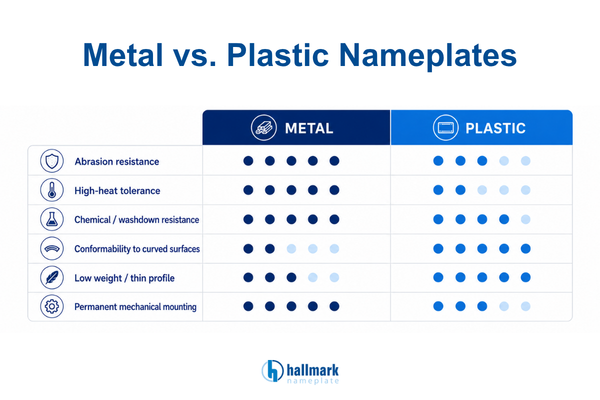
Metal vs. Plastic Nameplates: The 7 Factors That Actually Decide It
Before choosing a metal vs plastic nameplates, it helps to look beyond the material itself. The right choice depends on how and where the nameplate will be used, what it will be exposed to, and how long it needs to remain readable.
Here are the seven factors that matter most for industrial equipment labeling.
1. Heat
If the nameplate sits near engines, ovens, heated process equipment, or other elevated-temperature zones, start by checking the continuous and peak temperatures of the complete construction.
Metal usually provides greater temperature headroom, but the ink, adhesive, coating, and substrate still need to be specified for the actual exposure.
2. Chemicals and Cleaning
Do not write ‘chemical resistant’ on a spec sheet and call it done. List the actual cleaners, oils, solvents, process chemicals, disinfectants, and washdown routines the label will see.
That approach lines up with UL permanence-of-marking testing, which evaluates label systems against environmental conditions rather than assuming one material performs everywhere.
3. UV and Outdoor Exposure
Sunlight can fade graphics and degrade materials long before the equipment itself is ready to retire. Outdoor projects should consider UV exposure, temperature cycling, water, edge sealing, and whether the nameplate will face direct weather or partial shelter.
ANSI guidance also recognizes foreseeable damage from UV, abrasion, lubricants, chemicals, and dirt as a factor in safety-sign placement and durability.
4. Abrasion and Physical Abuse
Forklifts, tools, gloves, hoses, parts bins, and routine service can turn a neat label into a scuffed mystery surprisingly fast. If physical wear is intense, a metal construction or a protected subsurface-printed plastic construction may provide better resistance to repeated wear.
The important question is not “Will anyone touch it?” It is “What will touch it, how often, and with how much force?”
5. Shape and Flexibility
This is where plastic can win immediately. Thin films can conform to curves, recesses, bezels, panels, and complicated shapes that would make a rigid plate awkward or expensive.
If the label must wrap, flex, or integrate visually with a control panel, polycarbonate or polyester deserves a close look.
6. Mounting Method
A mechanically fastened plate is hard to beat when you want a permanent physical attachment. Screws and rivets can also reduce dependence on adhesive performance in especially harsh settings.
Adhesive-backed plastic nameplates, however, can simplify installation and avoid drilled holes—provided the adhesive is matched to the surface energy, texture, temperature, and contamination level of the equipment.
7. Compliance and Safety Information
If your label carries hazards, ratings, or certification information, material selection needs to support both readability and permanence. ANSI Z535.4 provides guidance for the design, application, use, and placement of product safety signs and labels.
For global product-safety programs, ISO 3864-2 establishes design principles for product safety labels used on products including industrial equipment.
Translation: If the message matters to safe operation or certification, do not leave label construction until the final week of the project.
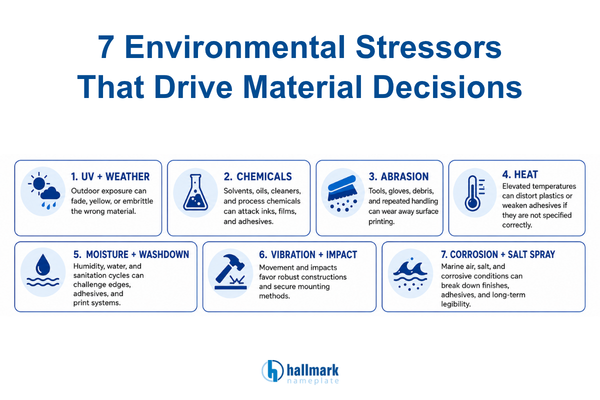
A Simple Selection Matrix for Industrial Equipment Labeling
The fastest way to narrow the field is to define the harshest condition first, then filter by geometry and mounting. Do not start with “Metal vs plastic nameplates?” Start with “what can make this label fail?”
Application condition | Strong starting point | Why | Validate before release |
High heat + abrasion | Metal nameplate | Rigid construction with good potential for wear and heat resistance when properly specified | Alloy, finish, marking method, fasteners |
Outdoor UV + weather | Anodized aluminum or polyester | Both can be specified for outdoor durability | UV system, edge exposure, adhesive/mounting |
Curved control surface | Plastic nameplate | Thin, conformable, graphic-friendly construction | Film type, embossing, adhesive, overlay stack |
Chemical / sanitary washdown | Stainless steel or specified polyester | Strong chemical/moisture potential when correctly specified | Exact chemicals, dwell time, concentration, temperature |
Permanent equipment ID | Metal nameplate | Excellent fit for long-term serial/rating identification | Data method, fasteners, corrosion environment |
Lightweight electronics/interface | Polycarbonate or polyester | Low profile and high graphic flexibility | Surface texture, adhesive, actuation/window requirements |
The Material Is Not the Whole Label
A durable base material can still fail if the wrong ink, adhesive, overlaminate, surface preparation, or attachment method is used. That is why the nameplate should be specified as a system, not a sheet of material.
Think about substrate material, surface texture, surface energy, exposure, print method, protective layers, adhesive or fasteners, edge design, size, shape, and installation process together.
This is also where samples and first-article review become powerful. A small amount of testing early can prevent a very expensive relabeling project later.
When Should You Choose a Metal Nameplate?
Choose metal first when the label needs high durability, rigid construction, mechanical mounting, high-heat capability, or long-term resistance to harsh industrial abuse.
It is especially compelling for permanent equipment identification, rating plates, serialized asset plates, outdoor machinery, heavy equipment, engines, food-service equipment, marine applications, and process environments.
If your team keeps saying, “This thing needs to last as long as the machine,” metal is probably where the conversation should start.
When Should You Choose a Plastic Nameplate?
Choose plastic first when flexibility, thinness, detailed graphics, conformability, windows, adhesive mounting, or lower weight are more important than maximum rigidity.
It can be an excellent fit for control panels, electronic equipment, operator interfaces, curved surfaces, indoor machinery, overlays, and applications where the label needs to feel integrated into the product design.
Just make the material specific. “Plastic” is not a performance spec; “polyester with a defined adhesive and protective print construction for this exact exposure” is much closer.
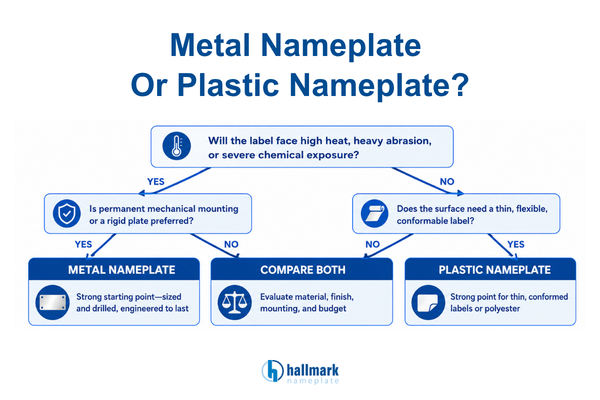
The Best Choice? Match the Nameplate to the Failure Mode
That is the big takeaway: there is no universal winner in the metal nameplate vs. plastic nameplate debate. There is only a better match for the environment, geometry, information, installation, and service life you are designing around.
Metal is often well suited to demanding rigid applications, while plastic brings powerful advantages in flexibility, graphics, weight, and conformability. Both can perform very well when the material, image system, and mounting method are engineered together.
Choose the Right Nameplate for the Job
The next time industrial equipment labeling lands on your project list, transition the question from “Which material is cheaper?” to “Which construction stays readable and attached in the real environment?”
Ask your team to document the heat, chemicals, UV, abrasion, washdown, substrate surface, mounting preference, regulatory marks, and target service life before requesting a quote.
Then bring that information to Hallmark Nameplate. With custom industrial nameplates in metal and plastic, in-house engineering support, and decades of manufacturing experience, Hallmark can help you match the material, finish, graphics, and attachment method to the application instead of forcing the application into a one-size-fits-all label.
Explore Hallmark’s metal nameplate capabilities, or request a quote to get your next equipment labeling project moving.
Frequently Asked Questions
Are metal nameplates better than plastic nameplates for industrial equipment?
Not automatically. Metal is often the stronger choice for high heat, abrasion, rigid mounting, and harsh exposure, while plastic can be better for curved surfaces, lightweight assemblies, adhesive mounting, and graphic-rich interfaces.
What is the best metal for an industrial equipment nameplate?
Anodized aluminum is a versatile choice for many industrial applications because it is lightweight, durable, and corrosion-resistant. Stainless steel is often preferred when the application involves more severe heat, chemicals, saltwater, washdown, or physical abuse.
What is the best plastic for an industrial nameplate?
Polycarbonate and polyester are two common options. Polycarbonate is useful for flexible, graphic-rich overlays and interfaces, while polyester can be a strong fit for thin labels that need resistance to moisture, UV, abrasion, and chemicals.
Can plastic nameplates be used outdoors?
Yes, if the film, ink system, adhesive, and protective layers are specified for outdoor exposure. UV, water, temperature cycling, edge exposure, and the equipment substrate should all be considered.
How long should an industrial equipment label last?
The target should be based on the equipment’s intended service life and the importance of the information on the label. For safety, rating, serial, or regulatory information, the construction should be validated for the expected environment and permanence requirements.
Should industrial nameplates use adhesive, screws, or rivets?
It depends on the environment and equipment design. Adhesives can simplify installation and work well when properly matched to the substrate, while screws or rivets are useful when a rigid plate needs a highly permanent mechanical attachment.
What information should I provide when requesting a custom nameplate quote?
Include the nameplate size and shape, material preference if known, artwork, quantity, substrate, indoor or outdoor use, chemicals or cleaners, temperature range, abrasion or washdown exposure, mounting method, regulatory requirements, and any serialization or barcode needs.