60-years-of-experience

60+ Years of Experience

satisfaction-guarantee

Satisfaction Guarantee

short-lead-times

Short Lead Times

What Is Laser Cutting & How Does The Technology Work?

Are you designing and manufacturing a metal nameplate for your business?
Struggling to find a fabricator who can cut your intricate design, without long lead times?
When it comes to manufacturing your nameplate, it all comes down to the machine that’s cutting the material.

But which machine is the best one to produce precise cuts quickly?

Introducing: laser cutting.

So, what is laser cutting, and what are its benefits?

In this article, we will explain:

  • The three different types of laser cutters
  • 5 benefits of laser cutting
  • IPG’s Photonics’ LaserCube
  • Where you can get the best metal fabrication

Let’s dive in!

What Is Laser Cutting?

First, let’s begin by explaining that laser stands for light amplification by stimulated emission of radiation.

Laser cutting is the process of using a laser to cut or engrave materials. It is often used for thicker metals that normal machines cannot cut through.

A laser cutter is a computer numerical control, or CNC, machine. This means it is controlled via a computer – not manually by a person. Using design software, the manufacturer can put in a precise design, and the cutter will automatically create it.

Types of Laser Cutters

There are three types of laser cutters:

  • CO2
  • Neodymium
  • Fiber

But what are their differences? Keep reading to find out.

What Is CO2 Laser Cutting?

This laser is created through electrically stimulated gas, mostly carbon dioxide. It is not as strong as the other cutters, so it is best for softer materials.

What Is Neodymium Laser Cutting?

There is neodymium (Nd) and neodymium yttrium-aluminum-garnet (Nd:YAG) formed with neodymium-doped crystals. Nd cutting is typically used for high-energy and low-repetition boring while Nd:YAG is best used for high-power boring.

It has a smaller wavelength than CO2 lasers. This means it has a higher intensity, so it can cut through thicker materials. But because of the high intensity, its parts wear faster.

What Is Fiber Optic Laser Cutting?

This laser is made up of what is called a “seed laser.” This process uses a high-power laser that is directed through optics as well as CNC.

The laser is moved with a motion control system to cut a pattern into the metal, leaving high-quality edges. Additionally, you can vary its focal length, allowing you to cut different layers and varying depths.

While it works at the same wavelength as Nd lasers, it requires less maintenance due to its non-moving parts.

How Does Fiber Optic Laser Cutting Work?

So, where does the laser come from? It is created when lasing materials are formed by electrical discharges in a confined space.

With a partial mirror, the lasing material is reflected and amplified until enough energy is created to make a stream of coherent monochromatic light. The light is directed by fiber optics through a lens onto the work area.

As it hits the material, it melts a micro pit and creates an anti-shock wave.

5 Benefits of Laser Cutting

There are several benefits to using all laser cutting systems, but we recommend fiber optic laser cutters. Here are 5 advantages to using laser cutters for your fabrication projects.

1. Quick Turnaround

Unlike most cutting processes, laser cutting is not messy and requires less cleanup or post-cutting sanding. This means you do not have to have as much downtime between sets.

Additionally, it is more efficient and cuts at a faster rate than manual cutting, or even other laser cutters. This means you can produce larger quantities in a shorter amount of time.

2. Affordability

From initial purchase price to lifetime costs, fiber optics saves a lot of money for manufacturers and in turn gives customers, like you, a cheaper price. Using fiber optic laser cutting reduces maintenance by about 50% because its parts are reliable with fewer moving parts and mirrors.

Not only that, but it produces less material waste, because the kerf width is very thin, and it consumes less energy, which translates to lower costs.

3. Intricate Design Capability

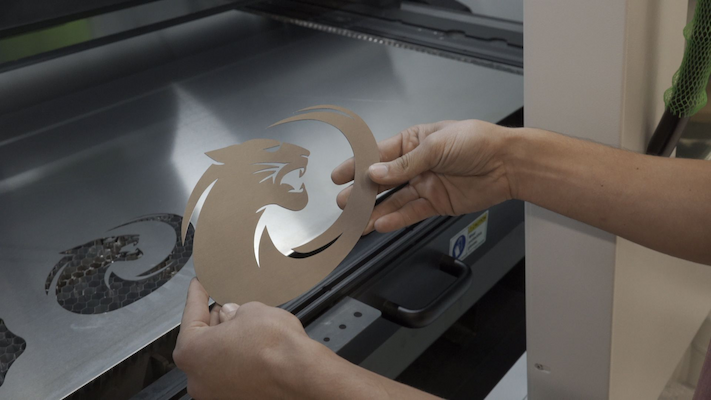
Another benefit of fiber optic lasers is that it produces more precise cuts because the light beam does not wear down. You also consistently get high-quality results because there is no chance of human error.
what is laser cutting

Using fiber optic laser cutting, you can create complex designs on smaller parts. This high level of accuracy makes it perfect for creating medical devices.

4. Works On Any material

Laser cutting is perfect for any application; it is not limited to any material because it can cut material up to .86” thick. It works on plastic, wood, paper, cardboard, or metal, including stainless steel.

It also has the ability to cut materials that are reflective without the worry of back reflections causing damage to the machine. This means you can cut copper, brass, and aluminum.

5. Energy Efficient

Laser cutters are generally more energy-intensive than other cutting methods, but Fiber-optic lasers are far more efficient than CO2. It uses about one-third the amount of energy and a quarter of the power of other lasers.

Fiber optic lasers require no gases, eliminating toxic emissions.

The Best Fiber Optic Cutter, IPG Photonics’ LaserCube

IPG Photonics is a leader in fiber lasers, developing lasers since 1990.

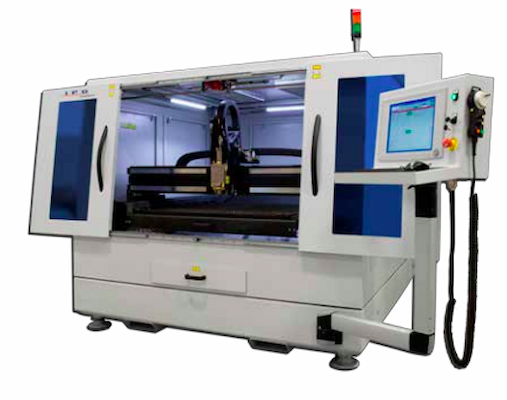
This flatbed fiber laser cutter offers 2 kW average power and 4 kW max peak power. This machine is very reliable and has low operating and part-processing costs.
what is fiber optic laser cutting

It uses high-force linear motors and has the stability and acceleration perfect for cutting small parts precisely.

Get High-Quality Metal Fabrication With Hallmark Nameplate

Tired of long lead times and sloppy cuts? Need a machine strong enough to cut through stainless steel or thick metal? Get high-quality custom metal fabrication for any application at a fraction of the time and cost of other manufacturers.

We offer state-of-the-art laser and use the finest equipment available, such as the IPG’s Fiber Optic LaserCube. Our engineering team ensures quality control that meets ISO 9001: 2008 standards from the beginning of each project through quality inspection and shipment.

No matter the end use you have in mind, our laser-cut and die process can customize the materials you need at the budget you require for the product you’ve designed. Ready to get started? Visit our website or call 352-383-8142 to request a free quote.
Wave Soldering vs Selective Soldering: Perfecting Your Electronic Assembly Process

Should you use the wave soldering process or the selective soldering process in electronic assemblies? The answer depends on the intended use of your PCB.

As electronic devices get more complex, so do their electronic assemblies. So, what are the different ways to create a strong electronic assembly, and how can you keep up with the more advanced components and their requirements? The answer lies with soldering.

Simply put, soldering is a term that describes a process that uses a metal alloy to create a strong, permanent bond between elements in electronic assemblies, such as a circuit board.

In this article, we’ll dive deeper into the world of electronic assemblies and soldering, and learn:

  • What is an electronic assembly
  • Proper ways to create circuit boards
  • Key differences between the wave soldering process vs the selective soldering process

Let’s start by defining the purpose of electronic assemblies and some of their uses.

What is an Electronic Assembly?

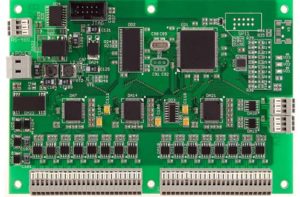
Custom electronic assemblies, also known as printed circuit board assemblies, involve mounting components to the wiring of a printed circuit board (PCB).

electronic assembly

The PCB is the foundation of electronic devices. A PCB has pathways that connect electronic components to transfer electricity. Additionally, it provides support for your components.

There are two main ways to create circuit board assemblies:

Depending on the type of PCB assembly, different soldering processes will be used.

Soldering Processes for a PCB Assembly

There are two main soldering techniques when creating a custom printed circuit board assembly:

  • Wave soldering
  • Selective soldering

You may be wondering what these two processes are and how they differ. Keep reading to learn the pros and cons of each.

Key Differences Between Wave Soldering & Selective Soldering

When choosing which process to use for your electronic assembly, it is important to understand their differences. Each soldering process has its advantages and disadvantages that can affect the end product.

wave vs selective soldering

Let’s begin with what wave soldering is.

What is Wave Soldering?

Traditionally, the most popular solution for electronic assembly manufacturing has been to utilize wave soldering. This process, also known as flow soldering, has been the standard process for many years.

Flow soldering is ideal for projects that only require conventional through-hole components or those with particularly large surface-mount components.

The Process

First, you spray a layer of the flux in order to clean the components of impurities.

Then you preheat the board to activate the flux. This also protects the board from thermal shock.

The PCB then passes through a molten wave, making an electrical connection between the components and the PCB. If you are soldering a double-sided PCB, you will need to pass it through twice.

This process is performed in a protective nitrogen area in order to reduce any defects.

Wave soldering

Pros of Wave Soldering

Wave soldering is perfect for simple soldering where you have a high quantity to do in a short amount of time.

The advantages of using flow soldering include:

  • Easy setup
  • Improved speed
  • Cheaper process

While there are advantages to using the flow soldering process, it also has its disadvantages

Cons of Wave Soldering

While the setup is easy, post-cleanup takes longer because of the molten wave. It also may require additional reworking, which, in the long run, can make the process more work.

Additionally, flow soldering requires more material, such as solder, flux, electricity, and nitrogen, to complete the process. Keeping up with the high rate of consumption can become expensive.

Next, let’s explain what selective soldering is.

What is Selective Soldering?

The other process is selective soldering. Selective soldering is a process where you solder individual through-hole components on a PCB using a solder fountain or head that moves to solder from underneath.

This method is becoming more and more common as the industry moves away from the assembly of larger PCBs of the past. Double-sided PCBs have become more common, which use smaller components.

The Process

First, apply flux to the components that will be soldered. Then you preheat the board to activate the flux.

Then, with an automated nozzle, solder specific components locally on an X-Y gantry to the PCB.

Selective soldering process

Pros of Selective Soldering

Selective soldering is perfect for soldering small components on boards that are densely populated. As each section of the board is soldered individually, selective soldering is far easier to control.

Among other things, this makes it possible to adjust various parameters like thermal profiles, pitch, and component heights.

Other advantages of selective soldering include:

  • Improves the reliability of solder joints
  • Removes the need for fluxing all components
  • Less expensive
  • Process optimization

Most importantly, selective soldering provides consistency so you can easily reproduce the project.

Selective soldering is perfect for difficult conditions such as:

  • Tall component height – tall components may block the wave from soldering
  • Tight spacing – if a thru-hole component is close to an SMT component, then there is not enough room for flow soldering
  • Uneven heating – certain thick metals cannot be heated thoroughly enough to form a solid solder joint with the flow soldering
  • Dense concentration – large connectors close together can make it difficult to reach the pins with wave soldering

As you can see, there are a lot of advantages to using selective soldering, which is why so many people are beginning to use it more. That being said, there are still disadvantages to using selective soldering.

Cons of Selective Soldering

Like flow soldering, selective soldering also has some disadvantages.

For starters, the setup is more complex because it uses unique programming for every board

The soldering process is also more time-consuming than its counterpart and, therefore, is not efficient for producing high quantities.

Nevertheless, selective soldering is great for those who value precision and high-quality end results.

electronic assembly using soldering

Create a Durable Electronic Assembly with Hallmark Nameplate

Whether you want to assemble your electronics through wave or selective soldering, Hallmark Nameplate ensures your soldering needs are professionally met.

At Hallmark Nameplate, we provide prototyping during our PCB assembly so you have peace of mind knowing that your electronic assembly exceeds expectations. Furthermore, for precise and efficient soldering, we use an Ersa Selective Soldering SMARTFLOW 2020. Not only that, but we also run several thorough tests, including temperature, humidity, thermal shock, and vibration testing.

Ready to start your electronic assembly? Our experts are always ready to help. Get in touch with us and we’ll find the right solution to meet your needs.

The 8 Key Components of Membrane Switches

For most devices, membrane switch components are meticulously designed with the user in mind. Every time you check out at the grocery store or click a button on your TV’s remote control, you interact with membrane switches. Even when I’m typing out these words, I am opening and closing the electrical circuit in my keyboard via membrane switches.

So, what exactly is a membrane switch? Well, that’s what we’re here to explore. In this blog, we will go over the key membrane switch components, what they are, and how they contribute to the functionality and reliability of these essential interfaces.

Let’s dive right in!

The 8 Key Membrane Switch Components

From the top layer that you touch to the circuitry that carries your commands, each component plays a critical role. Whether you’re a product designer, an engineer, or simply curious about the technology behind everyday devices, understanding these components will provide valuable insights. So, let’s get into it.

1.) Graphic Overlay

membrane switch overlay

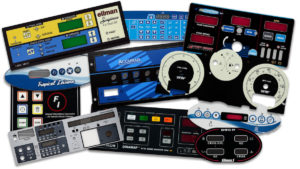
Now, this is the component you are most likely familiar with. The graphic overlay, also known as the faceplate or fascia, is the topmost layer of a membrane switch and serves as the interface between the user and the device. Typically, the overlay is screen-printed on durable polyester or polycarbonate materials.

The graphic overlay must withstand repeated use while providing clear and intuitive labels for the underlying buttons. It is customizable in color, texture, and design. Not only does this enhance the aesthetic appeal of the device, but it also ensures that the interface is user-friendly and easy to navigate.

2.) Mounting Adhesive

Next, the mounting adhesive layer secures the switch to the device’s control panel. This adhesive must provide a strong and durable bond, capable of withstanding environmental factors such as temperature variations, humidity, and mechanical stress.

Usually, the adhesive contains acrylic compounds that help ensure the membrane switch stays firmly in place throughout its time in operation.

3.) Tactile Layer

tactile dome layer on membrane switch

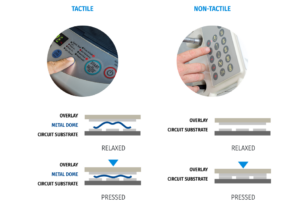
Membrane switch domes, also known as tactile domes, are critical for providing tactile feedback to the user. These domes are positioned beneath the graphic overlay and deform when pressed, creating a noticeable “click” that confirms the activation of the switch.

Usually, these are made from stainless steel or polyester. The domes come in a variety of sizes and materials, but metal is the popular choice. Overall, switch domes help enhance the user experience by providing a responsive and satisfying touch, which is crucial in applications where precise input is essential.

4.) Circuit Layer

printed circuit boards

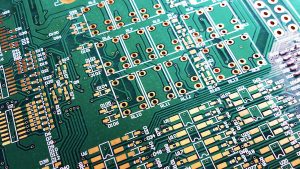
The circuit layer forms the core of the membrane switch, consisting of conductive pathways that connect the switch contacts to the device’s electronics. Typically, this layer is made from flexible printed circuits (FPC) or printed circuit boards (PCB), which can be customized to meet specific electrical requirements.

Moreover, the circuit layer ensures that signals are accurately transmitted from the switch to the device. Therefore, a reliable circuit layer is crucial to ensure the membrane switch operates efficiently. There are three main options for circuitry material.

  • Silver: The most common choice is using silver conductive ink printed on polyester. It’s cost-effective and effective for standard membrane switches.
  • Copper: Ideal for complex circuitry, copper flex circuits allow for soldering numerous components, meeting diverse design needs.
  • Rigid Printed Circuit Board: Suitable for complex designs, this option supports more termination options. It typically involves printing silver ink on polyester, adding a contact surface of etched plated copper, and enclosing it in a PCB with epoxy insulation and a dielectric layer for protection.

5.) Circuit Tail

what are membrane switches

Next, the circuit tail is an extension of the circuit layer that connects the membrane switch to the device’s main circuitry. This flexible tail typically terminates in a connector that plugs into the control board for easy installation and replacement.

The design and length of the circuit tail are critical for ensuring a secure and stable connection, as well as for accommodating the physical layout of the device.

6.) Back Panel

Hallmark Nameplate control panel, membrane switch components

While the back panel is optional, it provides structural support to the membrane switch assembly, ensuring that all layers remain aligned and securely bonded. This layer can be made from rigid or flexible materials, depending on the application requirements.

Moreover, this component can be especially useful in demanding environments where the device may be subjected to mechanical stress and vibration.

7.) Display Windows

Display windows are clear or tinted sections of the graphic overlay that allow users to view underlying displays or indicators. These windows must be optically clear and scratch-resistant to ensure long-term visibility and performance. Properly designed display windows provide important visual feedback to the user, such as status indicators or numeric displays.

8.) Backlighting & Indicators

what are membrane switches

Finally, backlighting and indicators are essential for improving the visibility and usability of membrane switches in low-light conditions. These elements are integrated using various technologies, such as light-emitting diodes (LEDs), electroluminescent (EL) panels, or fiber optics.

Effective backlighting not only enhances the aesthetic appeal of the device but also ensures that the interface remains functional and easy to use in any lighting environment.

What Are Membrane Switches Used For?

membrane switch components

Now that you know the key membrane switch components, you will understand the impact of every button you press. The reality is that membrane switches are all around us.

Their durability, reliability, and ease of customization make them ideal for a range of products and environments. Here are some common uses for membrane switches:

  • Consumer Products – Many household devices, such as remote controls, microwave ovens, washing machines, and gaming consoles, incorporate membrane switches. Their slim profile and responsive touch make them perfect for everyday consumer products.
  • Medical Devices – The medical field utilizes membrane switches in equipment like diagnostic machines, hospital bed controls, and wearable health devices. Their sealed design helps maintain hygiene standards and ensures reliable performance in critical applications.
  • Industrial Controls – Membrane switches are essential in industrial settings for machinery controls, control panels, and equipment interfaces. Their resistance to harsh conditions makes them suitable for use in factories and other demanding environments.
  • Aerospace & Military – Due to their reliability and ability to withstand extreme conditions, membrane switches are used in aircraft controls, military communication devices, and navigation systems.
  • Automotive Applications – In vehicles, membrane switches are used for dashboard controls, infotainment systems, and keyless entry systems. Their ability to integrate seamlessly into complex designs while providing intuitive control makes them a popular choice in the automotive industry.
  • Fitness Equipment – Treadmills, exercise bikes, and other fitness machines use membrane switches for their control panels. Their resistance to moisture and frequent use makes them ideal for this application.

As you can see, there are many applications for these devices. By providing a reliable and user-friendly interface on countless devices, membrane switches prove to be integral to modern technology.

Trust a Certified Electronic Assembler for Your Membrane Switch Needs

When you need electronic assembly, it’s important to find a trusted partner that upholds quality, reliability, and durability in all of their products. A certified electronic assembler brings a level of expertise and precision that is essential for creating high-performance membrane switches.

At Hallmark Nameplate, we pride ourselves on being a certified electronic assembler with decades of experience in the industry. We leverage cutting-edge technology and adhere to the highest standards to deliver membrane switches that meet and exceed your expectations.

Our commitment to quality, precision, and customer satisfaction sets us apart as a trusted partner for all your membrane switch needs. Trust Hallmark Nameplate to provide you with durable, reliable, and high-performance membrane switches.

Visit our website to learn more and request a FREE quote!

6 Signs You Need A New Nameplate Design

From product alterations to brand changes, it is important to keep your company cohesive across the board. So, when your organization makes a significant change, you need to make sure to update the nameplate design so it reflects the changes.

Depending on the developments of your organization, you may not need a total redesign. But maintaining updated information on your new nameplate is crucial for continuity, clarity, and brand recognition.

So, are you wondering whether or not you need to update to a new nameplate?

Well, you have come to the right place. In this article, we will discuss 6 common reasons why organizations might need to update to a new nameplate.

Key Takeaways:

  • Update your nameplate design to reflect brand changes, product updates, or company mergers.
  • A refreshed nameplate strengthens brand recognition, transparency, and customer trust.
  • Stay competitive by keeping designs current with industry trends and regulations.
  • Consistent, accurate nameplates ensure compliance, clarity, and professionalism across all products.

Why Would I Need a New Nameplate Design?

As we will discuss later in the article, there are a number of reasons why an organization may need to update their nameplates. Some of the conceptual reasons are: to improve brand recognition, provide inclusivity, and prioritize transparency.

Improve Brand Recognition

To promote brand recognition, your company’s nameplates should be different from those of your competitors in the industry. Making your product design memorable or unique will help improve your brand recognition, thus driving more loyal customers to your company.

Since all of your company’s products most likely include your logo or company name, your nameplate should as well. Therefore, any changes to your brand that affect people’s ability to identify it from your competitors should be displayed on your company nameplate.

new nameplate design

Provide Inclusivity

Now more than ever, organizations are prioritizing inclusivity through different initiatives. For example, the Army recently approved its soldiers to wear a redesigned nameplate on their Army Green Service Uniforms.

This new nameplate will enable the display of accent marks and hyphens on uniforms for the first time in Army history. By authorizing diacritics and hyphens on nameplates, they are trying to show support for minorities in the Army and assist in the correct pronunciation of soldiers’ surnames.

Prioritize Transparency

As mentioned earlier, you may need a new nameplate if your company undergoes significant changes to its branding or products. Addressing these changes in your company’s nameplates will ensure that your brand is as transparent as possible.

Transparency is beneficial for many reasons. The main reason this transparency will help your company is that it facilitates customer loyalty. For example, Label Insight, a company that specializes in product analysis, found that “94% of all customers are more likely to be loyal to a brand when it commits to full transparency.”

Since the purpose of a nameplate is to provide information about an organization, equipment, or even a person, it needs to be accurate and easily discernible. This is why maintaining up-to-date information on nameplates is important for products and industries that experience frequent changes or improvements.

6 Signs You Need A New Nameplate

If you are wondering whether or not you need a new nameplate for your business, here are 6 common reasons why you might need to update your nameplate design.

1.) Your Organization Changed Its Logo

One of the most common reasons why a nameplate design would need updating is if the company changed its logo. Obviously, significant changes to the logo should be implemented on all the company assets, such as products, the website, email signatures, etc.

However, even changes that may seem minor, like the addition of a comma or a slight brand color alteration, need to be updated. By prioritizing consistent branding across the board, you are helping your organization generate accurate brand recognition.

2.) Product Changes or Alterations

When making changes to your products, such as adding new features or tweaking their composition, it is a good idea to update the nameplate. Redesigning your nameplate to reflect these changes will promote your brand awareness and highlight your company’s transparency.

It will also ensure that your company is consistent and up to date with the descriptions of products and services on the market. So if your product has matured, then it is probably time for a new nameplate.

3.) You Merged With Another Company

If your company recently merged with another company, it might be time to update to a new nameplate. Mergers can often create a new identity for an organization, so your nameplate should mirror this identity change with updated branding.

Also, if the merger leads to an influx of new products, then you will want to make sure all of the products are implemented with the correct, redesigned nameplate.

4.) Product Line Expansion

Product expansion is often a result of a company merger. Since the new products that you acquired during the merger may not have the proper nameplate or accurate description, you will need to apply a new nameplate to the products that are added to your product line.

Some factors to take into consideration for product line expansion are model or product numbers, safety information, and manufacturing dates that will appear on the new nameplate design.

food service labels and food name plates

5.) Your Competitors Updated Their Nameplates

In order to keep up with your competition, you want to avoid being associated with outdated products, technology, and equipment. This is why it is important to be mindful of what your competitors are doing.

As we mentioned earlier, making your company stand out among its competitors will improve brand recognition and generate more loyal customers. So, it is useful to keep up with your competitors and adjust your nameplates accordingly.

6.) New Regulations or Restrictions in Your Industry

Since the main purposes of nameplates are to provide product tracking information and safety instructions, keeping your nameplates updated is a crucial step toward preventing improper use.

If you lack the properly updated safety or instructional information on your nameplate, then you may be at risk of violating industry regulations. You could also be putting your organization at risk for a lawsuit if someone is injured using your product.

Whenever there are important changes made in the regulations of your industry, your nameplates should reflect that information.

automotive labels and nameplates

As you can see, there are plenty of reasons why an organization may need a new nameplate. If you are wondering how you can get a new nameplate, we can help!

Upgrade Your Nameplate With Hallmark Nameplate

For more than 60 years, Hallmark Nameplate has been a trusted manufacturer of nameplates and custom metal fabrications. We serve numerous industries, including medical, aerospace, automotive, IT and computer, food service, and more.

If you have a certain order you need guidance on, we are happy to offer our expert advice to help you through the process. We also offer product sample boxes, so you can get the real look and feel for your nameplate.

So, let Hallmark Nameplate give you the quality and care you deserve. Visit our website or call 352-383-8142 to request a free quote.

What You Should Know About ANSI & Its Standards

When it comes to the foundation of great businesses and products, quality and established standards separate good companies from exceptional ones.

You may have heard that your products should meet industry and government-set standards, such as ANSI. You may also know that meeting these standards is often associated with high-quality products.

But what does it really mean? And what does keeping up with these standards mean for the groups that shape industries, including emerging professionals, companies, government agencies, organizations, and consumers?

Read on to learn more.

What Is ANSI?

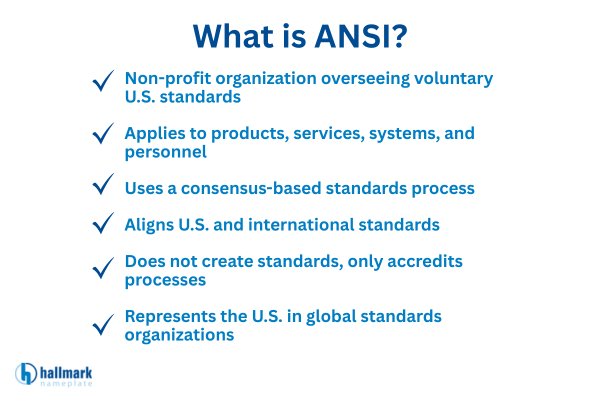
The American National Standards Institute (ANSI) is a nonprofit, private organization that oversees the development of voluntary standards in the United States.

These standards apply to personnel, products, processes, systems, and services and are developed through a consensus-based process by ANSI’s member businesses and organizations.

ANSI also plays a key role in aligning U.S. standards with international standards, helping ensure American goods and services can be used and accepted globally.

what is ansi standards

ANSI’s Role in Product Safety Standards

ANSI is one of the most recognized organizations in product safety standards, though its actual function is often misunderstood. ANSI does not create standards itself. Instead, it oversees a federation of organizations, businesses, and individuals that manage the voluntary standards system in the U.S.

While ANSI is not affiliated with any government agency, it works closely with government bodies and serves as the official voice of the United States in international standards organizations.

How ANSI Operates

ANSI is funded through member dues and the sale of standards-related publications. Its role centers on oversight rather than authorship, ensuring that standards developed by other entities follow established principles and procedures.

ANSI Accreditation for Standards Developers

Companies and organizations may receive ANSI accreditation when they develop their own standards that align with ANSI’s mission and values.

To qualify, organizations must demonstrate the ability to maintain:

  • Consistent quality and performance across products and services
  • Standardized terminology related to safety and compliance
  • Uniform testing methods across all products

Rather than creating standards itself, ANSI evaluates and accredits the process used to develop them. Accreditation confirms that this process follows essential principles such as consensus, due process, balance, and openness.

Accreditation for Certification Bodies

ANSI also accredits organizations that provide product and personnel certifications, as long as those certifications comply with applicable international standards.

ANSI’s Role in International Standards

ANSI is the official U.S. representative to the International Organization for Standardization (ISO) and a founding member of that organization. It also represents the U.S. in the International Electrotechnical Commission through the United States National Committee.

ANSI participates in nearly all technical programs for these organizations and leads many major committees and subgroups.

The ANSI Accreditation Process

ANSI accreditation involves several required steps:

  • Development of standards by a group representing all interested parties
  • A public review and comment period for draft standards
  • Consideration of and response to all public comments
  • Incorporation of approved changes that meet consensus requirements
  • An appeals process for participants who believe ANSI principles were not followed

Maintaining ANSI Accreditation

ANSI accreditation is valid for five years. After that period, organizations must reapply to maintain their status. If reapplication does not occur, accreditation is withdrawn.

How Do These Standards Influence Different Groups?

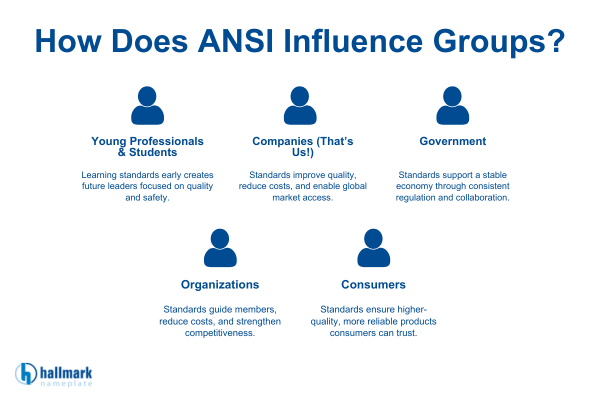
ansi standards influence

Young Professionals and Students

In order for industries like manufacturing — that are home to Hallmark Nameplate’s products — to succeed in a global market, it’s important to properly educate and train the next generation of professionals.

When they understand the importance of standardization early on, they are more likely to become energized leaders who prioritize the highest industry standards.

Companies

The most successful companies recognize how adhering to the highest standards improves their products and services, which in turn drives long-term success.

In fact, standardization is a business tool that Hallmark Nameplate manages in the same way that it manages safety, quality control, intellectual property, and environmental policies. Not only that, but a high level of standardization leads to lower production costs.

All of this helps Hallmark Nameplate’s products reach further than ever before because meeting ANSI and other international standards enables products to meet requirements in other countries as well.

Government Agencies

There’s no denying that standards and conformity assessments impact many aspects of life in the United States. Without them, we would not have a sound national economy.

Many government agencies have a need for standards, regulations, policies, and operations. Public-private standards partnerships provide opportunities to collaborate on standards issues and exchange input on regulatory needs.

Organizations

If you are a trade association or other standards-developing group, current and prospective members look to you for guidance on how to properly run their business according to the developed standards. Meeting national priorities is the end goal, and standards and conformity activities help organizations and their members achieve those goals.

In the U.S. marketplace, standards and conformance contribute to stronger, more competitive industries. Similarly, to the benefit of companies, this should be treated as a tool just like quality control, safety regulations, intellectual property, and environmental policies.

In the same way, these standards benefit Hallmark Nameplate; they also benefit organizations and industries as a whole by lowering costs all around. Let’s not forget the competitive advantages of being able to say that your products and services conform to regulations!

Consumers

This may seem like a no-brainer, but buying from businesses that adhere to voluntary standards means you’re investing in an ethical business while also receiving higher-quality products, and you will benefit from higher-quality, more reliable products.

Not only that, but only the highest-quality, industry-compliant products are widely used in public health and safety applications, and so this provides significant benefits! Products are more reliable, and consumer confidence is boosted.

Hallmark Nameplate and ANSI Compliance

It’s clear that regulations and standards established by those who are a part of the American National Standards Institute are good for business, and Hallmark Nameplate is living proof of that.

Our dedication to these standards reflects our commitment to keeping our employees safe and delivering high-quality products that meet our customers’ needs. Whether you are a young professional, a government representative, an organization, or a consumer, strict adherence to standards provides meaningful benefits.

If you are looking to start your next project, from nameplate to box build solutions, and want to work with an industry leader founded on quality and standards, contact us today!

At Hallmark Nameplate, we meet ANSI standards and are proud to maintain compliance with applicable accreditation requirements.