


Choosing where to build a printed circuit board assembly is a supply-chain decision before it is a pricing decision. This guide explains how the U.S. PCB market is segmented, how to score domestic assemblers against a consistent set of criteria, and how to compare domestic and offshore options on total landed cost rather than unit price alone.
Hallmark Nameplate has manufactured product identification and electronic assemblies from its Mount Dora, Florida facility for more than 60 years, and operates under ISO 9001:2015 and ISO 13485:2016 registration as an ITAR-registered manufacturer. That work sits at the intersection of circuit boards, membrane switches, and finished enclosures, which is where most buyer confusion about provider categories begins.
By the end of this guide you will be able to tell a fabricator from an assembler from a full-service EMS provider, and know which documents to request before a quote is meaningful. Start with the short answer below.
Short Answer: How to Choose a U.S. PCB Assembly Partner
To choose a PCB assembly partner in the USA, match the provider type to your build, verify certifications against documents rather than website badges, confirm the inspection stack covers your component packages, and compare quotes on total landed cost instead of unit price. Score every candidate on the same criteria.
- Provider type first. Fab-only, assembly-only, full-service EMS, and integrated HMI-plus-assembly suppliers solve different problems.
- Certifications are documents, not claims. Request current certificates with scope and expiration dates.
- Inspection stack decides yield. AOI, X-ray, in-circuit test, and functional test each catch a different defect class.
- Engagement model changes risk. Turnkey, consigned, and kitted models move supply risk between you and the assembler.
- Total landed cost beats unit price. Freight, duties, rework, travel, and change-order latency all belong in the comparison.
Types of U.S. PCB Providers: Fab-Only, Assembly-Only, EMS, and Integrated
U.S. PCB suppliers fall into four practical categories: bare-board fabricators, assembly-only houses, full-service electronics manufacturing services (EMS) providers, and integrated suppliers that combine electronic assembly with human-machine interface (HMI) components. Most sourcing mistakes trace back to quoting a program to the wrong category.
A fabricator produces the bare board, controlling layer stackup, copper weight, drilling, plating, and surface finish. An assembly-only house receives finished boards and populates them, which works well when you already have a qualified fabricator and a stable bill of materials.

Full-service EMS providers consolidate fabrication sourcing, component procurement, assembly, test, and often final packaging under one purchase order. That consolidation reduces coordination overhead and puts one organization on the hook for schedule.
Integrated suppliers add the parts of the product a user actually touches. When a device needs a populated board plus a membrane switch, a graphic overlay, and an enclosure, an integrated supplier removes the fit-and-tolerance handoffs between three separate vendors.
- Fab-only: bare boards, stackup and impedance control, no component placement.
- Assembly-only: SMT and through-hole placement on boards you supply or source separately.
- Full-service EMS: sourcing through test under one program owner.
- Integrated HMI + assembly: board assembly plus overlays, switches, labels, and box build.
Decide which category you are buying before you write the RFQ. The evaluation criteria in the next section apply differently depending on the answer.
A 12-Point Scorecard for Evaluating PCB Assembly Companies in USA
A useful evaluation scorecard covers capability match, quality system, inspection coverage, supply chain discipline, and commercial terms — scored identically for every candidate. Scoring matters more than the individual questions, because a consistent rubric exposes the gap between a shop that answers precisely and one that answers generally.
Engineers and purchasing teams often evaluate separately, which produces a technically strong supplier with unworkable terms, or the reverse. A single shared scorecard forces both perspectives into one decision.
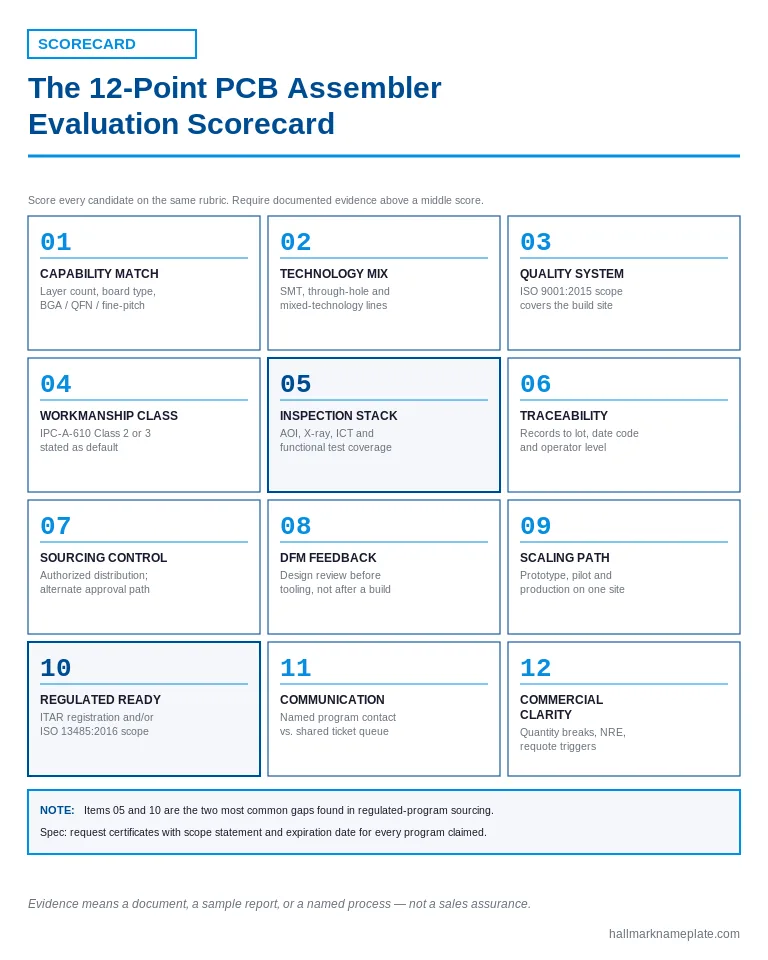
Score each of the twelve criteria on the same scale and require evidence for anything above a middle score. Evidence means a document, a sample report, or a named process — not a sales assurance.
- Capability match: layer counts, board types, and package styles your design actually uses, including BGA, micro-BGA, QFN, and fine-pitch parts.
- Technology mix: SMT, through-hole, and mixed-technology builds on the same line. Review how SMT and through-hole assembly differ before specifying.
- Quality system: current ISO 9001 registration, with scope covering the site that will build your product.
- Workmanship class: the IPC-A-610 class the shop builds to by default, and what changes at a higher class.
- Inspection stack: automated optical inspection, X-ray, in-circuit test, and functional test, plus the decision logic that sequences them.
- Traceability depth: whether records reach lot, date code, and operator level.
- Component sourcing: authorized-distributor policy, counterfeit-avoidance controls, and how alternates get approved.
- Engineering feedback: whether design-for-manufacturability review happens before tooling or after a failed build.
- Scaling path: whether the same site handles prototype, pilot, and production without a supplier change.
- Regulated-industry readiness: ITAR registration, ISO 13485 registration, or other program requirements you must flow down.
- Communication model: a named program contact versus a shared queue.
- Commercial clarity: quantity break points, tooling and NRE charges, and what triggers a requote.
The guide to PCB and electronic assembly covers the underlying process vocabulary if any of these criteria are unfamiliar. With the scorecard defined, the domestic-versus-offshore question becomes easier to answer on evidence.
Domestic PCB Assembly vs. Offshore: What Actually Changes
The practical differences between domestic and offshore PCB assembly are iteration speed, communication latency, regulatory exposure, and cost structure — not quality in the abstract. Capable shops exist in both places, so the decision belongs to the program, not to a general preference.
Iteration speed is usually the decisive factor during development. Shorter shipping lanes and shared business hours compress the loop between a failed prototype and a corrected revision, which matters far more at ten boards than at ten thousand.
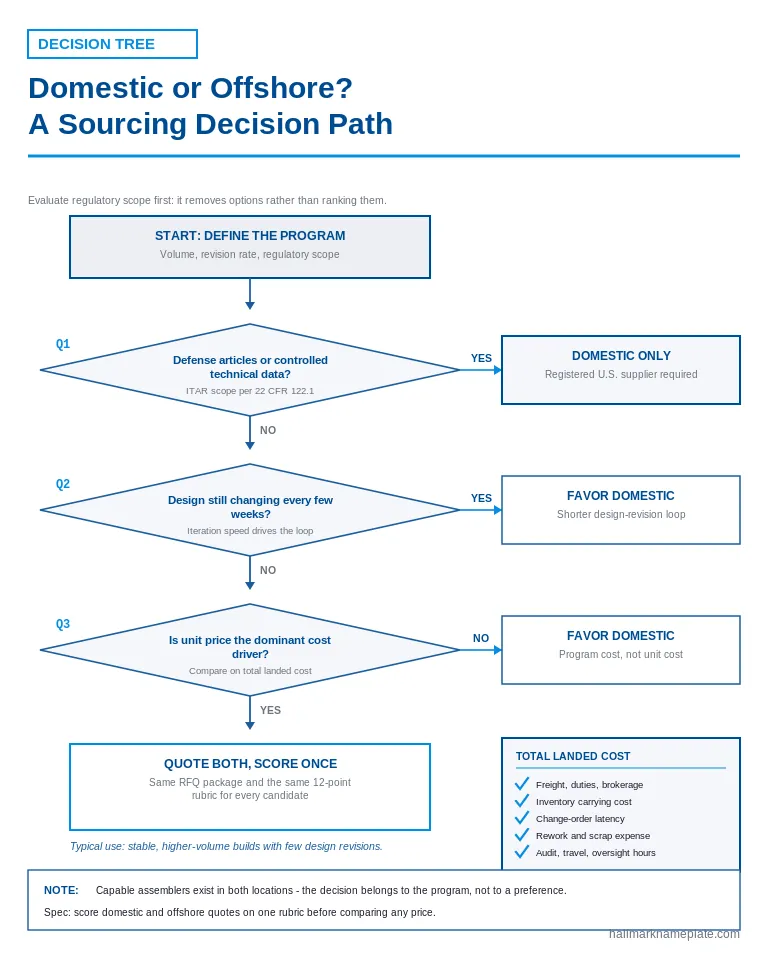
Regulatory exposure is not negotiable in the same way. Programs involving defense articles or controlled technical data carry legal obligations that constrain where work can be performed and who can access data, which removes offshore options from consideration entirely for some builds.
Cost comparisons fail when they stop at unit price. A defensible comparison of total landed cost includes the quoted price plus the items below, evaluated across the whole program rather than a single purchase order.
- Freight and duties: shipping, brokerage, and applicable tariff exposure on the finished assembly.
- Inventory carrying cost: the safety stock longer lead times require.
- Change-order latency: the schedule cost of an engineering change that has to cross an ocean.
- Rework and scrap: the expense of returning or scrapping boards that fail inspection.
- Oversight effort: travel, audits, and program-management hours.
Build that comparison once and reuse it. Compliance requirements, covered next, often narrow the field before cost enters the conversation at all.
Compliance to Verify: ISO 9001, ISO 13485, ITAR, IPC, and RoHS
Verify compliance against issued documents and the published standards themselves, not against logos on a capabilities page. Each program below answers a different question, and stacking them without understanding what each covers leads to over-specified — and more expensive — builds.
ISO 9001 establishes a quality management system and is the general baseline for a manufacturing supplier. It says a documented system exists and is audited; it does not by itself describe assembly workmanship.

Workmanship is governed by IPC-A-610, Acceptability of Electronic Assemblies, which defines three classes of acceptance criteria. Class 3 is typically specified for high-reliability applications where continued operation is required, and it carries tighter criteria and heavier inspection than Class 2.
Medical device programs generally flow down ISO 13485:2016, the quality management standard written for regulatory purposes in the medical device supply chain. Hallmark’s work on PCBs for medical equipment and its ISO 13485 registration illustrate how that flow-down reaches a component supplier.
ITAR obligations are set in federal regulation rather than by industry consensus. Under 22 CFR 122.1, any person engaged in the business of manufacturing defense articles in the United States must register with the Directorate of Defense Trade Controls, and a manufacturer that never exports is still required to register. Registration itself does not grant export authorization; it is a precondition to seeking one. Hallmark’s ITAR registration overview describes what that status means for a supplier relationship.
Material compliance is separate again. The EU’s RoHS Directive restricts ten substances in electrical and electronic equipment, including lead, mercury, cadmium, and hexavalent chromium, and obligates manufacturers to design and produce accordingly.
Ask for the certificate, the scope statement, and the expiration date for every program claimed. The engagement model you choose next determines who carries the risk of the parts that go onto the board.
Turnkey vs. Consigned vs. Kitted PCB Assembly
Turnkey, consigned, and kitted assembly describe who buys the components and who absorbs the risk when parts are late, obsolete, or non-conforming. The engagement model changes the quote structure, the schedule risk, and the amount of program management your own team performs.
In a turnkey model the assembler sources the bill of materials, kits it, builds, tests, and ships. That reduces internal purchasing effort and consolidates accountability, provided the assembler’s sourcing discipline and approved-vendor controls hold up under scrutiny.
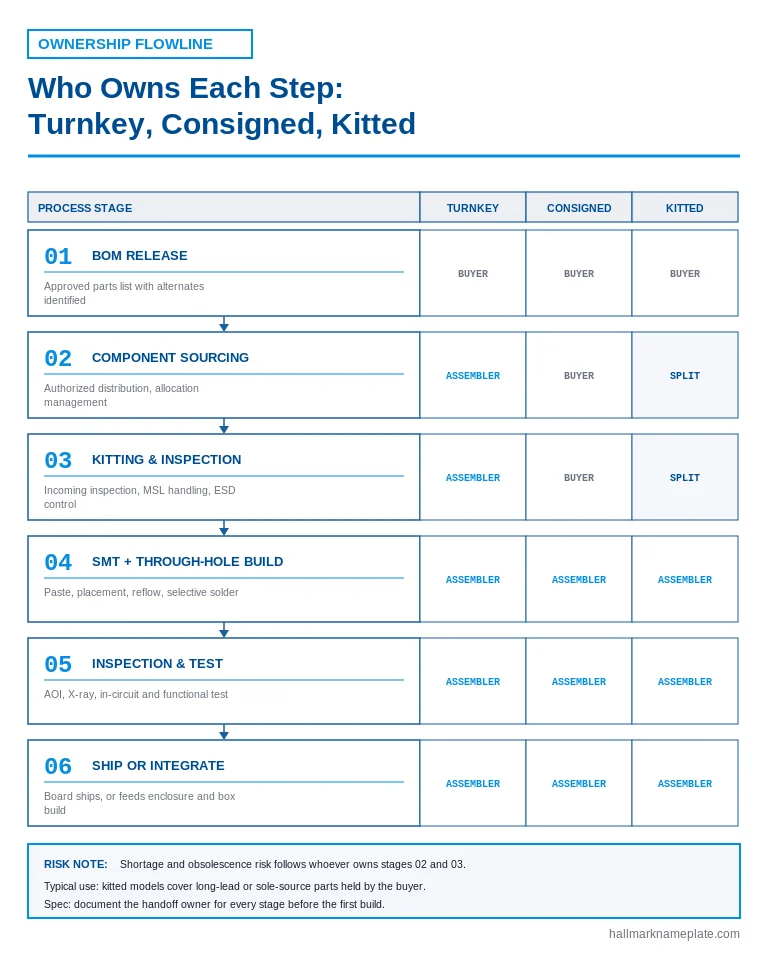
In a consigned model you supply all components and the assembler provides labor, equipment, and process control. Cost visibility improves and you keep direct control of part selection, but shortages and date-code problems land on your team.
Kitted and hybrid models split the difference, which is common when a design contains long-lead or sole-source parts. The buyer secures the constrained items and the assembler sources the commodity balance.
- Turnkey: lowest internal workload, highest dependence on the assembler’s supply chain.
- Consigned: maximum component control, with shortage risk retained by the buyer.
- Kitted/hybrid: targeted control over critical parts, commodity sourcing delegated.
Whichever model you select, document who owns each handoff before the first build. That definition becomes more important when the assembly is only one layer of a larger product.
Inside an Integrated Build: PCBA, Membrane Switch, Overlay, and Enclosure
An integrated build combines the populated circuit board with the interface and housing components that surround it, so a single supplier owns fit, tolerance, and finish across the stack. This is the category most buyers search for indirectly, describing a finished control panel or instrument front end rather than a board.
The populated board sits at the center, produced through the standard PCB assembly process of solder paste application, placement, reflow, and inspection. For a refresher on the underlying board itself, see the basics of printed circuit boards.
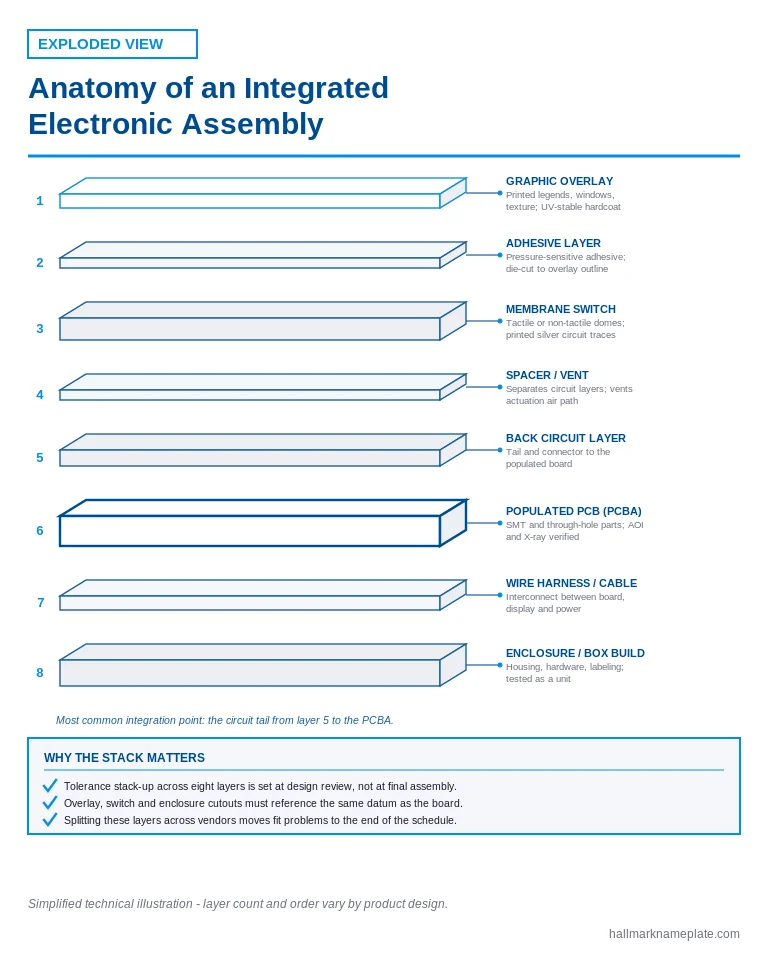
Above the board sits the interface stack: a tactile or non-tactile membrane switch, an adhesive layer, and a printed graphic overlay that carries legends, windows, and branding. Each layer has its own material and adhesion requirements, and misalignment between them is a common source of cosmetic rejection.
Around both sits the enclosure and the wiring that connects them, assembled and tested as a unit in what the industry calls a box build. Hallmark’s overview of box build assembly and its notes on electronic testing of box build assemblies describe how those steps are sequenced.
When these elements come from separate vendors, tolerance stack-up problems surface at final assembly rather than at design review. Consolidating them is one reason buyers evaluate integrated suppliers alongside conventional EMS providers.
Before You Send the RFQ: Data Package, Documents, and Questions
A complete RFQ package is what makes quotes comparable, and an incomplete one is the main reason quoted prices move after the assembler opens the files. Send the same package to every candidate and specify requirements explicitly rather than leaving them to shop defaults.
Your data package should carry the design intent without requiring interpretation. Anything the assembler has to assume becomes a risk premium in the quote or a change order later.

Alongside the data package, request evidence. Certificates, sample inspection reports, and a described inspection sequence tell you more about a shop than any capabilities brochure.
- Design data: Gerber or ODB++ files, drill files, fabrication notes, and assembly drawings.
- Bill of materials: manufacturer part numbers, approved alternates, and any parts designated no-substitute.
- Placement data: centroid or pick-and-place file matching the current revision.
- Requirements: IPC-A-610 class, conformal coating, programming, and test coverage stated explicitly.
- Quantities: prototype, pilot, and production tiers in one request so pricing scales are visible.
Then ask the questions that separate suppliers: what does your inspection sequence look like for a board with BGAs, how are alternates approved, who is my contact when a part goes on allocation, and what is your prototyping and testing path from first article to production. The answers, scored consistently, produce the shortlist.
Frequently Asked Questions About PCB Assembly in the USA
Which companies provide PCB manufacturing and assembly in the USA?
U.S. providers fall into four categories: bare-board fabricators, assembly-only houses, full-service EMS providers that cover sourcing through test, and integrated suppliers that combine board assembly with membrane switches, overlays, and enclosures. Rather than starting from a list of company names, identify which category your build requires and then evaluate candidates within it using a consistent scorecard.
What is the difference between offshore and domestic PCB assembly?
The practical differences are iteration speed, communication latency, regulatory exposure, and cost structure. Domestic assembly typically shortens the design-revision loop and simplifies compliance documentation, while offshore assembly can offer unit-price advantages that must be evaluated against total landed cost including freight, duties, carrying cost, and change-order delay.
What does ITAR PCB assembly actually require?
Under 22 CFR 122.1, anyone engaged in the business of manufacturing defense articles in the United States must register with the Directorate of Defense Trade Controls, including manufacturers that do not export. Registration is a precondition to seeking export authorization rather than an authorization itself, and buyers should confirm a supplier’s current registration status directly rather than relying on a website claim.
Does a PCB assembler need ISO 13485 for medical device work?
ISO 13485:2016 is the quality management standard written for the medical device supply chain, and device manufacturers commonly flow its requirements down to suppliers of critical components. Whether a specific assembler must hold registration depends on the role the assembly plays in the finished device and on the device manufacturer’s own supplier controls.
What is the difference between turnkey and consigned PCB assembly?
In turnkey assembly the assembler sources the components, kits them, builds, and tests, which reduces the buyer’s purchasing workload but depends on the assembler’s sourcing discipline. In consigned assembly the buyer supplies all components and the assembler provides labor and process control, giving the buyer more part-level control while retaining shortage and obsolescence risk.
How do you evaluate a PCB assembler before sending an RFQ?
Score every candidate on the same criteria: capability match to your package styles, quality system scope, IPC-A-610 workmanship class, inspection coverage, traceability depth, sourcing controls, engineering feedback, scaling path, and commercial clarity. Require documented evidence for any criterion scored highly, such as current certificates with scope and expiration dates or sample inspection reports.
What belongs in the total landed cost of a PCB assembly?
Total landed cost includes the quoted unit price plus freight, duties and brokerage, inventory carrying cost driven by lead time, rework and scrap expense, the schedule cost of change orders, and the internal hours spent on oversight, audits, and travel. Comparing quotes on unit price alone understates the difference between sourcing options, particularly on programs that expect design revisions.
Putting the Evaluation Into Practice
Choosing a U.S. PCB assembly partner is a structured comparison, not a search for the lowest number on a quote sheet. The suppliers worth shortlisting answer specific questions with specific evidence.
- Identify the provider category your build requires: fab, assembly, full-service EMS, or integrated HMI plus assembly.
- Build the scorecard from the twelve criteria above and use the same rubric for every candidate.
- Verify compliance with documents — certificates with scope and dates, and registration status confirmed at the source.
- Choose the engagement model deliberately, and record who owns each handoff before the first build.
- Compare on total landed cost across the full program, not on a single purchase order.
To see how these criteria apply within a specific regulated market, review the industries served overview. For the process vocabulary behind the scorecard, the SMT process explainer and Hallmark’s PCB assembly services page cover the steps referenced throughout this guide.