


A prototype nameplate that peels in a washdown test, an overlay whose colors shift under production tooling, or a membrane switch that behaves differently once it reaches volume: each of these problems traces back to the same root cause.
The wrong partner built the prototype.
This guide covers what a product identification prototype actually is, the four types of suppliers engineers typically consider, a 10-point scorecard for evaluating any of them, and what to send to get a faster, more accurate quote.
You will also see where prototype decisions intersect with real industry requirements — MIL-STD-130 marking, ITAR registration, and ISO 13485:2016 — so the prototype you approve today does not create a compliance problem in production.
Key Takeaways
- The best prototype partner is the one that can also build your production run — using the same materials, tooling logic, and processes, not just a visual mockup.
- Four supplier types dominate this market: local print/sign shops, online label printers, overseas suppliers, and U.S. identification manufacturers — each with different tradeoffs.
- A 10-point scorecard — covering materials, DFM support, certifications, and prototype-to-production continuity — gives you an objective way to compare suppliers instead of picking on price alone.
- Regulated industries add requirements most general-purpose print shops cannot meet, including MIL-STD-130 marking, ITAR registration, and ISO 13485:2016 traceability.
- Sending the right files up front — drawings, material specs, and environmental requirements — is the single biggest lever for a faster, more accurate prototype quote.
What Counts as a Product Identification Prototype
A product identification prototype is a working sample of a nameplate, data plate, label, graphic overlay, or membrane switch built before a full production run is committed.
It exists to answer a narrow set of questions: does it fit, does it read correctly, does it survive the environment it is destined for, and does it meet whatever regulatory marking a customer or program requires.
Unlike a general product prototype, an identification-part prototype is rarely about proving a mechanical concept. It is almost always about proving material performance and legibility under real conditions — something a quick digital mockup cannot demonstrate.
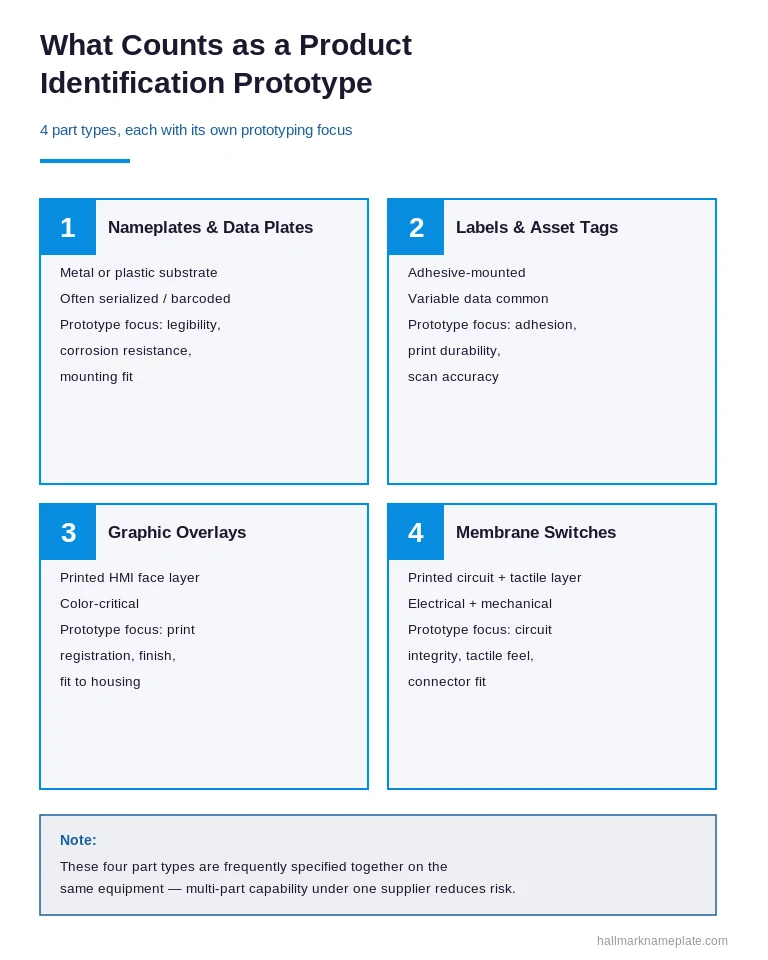
The category spans several distinct part types, each with its own prototyping considerations:
- Nameplates and data plates — metal or plastic, often serialized or barcoded
- Labels and asset tags — adhesive-mounted, sometimes with variable data
- Graphic overlays — the printed face of a control panel or human-machine interface
- Membrane switches — the printed circuit and tactile layer beneath that same overlay
Because these part types are frequently specified together on the same piece of equipment, the strongest prototype partners can typically handle more than one category without handing the project to a second vendor. Some programs also pair identification parts with printed circuit board assembly, which follows its own separate prototyping path.
Why Prototype Identification Parts Before Production
Skipping a prototype on an identification part usually shows up later as a re-approval, a re-order, or a failed inspection — all more expensive than the prototype would have been.
Identification parts sit at the intersection of engineering, branding, and compliance, which means a design flaw can surface in any of three places.
A prototype lets you validate each of these before committing to tooling and volume:
- Fit and mounting — does the part clear fasteners, ribs, or adjacent components on the actual assembly
- Legibility — do serialized text, barcodes, or fine print remain readable at the specified size and contrast
- Adhesion — does the mounting method (adhesive, rivet, or screw) hold on the actual substrate and surface finish
- Environmental durability — does the part hold up to the UV, chemical, or abrasion exposure it will see in service
- Customer or regulatory sign-off — does the part satisfy whatever internal approval or program-level marking requirement applies
Once these are validated on a prototype, the same specification carries forward into production — provided the prototype was built with production-equivalent materials and processes in the first place.
4 Types of Prototype Partners (and Where Each Falls Short)
Most engineers sourcing an identification-part prototype end up choosing between four categories of supplier, and each one optimizes for something different.
Local Print and Sign Shops
Local shops are fast to engage and easy to communicate with in person, which makes them a common first stop for a one-off prototype.
Their limitation is process breadth: most are built around vinyl, digital printing, or basic engraving, and few stock the anodized aluminum, MetalPhoto®, or industrial-grade polycarbonate substrates that regulated equipment typically requires.
Online Label Printers
Online label printers offer fast, low-minimum ordering through a self-service portal, which works well for standard adhesive labels.
They are generally not set up for custom membrane switch circuitry, multi-layer graphic overlays, or metal nameplate fabrication, and self-service tools rarely include engineering or design-for-manufacturability (DFM) feedback.
Overseas Suppliers
Overseas suppliers can offer competitive unit pricing on large production volumes once a design is finalized.
For prototyping specifically, the tradeoffs are longer lead times, more difficult revision cycles across time zones, and — for ITAR-controlled or export-restricted programs — the supplier may not be eligible to work on the part at all.
U.S. Identification Manufacturers
Manufacturers that specialize specifically in nameplates, overlays, membrane switches, and related electronic assemblies typically carry the broadest material and process capability under one roof.
The tradeoff is usually cost and minimum order quantity relative to an online printer — though for parts with compliance or durability requirements, that capability is often the deciding factor.
Comparison Table: Prototype Partner Types
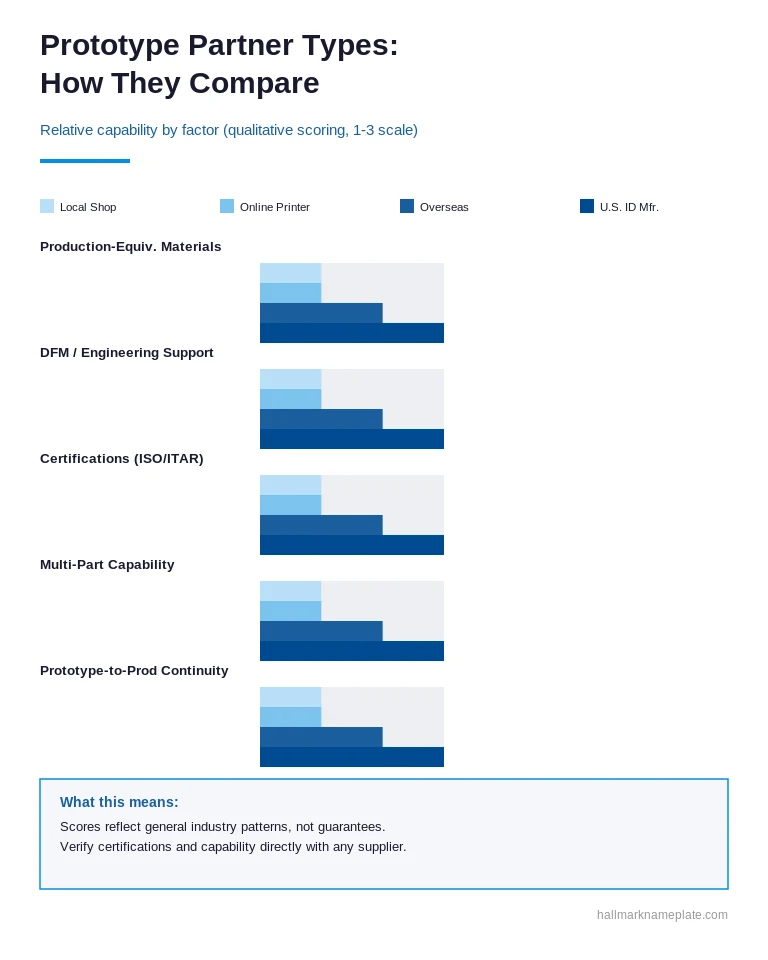
Here is how the four partner types generally compare across the factors that matter most for identification-part prototypes.
| Factor | Local Print Shop | Online Label Printer | Overseas Supplier | U.S. ID Manufacturer |
|---|---|---|---|---|
| Production-equivalent materials | Limited | Limited | Varies | Typically broad |
| DFM / engineering support | Rare | Rare | Varies | Typically available |
| Revision turnaround | Fast, local | Fast, self-service | Slower (time zone, shipping) | Moderate |
| Typical minimums | Low | Very low | Often high | Low to moderate |
| Multi-part capability (nameplate + overlay + switch) | Rare | Rare | Varies | Often available |
| Certifications (ISO, ITAR, etc.) | Uncommon | Uncommon | Varies, verify directly | Common among specialists |
| Prototype-to-production continuity | Low | Low | Varies | Typically high |
Ratings are general industry patterns, not guarantees — verify certifications, minimums, and capability directly with any supplier before committing.
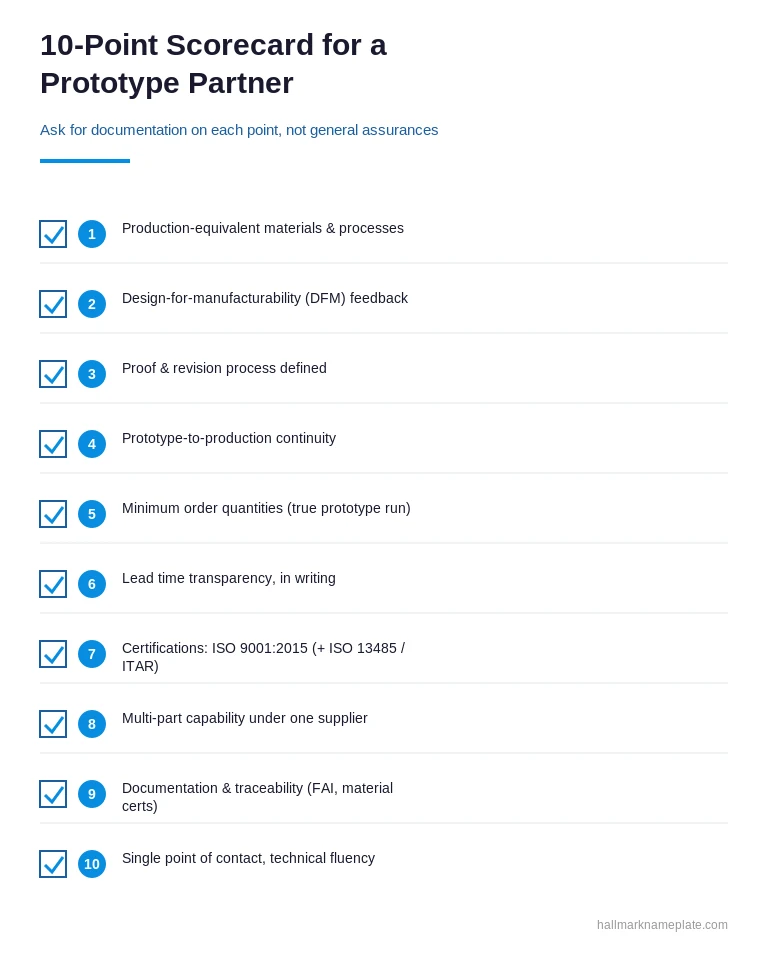
10-Point Scorecard for Choosing a Prototype Partner
Use this scorecard to evaluate any prototype partner, regardless of which of the four categories above they fall into.
- Production-equivalent materials and processes. Ask: will my prototype use the same substrate, adhesive, and printing method as the eventual production run?
- Design-for-manufacturability (DFM) feedback. Ask: will an engineer review my drawing before building, or does the file go straight to production as-is?
- Proof and revision process. Ask: how many revision rounds are included, and how is a proof approved before the physical prototype ships?
- Prototype-to-production continuity. Ask: will the same tooling, specs, and supplier carry through to volume production without re-qualification?
- Minimum order quantities. Ask: can I get a true low-volume prototype run, or is the minimum effectively a small production batch?
- Lead time transparency. Ask: what is the quoted lead time, and does it hold for a design with revisions?
- Certifications. Ask: is the supplier ISO 9001:2015 certified, and if relevant, ISO 13485:2016 or ITAR registered?
- Multi-part capability. Ask: can this supplier prototype my nameplate, overlay, and membrane switch together, or only one part type?
- Documentation and traceability. Ask: does the supplier provide material certs, first-article inspection reports, or UID/serialization support if required?
- Communication. Ask: will I work with a single point of contact who understands the technical requirements, in a time zone that supports my schedule?
Prototype Options by Part Type
Metal and Plastic Nameplates
Metal nameplates — anodized aluminum, MetalPhoto®, and stainless steel — are typically prototyped to confirm legibility, corrosion resistance, and mounting fit before a production run is tooled.
Plastic nameplates (polycarbonate or polyester) are usually prototyped to check color match, adhesive performance on the target surface, and UV or chemical resistance for the intended environment.
Graphic Overlays
An overlay prototype validates print registration, texture (matte vs. gloss), and how the overlay integrates with the switches, LEDs, or windows beneath it.
Because graphic overlays are often the customer-facing layer of a control panel, color accuracy and finish consistency matter as much as durability. See this guide on choosing the right overlay type for more on matching overlay construction to the application.
Membrane Switches and Keypads
Membrane switch prototypes exist primarily to validate the printed circuit, tactile feel (for dome or non-tactile designs), and connector compatibility with the target electronics.
This is typically the most iterative prototype of the four part types, since membrane switches combine mechanical, electrical, and graphic requirements in a single thin assembly. Where a membrane switch pairs with additional circuitry, PCB prototyping and testing follows a related but distinct validation process.
Serialized Tags and Data Plates
Serialized and barcoded identification parts are prototyped to confirm that variable data (serial numbers, UID codes, barcodes) prints legibly and scans correctly at production speed, not just as a static proof.
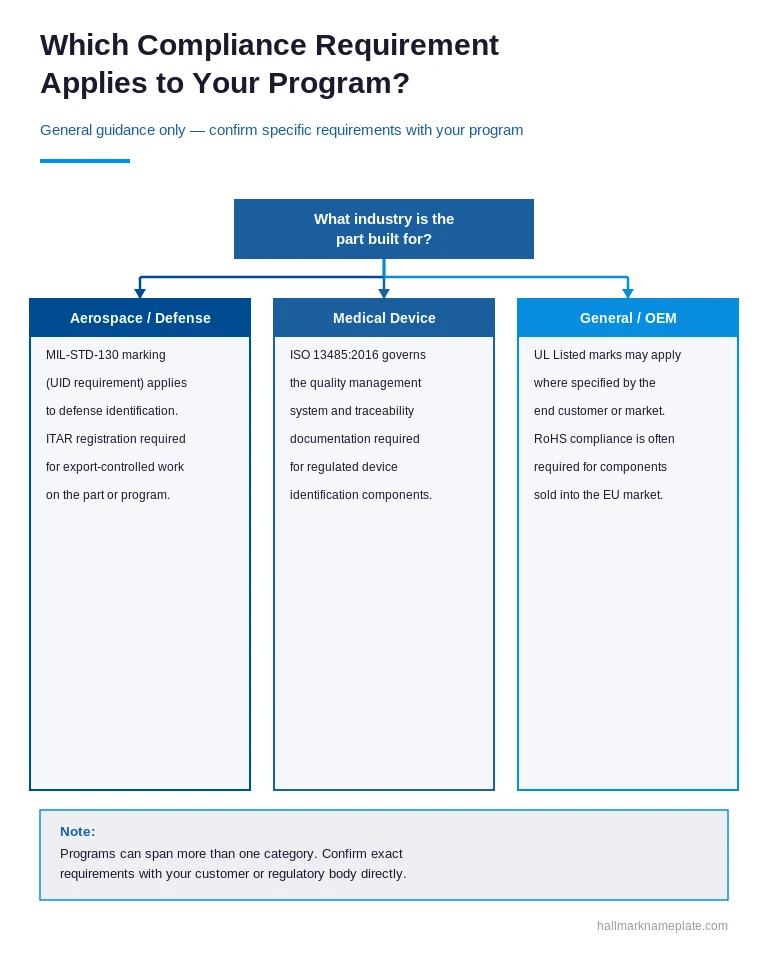
Industry Requirements to Plan For
Certain industries layer additional requirements onto the prototyping process, and it is far cheaper to plan for them before the first prototype than to discover them at final inspection.
Aerospace and defense programs frequently require identification marking to MIL-STD-130 for unique item identification (UID), and a supplier working on export-controlled hardware should be ITAR registered. Requirements for parts like aircraft data plates illustrate how specific this marking guidance can get.
Medical device programs typically require a supplier operating under ISO 13485:2016, which governs the quality management system and traceability documentation for regulated device components — see general guidance on identification requirements for medical equipment.
General industrial and OEM programs may not carry a specific regulatory marking requirement, but often specify UL Listed marks or RoHS compliance depending on the end market.
Confirming these requirements before the prototype stage avoids a scenario where a design passes initial review but has to be re-engineered to meet a marking or documentation standard later. A supplier’s certifications page is typically the fastest way to verify these credentials before you request a quote.
What to Send for a Faster Prototype Quote
The single biggest lever for a faster, more accurate prototype quote is sending complete information up front, rather than iterating over email.
A complete prototype request typically includes:
- A drawing or CAD file with dimensions, tolerances, and mounting locations
- Material specification or a description of the environment (indoor/outdoor, chemical exposure, temperature range)
- Graphic files (vector artwork) for any printed text, logos, or color requirements
- Mounting method (adhesive, rivet, screw) and the substrate it will be applied to
- Any compliance requirement — MIL-STD-130, ISO 13485:2016, RoHS, or a customer specification number
- Quantity and timeline for both the prototype and the anticipated production volume
Suppliers that ask clarifying questions at this stage — rather than quoting immediately off an incomplete file — are usually signaling that DFM review is part of their process, which is itself a positive indicator from the scorecard above.
From Prototype to Production: Avoiding Re-Approvals
A prototype only saves time and money if it accurately predicts what production will look like.
Re-approvals typically happen when a prototype is built with a different material, a different printing process, or different tooling than what production will actually use — making the “successful” prototype a poor predictor of the finished part.
To avoid this, confirm before the prototype stage that:
- The prototype uses the same substrate and finish specified for production
- Any color-critical graphics are proofed under the same printing method planned for volume
- The mounting method is tested on a sample of the actual production surface, not a generic test panel
- The same supplier (or an equivalent qualified process) will carry the part into production, preserving the original specification
When these four items hold true, a successful prototype becomes a reliable predictor of production performance rather than a best-case demonstration.
Questions to Ask Before You Commit
Before selecting a prototype partner, it is worth asking directly for evidence rather than assurances.
- Ask for a copy of their ISO 9001:2015 certificate (and ISO 13485:2016 or ITAR registration, if relevant to your program)
- Ask for a sample first-article inspection report from a past project
- Ask how many DFM revisions are typically included before a prototype ships
- Ask whether the same tooling and specification will be used for production, or whether re-qualification will be required
A supplier that can answer these questions specifically — rather than in general marketing terms — is applying the scorecard criteria above in practice, not just in principle.
Frequently Asked Questions About Choosing a Prototype Partner
What should I look for in a prototype partner for nameplates and overlays?
Look for production-equivalent materials, DFM feedback, relevant certifications (ISO 9001:2015, and ISO 13485:2016 or ITAR registration if applicable), and the ability to carry the same specification into production without re-qualification.
How long does a product identification prototype take?
Timelines vary widely by part complexity, supplier capacity, and revision rounds. Ask any supplier for a specific, written lead-time estimate for your part rather than relying on a general industry average.
Will my prototype match production parts?
Only if the prototype is built with the same materials, printing process, and tooling logic planned for production. Confirm this explicitly with the supplier before approving the prototype.
Can I prototype in the same material I’ll use in production?
Most identification-part manufacturers can prototype in production-equivalent materials, though minimum order quantities and setup costs vary. Confirm directly with the supplier for your specific substrate.
What files do I need to send for a prototype?
A dimensioned drawing or CAD file, vector graphic files for any printed elements, the intended mounting method and substrate, and any applicable compliance requirement (MIL-STD-130, ISO 13485:2016, RoHS, or a customer spec number).
What is the minimum order for prototype nameplates?
Minimums vary by supplier and part type. U.S. identification manufacturers and local print shops typically offer lower prototype minimums than online label printers configured for standard runs or overseas suppliers configured for volume production.
Should I prototype overlays and membrane switches with the same supplier?
When a control panel uses both, prototyping them together with one supplier reduces the risk of a fit or interface mismatch between the two parts once assembled.
How do I move from prototype to production without re-approvals?
Confirm before the prototype stage that the same substrate, printing process, mounting method, and supplier (or an equivalent qualified process) will carry through to production, preserving the original specification.
Conclusion
Choosing a prototype partner for identification parts comes down to matching supplier capability to what your program actually requires — not defaulting to whichever option is fastest or cheapest for a single unit.
Four steps summarize the approach covered in this guide:
- Identify which part types your project needs prototyped (nameplates, overlays, membrane switches, or a combination), since multi-part capability under one supplier reduces integration risk.
- Confirm any regulatory or customer requirement — MIL-STD-130, ITAR registration, ISO 13485:2016, RoHS — before requesting quotes, so you can screen out suppliers who cannot meet it.
- Run every candidate supplier through the 10-point scorecard, asking for documentation rather than accepting general assurances.
- Confirm prototype-to-production continuity in writing before approving the prototype, so the specification that passed testing is the one that ships in volume.
For a deeper look at evaluating manufacturing partners more broadly, see this guide on how to choose a nameplate manufacturer.