

Ever signed off on a nameplate order only to watch it fade, peel, or fail a compliance audit six months later? You’re not alone; it’s one of the most common (and costly) sourcing mistakes in regulated manufacturing.
After nearly seventy years of producing custom nameplates for aerospace, medical, defense, and industrial OEMs, we’ve seen firsthand which decisions separate a reliable supplier from a risky one. In the next few minutes, you’ll learn exactly what to vet before you issue that next PO and why the cheapest quote almost never wins.
Key Takeaways:
- Certifications filter first — ISO 9001:2015, ISO 13485, ITAR, UL, and RoHS are non-negotiable for regulated industries.
- Process range = design flexibility — Metalphoto®, etching, laser marking, and screen printing under one roof, preventing costly multi-sourcing.
- Industry expertise shortens lead times — Specialized suppliers skip the learning curve on your dime.
- U.S. manufacturing is now a cost advantage — Tariffs and ITAR make domestic sourcing the lower-risk choice.
- Great suppliers act as engineering partners — Design review, material guidance, and documented testing separate vendors from partners.
Why Your Nameplate Manufacturer Matters More Than You Think
Here’s the reality: a nameplate isn’t decoration. It’s a functional component that carries UL marks, serial numbers, ITAR-controlled data, traceability codes, and compliance identifiers your end customer depends on every single day.
Think about what’s actually riding on that small piece of aluminum or polycarbonate. Equipment certifications. Warranty validation. Regulatory audits. Product liability.
Choose wrong, and you’re looking at field failures, product recalls, failed FDA or AS9100 audits, and supply chain delays that cascade through your entire operation. Choose right, and you’ve got a supplier who actively reduces risk across your production line and frees your engineering team to focus on what they do best.
That’s why engineering and procurement teams can’t afford to source on price alone. You need a clear, repeatable vetting framework, not a gut feeling or a recommendation from someone three companies removed.
8 Criteria Every Engineer and Buyer Should Vet Before Signing a PO
Choosing a nameplate manufacturer isn’t about finding the lowest quote; it’s about finding a partner who won’t put your compliance, timeline, or reputation at risk.
Use this checklist to pressure-test every supplier on your shortlist before you commit.
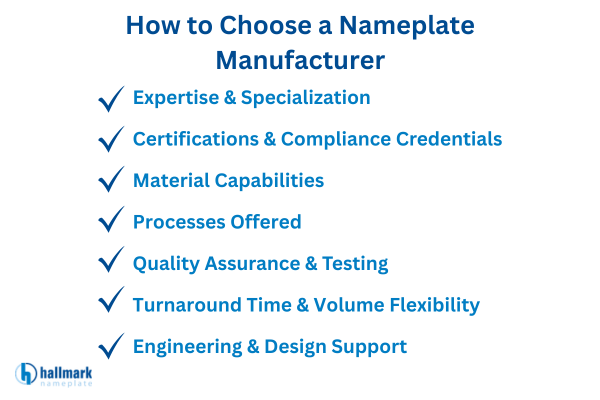
1. Industry Expertise and Specialization
Not every nameplate manufacturer is built for your application. A shop producing decorative plaques isn’t equipped to handle MIL-SPEC aerospace ID plates or ISO 13485-compliant medical device labels.
Look for a partner with verifiable experience in your vertical:
- Aerospace
- Medical
- Military
- Telecommunications
- Automotive
- Industrial controls
Ask for sample projects and about the tolerances and regulatory hurdles they’ve cleared.
Specialization shortens your lead time. It also eliminates the costly “education tax” you pay when a vendor learns your industry on your dime.
2. Certifications and Compliance Credentials
This is non-negotiable for regulated industries. Your manufacturer’s certifications directly determine whether your finished product can ship.
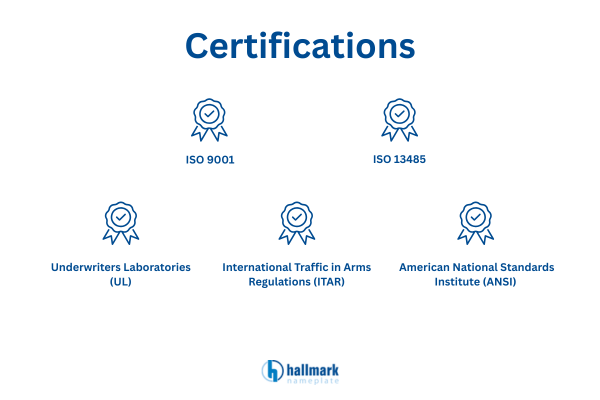
At minimum, vet for:
- ISO 9001 — baseline quality management
- ISO 13485 — required for medical device components
- ITAR registration — mandatory for defense and aerospace work
- UL Listed capability — for electrical safety markings
- RoHS compliance — for electronics shipped globally
- 3M Preferred Converter status — signals material expertise with industry-leading adhesives
Missing one of these? That’s a red flag. A manufacturer without proper certifications transfers compliance risk directly to you, and that risk travels all the way to your end customer.
3. Material Capabilities and Range

Your application dictates your material:
- Polycarbonate
- Polyester
- Vinyl
- Aluminum
- Stainless steel
- Paper
A strong manufacturer stocks and processes all of them.
Here’s why range matters: as your product evolves, so do your material needs. A supplier locked into two or three substrates forces you to multi-source. Multi-sourcing kills consistency and inflates your total landed cost.
The better move? Consolidate with one partner capable of handling metal nameplates, graphic overlays, membrane switches, and electronic assemblies under one roof.
4. Manufacturing Processes Offered
More process capability equals more design flexibility. Period.
A top-tier nameplate manufacturer should offer:
- Photo-anodizing and Metalphoto® — for near-indestructible, high-resolution metal nameplates
- Chemical etching and laser marking — for permanent, tamper-resistant identification
- Screen printing and digital printing — for vibrant color, logos, and variable data
- Domed and embossed finishes — for premium branded product plates
- Subsurface printing on polycarbonate — for membrane switch graphic overlays
Limited process offerings force design compromises. Full-capability shops let your engineers design for performance, not for the vendor’s constraints.
5. Rigorous Quality Assurance and Testing
Saying “we make durable nameplates” is marketing. Proving it is engineering.
Ask any prospective supplier how they validate performance. A credible manufacturer tests for UV exposure, salt spray, chemical resistance, abrasion (Taber), adhesion, and thermal cycling, with documented results.
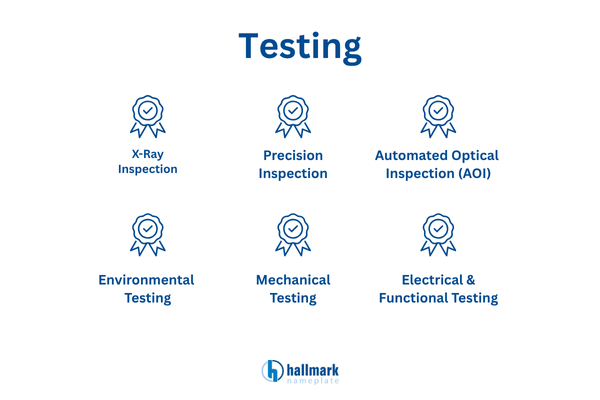
Request test reports, material certs, and first-article inspection documentation. If they hesitate, move on.
6. Turnaround Time and Volume Flexibility
Your production schedule doesn’t care about supplier excuses. Whether you need 50 prototype plates or 50,000 production units, your manufacturer must scale without dropping quality.
Ask three specific questions:
- What’s your standard lead time?
- What’s your expedite capability?
- Can you support blanket orders with scheduled releases?
Answers here directly impact your inventory carrying cost and line-down risk. Vague answers predict missed ship dates.
7. Engineering and Design Support
The best nameplate manufacturer operates as an extension of your engineering team, not just a print shop.
Look for suppliers offering in-house design review, material recommendations, adhesive consultation, and prototyping support. This early-stage collaboration catches problems before tooling is cut, saving you weeks and thousands in rework.
It’s the difference between a vendor and a partner.
One takes orders. The other protects your timeline and your margins.
8. U.S. Manufacturing and Supply Chain Transparency
Domestic production matters more than ever. Tariffs, geopolitical disruptions, and ITAR restrictions have made offshore sourcing a liability for anyone serving regulated markets.
A U.S.-based nameplate manufacturer delivers shorter lead times, clearer communication, stronger IP protection, and zero import-tariff exposure. That’s real dollars on your bottom line, not just a flag on a webpage.
Nameplate Manufacturer FAQs
What certifications should a nameplate manufacturer have for regulated industries?
A nameplate manufacturer serving regulated industries should hold ISO 9001 for baseline quality management, ISO 13485 for medical device components, ITAR registration for defense and export-controlled aerospace work, UL Listed capability for electrical safety markings, RoHS compliance for electronics shipped globally, and 3M Preferred Converter status to signal material expertise with industry-leading adhesives.
Missing the certifications required for your specific application can increase compliance risk for both you and your end customer.
What materials do custom nameplate manufacturers work with?
A full-capability nameplate manufacturer should be able to process materials such as polycarbonate, including Lexan, polyester, including Mylar, vinyl, aluminum, stainless steel, and paper.
Each material suits different applications: polycarbonate for UV and heat resistance, polyester for chemical and outdoor durability, aluminum and stainless steel for industrial and marine environments, vinyl for versatile indoor and outdoor use, and paper for short-term or economical applications.
Why does U.S. manufacturing matter when sourcing nameplates?
U.S.-based nameplate manufacturing can support shorter lead times, clearer communication, stronger intellectual property protection, and reduced exposure to import tariffs.
Tariffs, geopolitical disruptions, and ITAR restrictions can make offshore sourcing more challenging for manufacturers serving regulated aerospace, medical, defense, and industrial markets. With current tariff rates and freight volatility, domestic sourcing is now a cost advantage, not a premium.
What manufacturing processes should a nameplate supplier offer?
A top-tier nameplate supplier should offer photo-anodizing and Metalphoto for near-indestructible metal nameplates, chemical etching and laser marking for permanent tamper-resistant identification, screen printing and digital printing for vibrant color and variable data, domed and embossed finishes for premium product plates, and subsurface printing on polycarbonate for membrane switch graphic overlays. Limited process offerings force design compromises and drive multi-sourcing.
What quality tests should a nameplate manufacturer perform?
A credible nameplate manufacturer validates performance through UV exposure testing, salt spray testing, chemical resistance testing, abrasion testing using the Taber method, adhesion testing, and thermal cycling, and documents the results. Buyers should request test reports, material certifications, and first-article inspection documentation before placing a production order.
What industries does Hallmark Nameplate manufacture custom nameplates for?
Hallmark Nameplate manufactures custom nameplates for aerospace, medical, defense, and industrial OEM customers. The company was founded in 1957 and holds ISO 9001:2015, ISO 13485:2016, ITAR registration, UL Listed, RoHS compliance, and 3M Preferred Converter certifications. All manufacturing is performed at the Mt. Dora, Florida, facility, with full U.S.-based engineering support.
How do I evaluate a nameplate manufacturer before issuing a purchase order?
Evaluate nameplate manufacturers across eight criteria before issuing a purchase order: verifiable industry expertise, compliance certifications, material range, manufacturing process depth, documented quality testing, turnaround and volume flexibility, engineering and design support, and U.S. manufacturing footprint.
Sourcing based solely on price without vetting these eight factors is the most common and costly mistake in regulated manufacturing.
Should minimum order requirements be considered when choosing a nameplate manufacturer?
Yes. Some manufacturers require a minimum quantity, minimum spend, or both, which can affect prototyping costs, inventory, and purchasing flexibility. Hallmark Nameplate does not have a minimum order quantity, but we do have a $250 minimum order value. A good manufacturing partner should also be upfront when a project is not the right fit and help guide you toward a better solution when possible.
What should buyers ask a nameplate manufacturer about bulk production capabilities?
Ask whether the manufacturer can support your current quantity while also scaling to larger or repeat production runs. Buyers should also consider lead times, quality controls, documentation, production consistency, and whether the manufacturer has enough in-house capabilities to support the program as demand grows.
Make Your Next Sourcing Decision a Confident One
Choosing the right nameplate manufacturer comes down to eight checkpoints: industry expertise, certifications, material range, process depth, quality validation, scalability, engineering support, and domestic capability. Nail those, and you’ve de-risked your supply chain for years.
So here’s the question: Does your current supplier check every box?
Since 1957, Hallmark Nameplate has been the trusted custom nameplate manufacturing partner for aerospace, medical, defense, and industrial OEMs across the country. Our products are ISO 9001:2015 and ISO 13485:2016 certified, ITAR registered, UL Listed, RoHS compliant, and a 3M Preferred Converter, and proudly manufactured in Mt. Dora, Florida.
Request your free sample kit so you can see, feel, and test the quality before you commit. Or contact our team to discuss your next project, no pressure, just straight answers from people who’ve been doing this for nearly seven decades.
Want to learn more? Read The Complete Guide to Custom Nameplates: Types, Materials, and Applications.