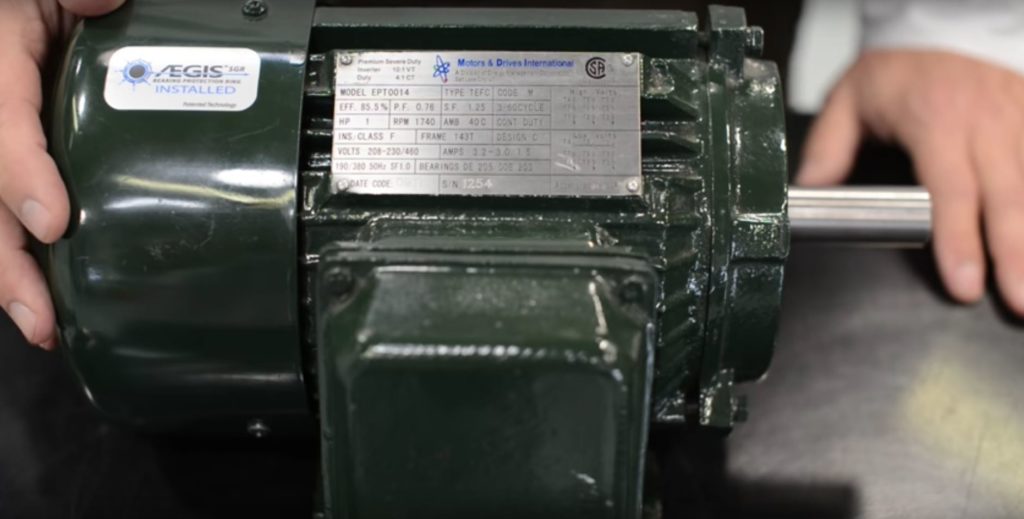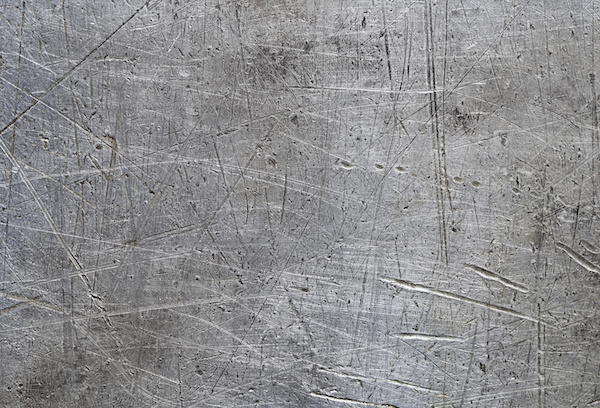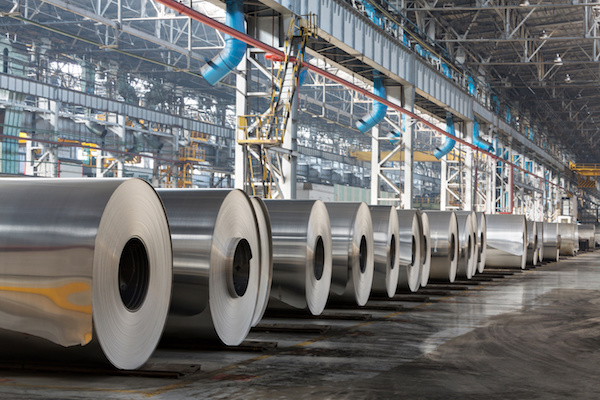


Request a free sample box to compare aluminum and stainless steel nameplates side by side. Or contact our engineering team for a material recommendation specific to your application.
Custom Aluminum Nameplates
Home »
Custom Aluminum Nameplates
Hallmark Nameplate manufactures custom aluminum nameplates built to meet the specific requirements of your product, equipment, and operating environment.
60+ Years Experience | Made in USA | ISO 9001 | ISO 13485 | ITAR Registered
Expert Aluminum Nameplate Manufacturing
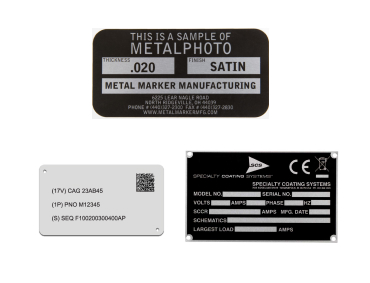
Hallmark Nameplate offers premium-quality aluminum nameplates in different alloys and finishes. We also offer Metalphoto® nameplates, which are made from photosensitive anodized aluminum.
Of all the available nameplate materials, aluminum is extremely durable, lightweight, versatile, and scratch-resistant, which makes it one of the most widely used materials for nameplates. Aluminum nameplates can stand up to harsh weather, various chemicals, and heavy usage. They can last for many years. Our aluminum nameplates are available in 1100, 1145, and 5005 aluminum alloys.
Aluminum tags withstand harsh environments and heavy industrial use. Aluminum nameplates can be designed to meet military, ANSI, UL, and CSA specifications. Aluminum is a great nameplate material for clients who want an attractive finish in a hard, tarnish-proof, and rust-proof material. Aluminum is frequently used for outside applications, but it can also be used inside. Its most common use is for equipment asset tags.
Our Certifications







Why Choose Hallmark for Custom Aluminum Nameplates?
Made in the USA
Custom aluminum nameplates are manufactured at Hallmark's Mt. Dora, Florida facility.
Built to Your Specifications
Choose the alloy, thickness, finish, mounting method, shape, graphics, and variable data required for your application.
Prototype Through Production
Hallmark supports custom commercial projects ranging from prototypes and smaller production needs to ongoing high-volume programs.
Quality & Compliance Support
Hallmark maintains ISO 9001:2015 and ISO 13485:2016 certifications and supports applications with specialized industry requirements.
Advanced Technology
Hallmark’s advanced fiber laser cutting technology allows us to produce detailed, custom aluminum nameplates with precise cuts, clean edges, and greater flexibility for intricate designs.
Material & Engineering Guidance
Not sure which alloy, thickness, or finish fits the application? Hallmark can help evaluate the operating environment and project requirements.
Aluminum Alloys We Work With
Hallmark Nameplate manufactures custom aluminum nameplates from three primary alloy families, each selected for specific performance characteristics. Our alloy inventory is maintained in-house at our Mt. Dora, Florida, facility, which can help streamline production planning and support efficient lead times.
| 1100 | ≥99.0% aluminum | Superior corrosion resistance, high formability, excellent conductivity | General-purpose nameplates, non-anodized applications, high-conductivity requirements | H14 (half-hard) | Good — accepts clear seal and dye processes |
| 1145 | ≥99.45% aluminum | Highest conductivity in our portfolio, ultra-formable | Thin-gauge flexible nameplates (0.003”–0.008”), insert applications for formed plastic parts | H19 (extra-hard) | Excellent — ideal for scratch-brush anodized finishes |
| 5005 | 0.8% magnesium, balance aluminum | Medium strength with superior marine-grade corrosion resistance | Outdoor/marine environments, mil-spec applications, control panels, heavy-duty asset tags | H34 (stabilized) | Superior — best anodizing response; accepts mill finish and clear sealed processes |
Temper Designations Explained
Every aluminum alloy is supplied in a specific temper that defines its mechanical properties. Here is what each temper designation means for your nameplate application.
| H14 | Cold-worked and strain-hardened to a tensile strength midway between annealed (O) and full hard (H18). | Less rigid than full-hard tempers, allowing easy forming. Ideal for nameplates that require bending, die-cutting into complex shapes, or installation around curved surfaces. |
| H19 | Strain-hardened to 1.5 ksi (10 MPa) above H18 full hard. | Maximum hardness for thin-gauge stock. Provides excellent scratch and abrasion resistance on nameplates as thin as 0.003”. |
| H34 | Cold-worked and stabilized at low temperature to prevent age-hardening. | Dimensionally stable over time. The go-to temper for control panels, mil-spec asset tags, and nameplates that must maintain flatness across temperature cycles. |
Aluminum Nameplate Uses by Thickness
The .020” aluminum is very popular, as it’s structurally stable and cost-effective. Thinner material can be used if a highly flexible nameplate is needed for forming or to insert into formed plastic parts. For serializing and adhesive-backed nameplates, .025” aluminum is recommended. The .050” and .064” aluminum is most often used on control panels, while the thickest stock, .125” aluminum, is commonly used on heavy cases. This type of material can be used for commemorative plaques.
| 0.003”–0.008” | Insert nameplates for formed plastic housings, highly flexible labels | Ultra-flexible, conforms to compound curves | Adhesive, insert molding |
| 0.020” | General-purpose equipment identification (most popular) | Structurally stable, cost-effective | Adhesive, rivets |
| 0.025” | Serialized nameplates, adhesive-mounted asset tags | Optimal for adhesive bonding | 3M adhesive (Preferred Converter) |
| 0.050”–0.064” | Control panels, instrument bezels | Rigid, durable under mechanical stress | Screws, bolts, rivets |
| 0.125” | Heavy-duty equipment cases, commemorative plaques | Maximum rigidity and impact resistance | Bolts, standoffs |

Aluminum Finishes
Our finish options determine both the aesthetic appearance and the environmental durability of your nameplate.
| Mill Finish | Natural appearance as received from the rolling mill. No chemical or mechanical finishing applied. | Cost-effective indoor applications, base for screen printing. |
| Brush Anodized, Clear Sealed | Mechanical brushing followed by an anodic oxide layer and sealing. Provides a satin directional grain pattern. | Professional-grade indoor/outdoor nameplates requiring corrosion protection and premium appearance. |
| Undyed / Unsealed Anodized | Anodized without dye or sealant to conform to specific military specifications (e.g., MIL-A-8625). | Defense and military applications where sealing would interfere with subsequent processing steps. |
| Photo Sealed (Anodized) | Screen-printed graphics sealed beneath a protective anodized layer. Available in chrome and silver. | Serial number tags, instructional labels, corporate identity plates, scales, dials, and rating plates. |
| MetalPhoto® | Photosensitive imaging process that seals high-resolution graphics inside the anodized aluminum. No printing involved; the image is part of the metal. | Extreme-durability applications. 20+ years of outdoor life. Barcode/variable data asset tags, MIL-SPEC control panels, aerospace identification. |
Anodized Aluminum (Clear Sealed; also known as Photo Sealed)
Lightweight yet durable, anodized aluminum is suitable for both indoor and outdoor applications. It’s known for its corrosion and abrasion resistance and is lighter than other metals. For a photo sealed aluminum nameplate, the design is screen printed with ink onto the surface. The nameplate is then sealed with a protective anodized layer.
We offer anodized aluminum nameplates in chrome and silver. Anodized aluminum nameplates are used for instructional tags, serial number and corporate identity tags, scales, dials, templates and rating plates.
Photosensitive Anodized Aluminum (Metalphoto)
Metalphoto® is a special process that creates extremely durable, high-resolution nameplates, control panels, signs, and labels. Metalphoto involves no printing. The process takes place in a darkroom and uses a film negative that’s similar to traditional photo processing.
The image is sealed inside the anodized aluminum, which makes the nameplate resistant to sunlight, corrosion, high temperatures, abrasion, and exposure to chemicals. The appearance is that of printed ink, but with exceptional durability. Metalphoto nameplates have a rating of 20+ years for outdoor use. The image is sealed within the anodized aluminum, helping protect it against fading, abrasion, and wear over time.
Undyed / Unsealed Aluminum
This is designed to conform to military specifications and other requirements. Sealed aluminum increases corrosion resistance but may decrease abrasion resistance. Some applications require aluminum to be unsealed — for instance, the military specification MIL-A-8625.
Available Options for Aluminum Nameplates
Every aluminum nameplate is manufactured to order at our ISO 9001 and ISO 13485 certified facility in Mt. Dora, Florida:
| Custom Die-Cut Shapes | Custom shapes and thicknesses ranging from 0.003” to 0.125”, depending on design and manufacturing requirements. |
| Corner Radii | 0.0312” to 0.500” |
| Mounting Options | Bolt holes, rivet holes, screw holes, 3M adhesive backing (Hallmark is a 3M Preferred Converter) |
| Printing | Custom screen printing, MetalPhoto® sub-surface imaging, digital printing |
| Variable Data | Serialization, barcodes (1D/2D), QR codes, UID marking |
| Compliance | Military (MIL-P-15024, MIL-P-19834, MIL-A-8625), ANSI, UL, CSA |
| Certifications | ISO 9001:2015, ISO 13485:2016, ITAR Registered, UL Listed, RoHS Compliant |
Trusted By 100s of Businesses

General Manager
Mining Equipment Manufacturer
“We are very pleased with the prototypes. Pinouts are good to go. Dimensions were on point. Please proceed and thank you for the quality work!”

CEO
Data Monitoring Device Manufacturer
“I really appreciate the quick turnaround on questions, quotes etc. Greatly appreciated!”

Buyer/Planner
Medical Device Manufacturer
“Hallmark has impressed the Robotics Solutions team with the work you recently completed for us. Looking forward to your quotation. Thank you to all and stay healthy and safe!”
Industries We Serve
Aluminum vs. Stainless Steel Nameplates: Which Material Is Right for Your Application?
Aluminum and stainless steel are the two most common metals used for industrial nameplates, and each delivers distinct advantages depending on your application environment, budget, and performance requirements. As a full-service nameplate manufacturer with 60+ years of expertise in both materials, Hallmark Nameplate helps engineers and purchasing teams select the right substrate for every project.
Side-by-Side Comparison Table
| Weight | Heavier (~7.9 g/cm3). Adds significant mass to equipment. | Lightweight (~2.7 g/cm3). Roughly one-third the weight of stainless steel. |
| Corrosion Resistance | Excellent natively via the chromium oxide layer. Best in high-chloride and high-acid environments, especially 316. | Excellent when anodized; the natural oxide layer self-heals. Superior in marine and chemical environments with 5005 alloy. |
| Temperature Resistance | Withstands very high heat (up to ~1500F / 815C for 304/316). Best for high-heat exhaust and engine applications. | Effective to ~400F for standard anodized; MetalPhoto withstands sustained heat to ~650F. |
| Graphic Sharpness | Good. Etching and engraving produce strong, durable marks but less fine detail than aluminum photo-imaging. | Superior. Anodized and MetalPhoto processes deliver sharper text and finer barcode resolution. |
| Abrasion Resistance | Good. Resists scratching and maintains structural integrity under heavy use. | Good to excellent depending on finish; anodized aluminum is very hard at the surface. |
| Formability | Formable but requires more tooling force; complex shapes increase cost. | Highly malleable. Easy to die-cut into complex shapes, bend, and form. |
| Cost | Higher material cost; more expensive to machine and finish. | Lower material and fabrication cost; cost-effective at most thicknesses. |
| Outdoor Durability | Long-lasting performance in many outdoor environments, depending on the stainless steel grade, exposure conditions, and maintenance. | 20+ years with the MetalPhoto process; anodized finishes provide excellent UV resistance. |
| Best Applications | High-heat engine plates, chemical processing equipment, food-grade (316) applications, marine and structural ID plates. | Asset tags, serial plates, control panels, barcode/UID labels, aerospace ID plates. |
For most industrial nameplate applications, aluminum delivers the best combination of cost, graphic quality, durability, and compliance. When your application demands extreme heat tolerance or direct contact with corrosive acids, stainless steel may be the better choice.
Hallmark Nameplate manufactures both materials in-house. Tell us about your project, and a specialist will recommend the right solution for your specific environment and requirements.
Not Sure Which Material is Right For Your Project?
Frequently Asked Questions About Aluminum Nameplates
The Best Aluminum Nameplates for Your Project
With more than 60 years of engineering and manufacturing expertise, Hallmark Nameplate can help to design the ideal nameplates for your application. There are many considerations, such as where they’ll be used, environmental conditions and requirements specific to your industry. Tell us about your project and a specialist will work with you to recommend a solution that’s durable, long-lasting, on-brand and cost-effective.