60-years-of-experience

60+ Years of Experience

satisfaction-guarantee

Satisfaction Guarantee

short-lead-times

Short Lead Times

Get to Know Your Nameplate Substrate: Vinyl

Previously, we explored a few substrates available for your next nameplate project. While those materials are excellent for certain applications, there are many other substrates worth considering.

In this installment of our series, we focus on vinyl, a flexible, durable, and cost-effective material that offers a wide range of applications for both indoor and outdoor use.

Nameplates provide decorative and informative solutions that enhance your product, all while offering quick turnaround times without sacrificing quality. Compared to graphic overlays, vinyl nameplates can be produced faster, at a lower cost, and with high-quality consistency.

What is Vinyl?

Vinyl is a synthetic plastic material that is highly versatile and widely used in industrial and commercial applications. When used for nameplates, vinyl can be:

  • Rigid or flexible, depending on your needs
  • Available in thicknesses from .004″ to .030″
  • Offered in gloss or matte finishes
  • Suitable for indoor use and outdoor use with a UV over-laminate

Its flexibility allows vinyl to conform to a variety of surfaces, including concave or convex areas, while maintaining strong adhesion and durability.
vinyl nameplate benefits


Benefits of Vinyl Nameplates

Vinyl nameplates are a versatile and practical solution for a wide range of applications, and their popularity stems from a combination of performance, affordability, and aesthetic appeal. Here’s a closer look at the key benefits.

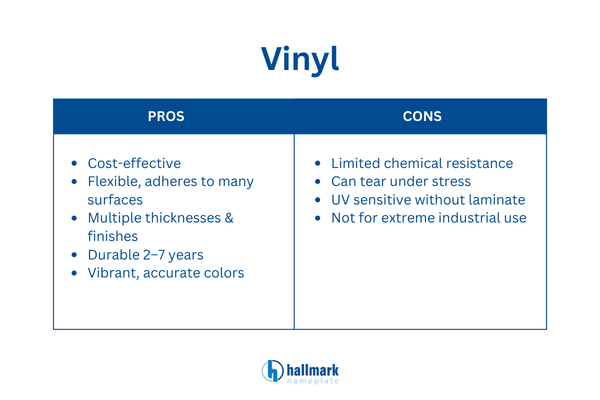
1. Cost-Effective

One of the biggest advantages of vinyl is its affordability. Compared to other substrates, vinyl is generally less expensive to produce, making it an ideal choice for projects with tighter budgets or high-volume needs.

This cost-effectiveness doesn’t mean sacrificing quality; vinyl nameplates can still offer sharp graphics, vibrant colors, and consistent performance. Whether you’re producing hundreds of decals, asset tags, or promotional labels, vinyl delivers excellent value.

2. Flexible Applications

Vinyl is incredibly adaptable, capable of adhering to a wide variety of surfaces and textures. Its flexibility allows it to conform to flat, concave, or convex surfaces, making it suitable for equipment, machinery, or signage that may have irregular shapes.

Vinyl performs well both indoors and outdoors, and when paired with a UV overlaminate, it can withstand exposure to sunlight without fading. This versatility makes it a go-to option for products ranging from industrial machinery to event banners.

3. Variety of Finishes and Thicknesses

Customization is a key advantage of vinyl. It’s available in a range of thicknesses, from ultra-thin (.004″) to more robust options (.030″), allowing it to suit different functional needs. You can also choose from gloss, matte, or even velvet finishes to match your product aesthetics or branding guidelines.

This flexibility means your vinyl nameplate can seamlessly integrate into your design while maintaining the durability and readability required for its intended use.

4. Durability

Vinyl nameplates are designed to last. Depending on environmental factors and application, they can maintain their appearance and adhesion for approximately 2–7 years.

While vinyl is not as resistant to chemicals as some other substrates, it handles everyday wear and tear exceptionally well. Its resilience makes it perfect for both temporary applications, like event signage, and longer-term needs, such as company asset tags or outdoor decals.

5. Visual Appeal

A major benefit of vinyl is its ability to deliver eye-catching graphics and precise color reproduction. An experienced manufacturer ensures accurate color matching, giving you access to virtually any hue imaginable.

This makes vinyl ideal for branding purposes, logos, and promotional graphics where maintaining a consistent visual identity is critical. Its smooth surface allows for high-resolution printing, ensuring text, logos, and other design elements look sharp and professional.

6. Lightweight and Portable

Beyond aesthetics and durability, vinyl is also lightweight and easy to handle, making installation quick and straightforward. This is especially useful for banners, event signage, and temporary applications where mobility and ease of setup are important.

7. Eco-Friendly Options

Modern vinyl production techniques often include eco-solvent or water-based inks, which reduce environmental impact while still providing durable, vibrant graphics. This allows businesses to create high-quality nameplates without compromising on sustainability.

Uses of Vinyl

Overall, vinyl’s combination of affordability, flexibility, durability, and visual quality makes it an excellent choice for a wide variety of projects, from industrial labeling to promotional and decorative applications.

It is most often used to promote a company’s logo, a special promotion, event, team, or school. Since vinyl is both flexible and portable, you could see a vinyl banner just about anywhere, such as billboards, table banners, trade show banners, building banners, street banners, festival banners, and stadium flags.

Its flexibility and portability make vinyl a great choice for trade shows, festivals, stadiums, and more.
vinyl nameplate

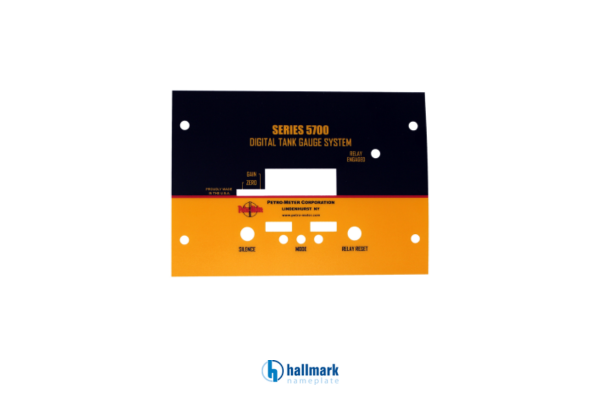
Vinyl Nameplate Options

Vinyl nameplates are offered with a variety of options to meet your project requirements:

  • Surface: The type of surface it will be mounted to
  • Indoor or outdoor applications (UV over-laminate available for sun exposure)
  • Finish options: Gloss, matte, or velvet
  • Thickness: Ranging from .004” to .030”
  • Special features: Serialization, barcodes, display windows (LED/LCD), domed elements
  • Assets: Drawings and art files available
  • Compliance: UL or CSA requirements, if needed

This flexibility ensures that your vinyl nameplate is perfectly suited for your product, branding, or industrial requirements.

How Vinyl Nameplates are Created

Vinyl nameplates can be produced using digital printing or screen printing. Both methods allow for precise customization, ensuring your vinyl nameplate meets your exact specifications.

Digital printing

This process utilizes aqueous (water-based), eco-solvent, solvent-based, or UV-curable inks. Solvent and UV inks provide superior weather and UV resistance.

Large-format inkjet printers and grand-format printers can produce pieces wider than 2.5 meters, with some machines capable of printing up to 3,000 square feet per hour.

Screen printing

Involves applying ink through a stencil or screen, one color at a time. This process can be done manually or with automated multi-color presses for consistent, high-quality results.

Get Custom Vinyl Nameplates

Vinyl is one of the most versatile substrates available for nameplates, offering flexibility, durability, and cost-effectiveness. Whether you need a vinyl nameplate for a company logo, warning decal, or promotional banner, Hallmark Nameplate has the experience and resources to guide you through every step of the process.

With over 55 years in the industry, we ensure that your nameplate is crafted to meet your specific needs — from the type of surface it will be mounted on to the ideal finish, thickness, and compliance requirements.

When it’s time to start your next project, trust Hallmark Nameplate to deliver the right vinyl solution for your application.

Get to Know Your Nameplate Substrate: Polycarbonate (Lexan)

With so many nameplate substrate options, it can be hard to tell which is best for your project.

To help you make the most informed decision, we’re continuing our substrate series by taking a closer look at polycarbonate, also known by the brand name Lexan®.

What Are Polycarbonate Nameplates?

Nameplates provide decorative and informative solutions that enhance your product while maintaining quick turnaround times and consistent quality.

Unlike graphic overlays, nameplates typically do not require embossing or extensive engineering, making them faster to produce and more cost-effective, without sacrificing durability or visual appeal.

Polycarbonate is a widely used engineering plastic known for being strong, tough, and flexible, with certain grades offering optical transparency. Because of these properties, polycarbonate is easily molded, thermoformed, and worked into complex shapes, making it an excellent choice for nameplates used in demanding environments.

polycarbonate nameplate

A Brief History of Polycarbonate

Polycarbonate materials were first discovered in 1898 by German scientist Alfred Einhorn at the University of Munich.

Despite decades of early research, the material wasn’t commercially developed until 1953, when Hermann Schnell of Bayer patented the first linear polycarbonate.

Since then, polycarbonate has become a staple material across engineering, manufacturing, and industrial applications.

Why Choose Polycarbonate for Nameplates?

Polycarbonate offers a unique balance of durability, flexibility, and visual performance, with several key benefits that make it one of the most versatile nameplate substrates available.

Engineered for Durability & Performance

Polycarbonate delivers a rare combination of durability, flexibility, and visual performance, making it one of the most versatile substrates available for nameplates.

Its engineering-grade properties allow it to perform reliably in demanding environments while maintaining a clean, professional appearance across a wide range of applications.

Wide Temperature Tolerance

One of polycarbonate’s most significant advantages is its ability to withstand extreme temperatures. It performs well in both high-heat and low-temperature conditions without warping, cracking, or losing structural integrity.

This makes it an excellent choice for nameplates used on manufacturing equipment, outdoor installations, transportation systems, and other environments where temperature fluctuations are common.

Flexible Thickness Options

Polycarbonate is available in a broad range of thicknesses, from .005” to .025”, giving designers greater control over durability, weight, and cost.

Thinner gauges are ideal for lightweight labeling and compact equipment, while thicker options provide added rigidity and impact resistance for heavy-duty or industrial applications.

Versatile Finish Selections

When it comes to appearance, polycarbonate offers unmatched flexibility. It is available in gloss, velvet, and matte finishes, allowing manufacturers to customize the look and feel of a nameplate based on branding goals, lighting conditions, and user interaction.

Whether you need a high-shine, premium look or a low-glare surface for improved readability, polycarbonate delivers consistent, high-quality results.

Indoor & Outdoor Compatibility

Polycarbonate performs reliably in both indoor and outdoor environments.

It resists common environmental stressors such as humidity, temperature swings, and UV exposure, making it suitable for applications ranging from indoor control panels to outdoor equipment housings and enclosures.

Flammability Ratings & Compliance Support

For applications that require regulatory compliance, polycarbonate offers flammability ratings such as UL94 V-2.

These options help manufacturers meet safety and certification requirements without compromising material performance or design flexibility.

High Impact Resistance & Optical Clarity

All of these advantages are reinforced by polycarbonate’s high impact resistance and excellent optical properties. The material is extremely tough and resistant to cracking under stress while still allowing for clear visibility when transparency is needed.

While polycarbonate has lower scratch resistance than some harder materials, its overall strength, resilience, and long service life make it a dependable solution for long-term nameplate applications.

Ideal for Contoured & Complex Surfaces

Engineering plastics like polycarbonate have steadily replaced traditional materials such as wood and metal in many applications. They often equal or exceed these materials in strength while being significantly lighter and easier to manufacture into complex shapes.

If your nameplate needs to be applied to a contoured or irregular surface, polycarbonate is highly recommended. Its flexibility ensures superior coverage and a high-quality finished appearance.

Subsurface Printing for Long-Lasting Graphics

Polycarbonate nameplates are printed on the underside of the transparent material, allowing the substrate itself to protect the graphics.

This subsurface printing process shields colors, text, and images from:

  • Cleaners and solvents
  • Abrasions and wear
  • Extreme temperatures
  • Outdoor elements and UV exposure

The result is a durable, economical labeling solution with crisp, vibrant, and precise graphics that stand the test of time.

Easy Forming & Prototyping Benefits

Unlike most thermoplastics, polycarbonate can undergo large plastic deformations without cracking or breaking. It can even be formed at room temperature using sheet-metal-style techniques, such as bending on a brake.

This makes polycarbonate especially valuable for prototyping applications where transparent or electrically non-conductive parts are required, situations where metal simply isn’t an option.

polycarbonate nameplate

Key Variables We Consider for Your Nameplate

Polycarbonate is just one of many substrate options we evaluate when designing your nameplate.

To ensure the best possible outcome, we consider variables such as:

  • Mounting surface type
  • Indoor vs. outdoor application
  • Finish selection (gloss, velvet, or matte)
  • Serialization and barcodes
  • Display windows (LED or LCD)
  • Available drawings and artwork files
  • Domed elements
  • UL or CSA requirements

Get Custom Polycarbonate Nameplates

With more than 55 years of experience, Hallmark Nameplate guides you through the entire development process, from initial concept to final production.

Our facility supports both screen and digital printing on materials ranging from .003” to .030”, ensuring precision and consistency at every stage.

Still have questions? Contact Hallmark Nameplate today and experience the highest quality service, from your first inquiry to your finished product.

Get To Know Your Nameplate Substrate: The 411 on Aluminum Nameplates

Nameplates are more than just identification; they’re a statement of quality, durability, and reliability. They communicate critical information, reinforce branding, and must remain legible throughout the life of the product, often in environments where failure is not an option.

When the job calls for rugged performance, aluminum nameplates are the go-to solution. Engineered to endure extreme temperatures, abrasion, chemical exposure, and constant wear, aluminum delivers dependable performance where other materials fall short.

In this blog, we will explain why aluminum nameplates are used to withstand the toughest conditions, from demanding military applications to heavy-duty industrial equipment.

What Is Aluminum?

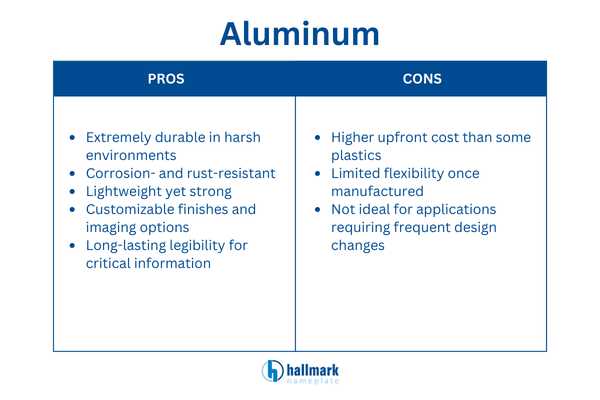
Aluminum is a lightweight, corrosion-resistant metal known for its strength-to-weight ratio and versatility. Its natural resistance to rust, chemicals, and UV exposure makes it ideal for both indoor and outdoor applications.

Because it is easily fabricated, anodized, or printed on, aluminum can be customized to meet virtually any design or durability requirement.

How Aluminum Nameplates Are Made

Aluminum nameplates are manufactured using precise, controlled processes to ensure exceptional durability, clarity, and long-term performance.

Each step is designed to enhance resistance to wear, corrosion, and environmental exposure while meeting exact customer specifications.

Anodizing

Anodizing is an electrochemical process that transforms the surface of aluminum into a durable, corrosion-resistant oxide layer. Unlike coatings or paints, this layer becomes an integral part of the metal, preventing peeling or fading over time.

Anodizing also allows for a range of finishes, including matte and mill, and provides an ideal surface for permanent imaging and text. This process significantly improves the nameplate’s resistance to UV exposure, chemicals, and abrasion.

MetalPhoto® Imaging

MetalPhoto® is a specialized photo-imaging process used for applications requiring extreme durability and precision. During this process, graphics, text, barcodes, and serial numbers are sealed directly into the anodized aluminum surface.

The result is a nameplate that is highly resistant to scratching, chemicals, and harsh environmental conditions. MetalPhoto® aluminum nameplates are MIL-qualified and commonly used in military, aerospace, and industrial environments where permanent identification is critical.

Thickness Options

Aluminum nameplates are available in a wide range of thicknesses, from 0.003” to 0.032”, to accommodate different performance requirements.

Thinner gauges are ideal for lightweight applications or tight installation spaces, while thicker options provide added rigidity and durability for heavy-duty equipment and outdoor use.

Finish Options

To meet both functional and aesthetic needs, aluminum nameplates are available in matte or mill finishes. Matte finishes reduce glare and improve readability in bright or high-light environments, while mill finishes offer a clean, metallic appearance suited for branding and product identification.

These finish options ensure the nameplate performs well while aligning with the desired visual presentation.

Together, these manufacturing processes allow aluminum nameplates to deliver consistent quality, long-lasting legibility, and reliable performance across even the most demanding applications.

aluminum nameplate

Benefits of Aluminum for Nameplates

Aluminum is an exceptional material for nameplates because it offers a unique balance of strength, versatility, and long-term reliability. Its performance advantages make aluminum a trusted choice across demanding industries.

Durability

Aluminum nameplates are engineered to withstand extreme temperatures, constant handling, abrasives, and prolonged exposure to harsh environments.

Whether subjected to heat, friction, or repeated cleaning, aluminum maintains its structural integrity and legibility over time, making it ideal for high-wear applications.

Corrosion Resistance

Unlike many metals, aluminum naturally resists rust and corrosion. When anodized, this resistance is further enhanced, allowing nameplates to perform reliably in outdoor settings or environments exposed to moisture, chemicals, UV rays, and other environmental stressors.

Lightweight Strength

Aluminum delivers impressive strength without unnecessary weight. Its lightweight nature makes installation easy and cost-effective while still providing the durability needed for industrial, military, and commercial use.

This combination reduces strain on equipment without sacrificing performance.

Customization and Versatility

Aluminum nameplates can be fully customized to meet precise design and functional requirements. Options include anodized aluminum, matte or mill finishes, and MIL-qualified MetalPhoto® imaging.

These customization capabilities allow for permanent graphics, barcodes, serial numbers, and branding that remain clear and readable throughout the product’s lifecycle.

Applications of Aluminum Nameplates

Aluminum nameplates are highly versatile and engineered for reliable performance in both indoor and outdoor environments. Their durability, legibility, and resistance to harsh conditions make them a preferred choice across a wide range of industries.what is a vehicle aluminum nameplate

Military and Defense

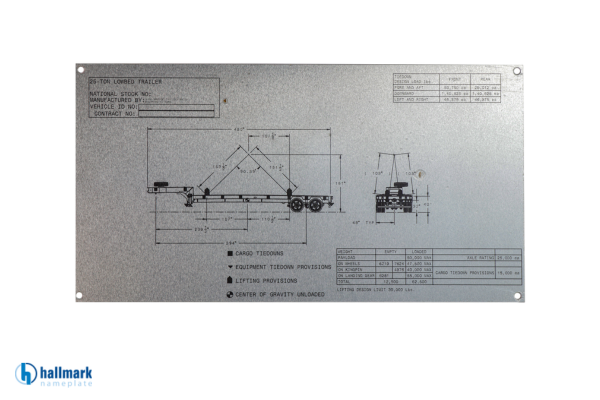
In military and defense applications, aluminum nameplates are used for equipment identification, asset tagging, and compliance labeling in some of the most demanding environments.

These nameplates must withstand extreme temperatures, abrasion, moisture, and prolonged exposure to the elements while remaining permanently legible.

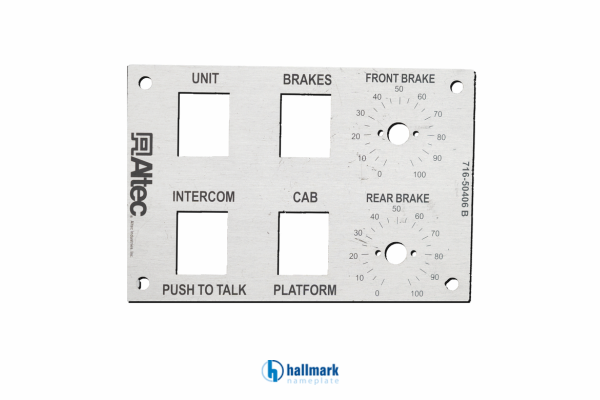
MIL-qualified anodized aluminum and MetalPhoto® nameplates are commonly used on vehicles, weapons systems, and mission-critical equipment where durability and accuracy are essential.

Industrial Machinery and Equipment

Industrial environments require labeling solutions that can endure heavy use, heat, chemicals, oils, and frequent cleaning. Aluminum nameplates provide long-lasting identification for machinery, control panels, safety instructions, and serial number tracking.

Their resistance to wear and corrosion ensures that critical information remains readable throughout the lifecycle of the equipment, supporting safety, maintenance, and regulatory compliance.

Electronics and Appliances

For electronics and appliances, aluminum nameplates deliver a professional, high-quality appearance while offering excellent durability. They are commonly used for branding, model identification, and technical data on both consumer and industrial products.

Aluminum’s lightweight nature and ability to hold fine detail make it ideal for applications requiring precise graphics, barcodes, or serialized information without compromising aesthetic appeal.

office aluminum nameplate

Custom Designs and Expert Support

At Hallmark Nameplate, we can follow your exact specifications or collaborate with you to create an efficient, cost-effective design that meets your end user’s requirements. Our team is committed to helping you find the right aluminum solution for your unique application.

Our products are quality assured and can stand up to a variety of conditions. Our toughest jobs call for aluminum nameplates. Hallmark Nameplate’s anodized aluminum and MetalPhoto aluminum nameplates meet military specifications MIL-P-15024 and MIL-P-19834. They also follow ITAR Compliance regulations and are ISO 9001:2008 quality assured.

If you have questions about the use and applications of aluminum nameplates, contact your sales team at Hallmark Nameplate today!

Top Custom Nameplate Applications and Uses Across Industries

Nameplates are no longer just simple labels; they’ve become essential tools that support identification, safety, branding, and trust across a wide range of applications. In today’s business and industrial environments, modern nameplates do far more than display a name.

They communicate critical safety warnings, provide clear operating instructions, and help identify equipment, assets, and professionals with confidence. Cost-effective and highly versatile, nameplates play a vital role in everything from machinery labeling and compliance to workplace recognition, making them an indispensable component in many industries.

Considering the Application When Designing Nameplates

When designing and manufacturing nameplates, understanding the intended application is critical to ensuring durability, readability, and effectiveness. The environment in which a nameplate will be used, whether exposed to heat, moisture, chemicals, vibration, or heavy handling, directly influences the choices you make when designing your nameplate.

Materials

Selecting the right material, whether aluminum, stainless steel, polycarbonate, or another durable substrate, is essential to withstand environmental stressors and maintain legibility over time. The wrong material can lead to corrosion, fading, or cracking.

Printing Methods

The method used to apply information to the nameplate, such as engraving, screen printing, etching, or laser marking, affects both durability and clarity. Harsh environments may require more resilient printing techniques to prevent smudging or wear.

Mounting Options

How a nameplate is attached, using screws, rivets, clips, or adhesive, must accommodate the application’s conditions. Proper mounting ensures that the plate remains securely in place and readable even under heavy use, vibration, or exposure to chemicals.


A nameplate designed without considering its application may fade, corrode, or become illegible, compromising safety, compliance, and identification. By tailoring nameplates to their specific use, businesses can create long-lasting, high-performance solutions that meet both functional and aesthetic needs.

Industries That Use High-Quality Nameplates

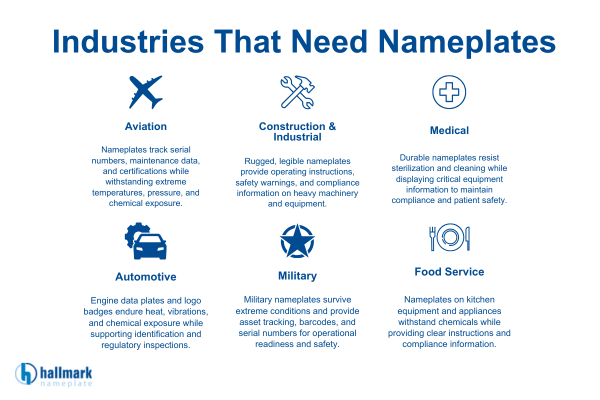
High-quality nameplates are essential across a variety of industries, providing clear identification, improving safety, ensuring regulatory compliance, and enabling long-term traceability.

Because nameplates are often exposed to harsh or demanding environments, choosing durable materials and precise printing methods is crucial to maintaining legibility, accuracy, and longevity throughout the product’s lifecycle.

industries using nameplates

Aviation

In aviation, accuracy and compliance are paramount. Nameplates are used to display serial numbers, maintenance histories, certifications, and regulatory markings on aircraft components and systems. These plates must remain readable despite extreme temperature changes, high-altitude pressure variations, and exposure to fuels, oils, and other chemicals.

Aluminum and metalphoto are commonly used materials due to their durability, corrosion resistance, and ability to maintain crisp, precise printing over time. For both commercial and military aircraft, reliable nameplates are critical for safety, traceability, and regulatory adherence.

Construction & Industrial

Heavy machinery, industrial equipment, and instrumentation depend on rugged nameplates to convey operating instructions, safety warnings, and compliance information. In these settings, plates face constant vibration, dust, moisture, and exposure to chemicals or oils.

Screen-printed, engraved, or embossed metal nameplates are preferred for their long-term durability and visibility, helping protect workers, reduce errors, and support safe, efficient operations. By providing clear, lasting information, these nameplates help businesses meet regulatory requirements while maintaining smooth workflow.

Medical

Medical facilities and equipment require nameplates that meet strict hygiene and regulatory standards. They must withstand frequent cleaning, sterilization processes, and harsh disinfectants without losing clarity.

Nameplates in medical environments are used for equipment identification, displaying model and serial numbers, calibration dates, and safety or operational warnings. Materials such as stainless steel and polycarbonate ensure durability, cleanliness, and compliance, supporting both patient safety and efficient hospital operations.

Automotive

The automotive industry relies on nameplates for branding, identification, and regulatory compliance across vehicles and components. Engine data plates, chassis identifiers, and branding badges must endure high heat, continuous vibration, and exposure to oils, fuels, and road chemicals while remaining legible.

Metal and aluminum nameplates provide long-lasting readability for inspections, maintenance, and regulatory audits, while also supporting brand recognition and quality assurance.

Military

Military nameplates are engineered to survive the harshest conditions, from extreme climates to battlefield environments. They are used for asset tracking, identification, and compliance, often including serial numbers, barcodes, and UID markings.

Military-grade nameplates must resist corrosion, abrasion, UV exposure, high impacts, and temperature extremes. Materials like engraved stainless steel and metalphoto are essential for maintaining operational readiness, ensuring accountability, and supporting mission-critical safety.

Food Service

In the food service industry, nameplates are crucial for safe and efficient operation. They are commonly found on kitchen appliances, equipment, and storage units, providing operating instructions, maintenance guidance, and regulatory information.

These nameplates must withstand heat, moisture, grease, and repeated cleaning with harsh chemicals while remaining legible. Stainless steel, anodized aluminum, and durable plastics ensure clarity, durability, and hygiene, helping food service businesses maintain compliance and operational efficiency.

nameplate applications

Across all of these industries, the right combination of materials, printing methods, and mounting options ensures nameplates deliver lasting durability, clarity, and performance, no matter the environment.

Get The Perfect Custom Nameplate For Your Business

Whether your application is medical, industrial, consumer, computer peripheral, or military, Hallmark can manufacture a nameplate for you.

At Hallmark Nameplate, we have the experience and capability to make your nameplate out of the right material. We have five substrates that we can use to make your nameplates: polycarbonate (Lexan), polyester (Mylar), vinyl, paper, and aluminum. Determining what kind of material you’ll want your nameplates made from will depend on factors such as where they will be located, how thick they need to be, and what they will be used for.

There are several questions that will be required to help us determine how to create your nameplates. These include what type of surface they will be mounted to, whether they’ll be used indoors or outdoors, what type of finish is best (gloss, velvet, or matte), serialization and barcodes, which display window will be necessary (LED, LCD), the drawings and art files that are available, domed elements, and the UL or CSA requirements.

At Hallmark Nameplates, we have a staff of seasoned professionals who are here to help you in any way you need. So if you are looking for nameplates for your product. Come to Hallmark Nameplate for a quick, easy, and pleasant experience.

Membrane Switch Construction Elements

When designing custom electronics, the right membrane switch can make all the difference in performance and durability. They help countless industries, from medical devices to aerospace, and when done right, can protect your sensitive equipment while providing reliable user interfaces.
In this guide, we’ll break down the three main membrane switch elements, conductive silver, copper flex, and PCB-based, highlighting their pros, cons, and how to choose the best one for your application. Whether you’re working with tight spaces, complex circuits, or high-vibration environments, this overview will help you make an informed decision.

What Are Membrane Switches?

Membrane switches feature a robust construction that is completely sealed from the outside environment.

Membrane switches have both tactile and non-tactile variations, which support a wide variety of designs and applications. Non-tactile switches are more robust, completely sealed from the external environment, and are capable of more than five million actuations. Tactile switch types, on the other hand, are internally vented for a complete seal, available in SS dome, polydome, and hydro form dome constructions. They are also capable of more than one million actuations.

Membrane switches are non-standard, which means that each one is specially designed for your product specifications. This is ideal for medical equipment, computer peripherals, and even the military and aerospace industries. This allows a user interface with equipment while protecting the machinery from contaminants, environmental hazards, and debris.

Membrane Switch Elements

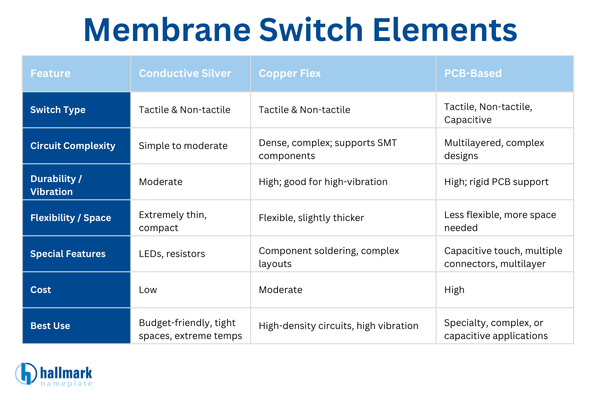
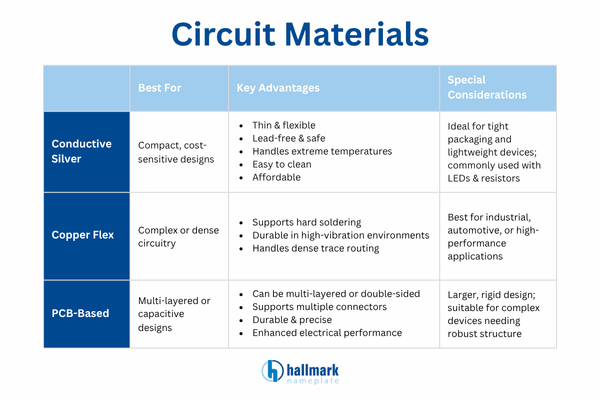
Ultimately, there are three types of membrane switch construction elements: conductive silver, copper flex, and PCB-based.

membrane switch elements

Conductive Silver

Silver flex membrane switches are the most common construction for flexible, custom membrane switches. It’s also the most popular switch construction due to its affordability, especially when compared to bulky, costly electromechanical switch assemblies.

Silver flex membrane switches feature very thin, flexible layers of material, of which some layers use screen-printed silver and carbon conductive links, and are separated by an adhesive layer. Conductive silver can be used for tactile and non-tactile construction.

It’s also great for LEDs and resistors. A great advantage of using conductive silver is that they’re lead-free. Cure temperatures are much lower than those of some other elements. Conductive silver also works very well for steady-state temperature environments, particularly at extreme temperatures.
Extremely thin construction makes conductive silver great for saving precious design space on your membrane switch. It can also be easily cleaned.

Copper Flex

Membrane switch panels made of copper flex are made by laminating a very thin sheet of copper to a flexible film substrate, and then chemically etching it away. Copper traces are left as a result.

Copper flex has the ability to provide higher-density traces. It also has SMT low-profile components and is available for tactile and non-tactile construction. Copper flex membrane switches are ideal for smaller complex designs, where dense circuit patterns or trace routing limitations exist.

The design also allows the ability to accommodate more complex circuit patterns while still maintaining the flexibility of a membrane switch. The copper flex keypads also have the advantage of being able to hard solder active and passive components into the assembly, making it a great choice in high-vibration, high-reliability environments.

PCB Based

A PCB (aka print circuit board) is typically made of copper-clad fiber infused into a resin material. The PCB membrane switch construction uses a PCB as the main structure or support substrate, with the membrane switch on the front of the PCB assembly, and the display, along with any other discrete components, on the back side of the PCB.

PCB-based membrane switches are available in tactile, non-tactile, and capacitive switches. They are also versatile in that they can be single-sided, double-sided, or multilayered in construction. PCB-based membrane switches also allow for multiple connector options.

How to Determine the Right Membrane Switch Element

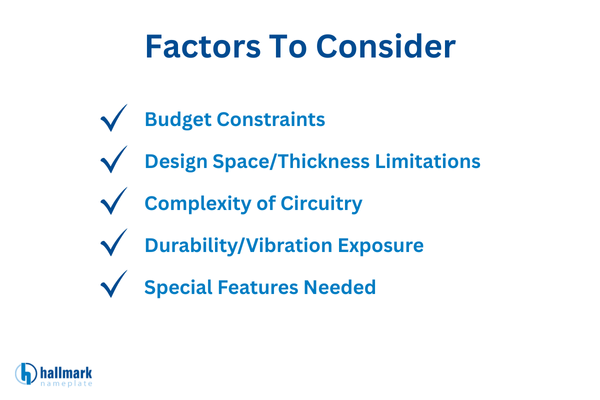
So how do you decide which is right for you? Here are a few things to consider.

factors to consider for membrane switches

Budget Constraints

If cost is a major consideration, conductive silver switches are the most economical option. They provide reliable functionality at a lower price point than copper flex or PCB-based switches, making them ideal for projects with tight budgets or high-volume production runs.

Design Space/Thickness Limitations

When your project requires a compact, thin design, conductive silver or copper flex switches are the best choices. Conductive silver offers extremely thin layers, perfect for tight packaging. Copper flex is slightly thicker but still maintains flexibility while supporting more complex circuitry.

Complexity of Circuitry

For projects with dense circuit patterns or intricate layouts, copper flex switches excel because they allow higher-density trace routing and can handle low-profile surface-mount components.

If your design requires multilayered, double-sided, or specialty connections, a PCB-based switch may be necessary for added versatility and complexity.

Durability/Vibration Exposure

In environments where the switch will be subject to mechanical stress or vibration, durability is key. Copper flex switches allow hard soldering of components and maintain reliability in high-vibration settings. PCB-based switches also offer strong structural support, making them suitable for demanding applications where long-term reliability is critical.

Special Features Needed

Certain applications require unique functionality, such as capacitive touch, multiple connector options, or multilayered construction. Only PCB-based switches can accommodate these requirements, making them the go-to choice for specialized or highly integrated electronic designs.

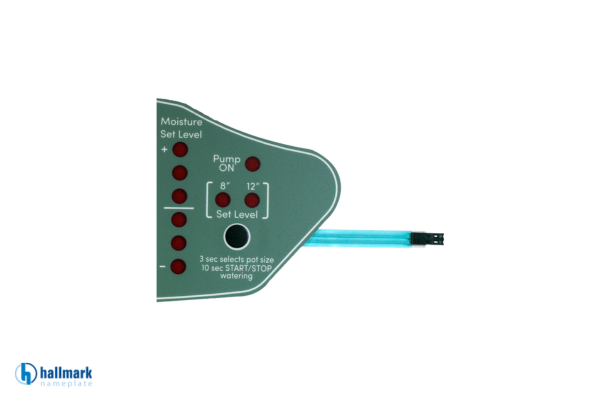
membrane switch elements

Get High Quality Membrane Switches

Membrane switches from Hallmark Nameplate can be specifically designed to meet your environmental considerations. Our switches are internally vented and sealed to protect your equipment from contaminants.

Hallmark Nameplate’s membrane switches can also be provided with or without terminating connectors, as well as:

  • LED Indicator Lights
  • Backlight (LED, fiber optic, EL)
  • Chemical and weather-resistant
  • ESD/EMI/RFI Shielding
  • Various connector configurations

We at Hallmark Nameplate are notorious for producing the highest quality products and using our experience and knowledge in the technology field to the utmost. We keep not just our products, but also our customers, at the top of our priority list when it comes to the task at hand, and membrane switch production is no exception. We’re fully equipped to assist with every step along the way, allowing you to rest easy knowing that your upcoming product is in great hands.

Contact us at Hallmark Nameplate today to learn more about the various constructions and product features we can offer, and learn how we can customize your membrane switch to meet and exceed your unique application requirements. With our experience and our long history of producing high-quality products for various needs, you can rely on Hallmark Nameplate to deliver what you need and beyond, and complete the job efficiently.

What Is Tactile Feedback? Construction, Benefits, and Use Cases

At the design stage, manufacturers must consider not only how machinery or equipment functions, but how users will ultimately interact with it. Controls, interfaces, and feedback mechanisms all play a critical role in usability, efficiency, and safety.

This is where membrane switches come into play. Membrane switches act as the primary interface between the user and the equipment, providing both visual and tactile cues that guide operation and confirm inputs. Among the many available design options, tactile feedback is one of the most important and misunderstood features.

Tactile feedback is not simply an optional upgrade that adds cost. In many applications, it is a functional necessity. Some environments benefit greatly from tactile response, while others may not require it at all. Understanding how tactile feedback works and how tactile membrane switches are constructed is essential to choosing the right solution for your product.

Below, we’ll break down what tactile feedback is, how tactile switches are constructed, the different element options available, and the key benefits and drawbacks to consider when designing a tactile membrane switch.

What Is Tactile Feedback?

Tactile feedback is the use of physical sensation, typically vibration or resistance, to communicate information to a user. Instead of relying solely on visual cues (like LEDs) or audible alerts (such as beeps or alarms), tactile feedback engages the sense of touch to confirm actions or relay information.
Common examples include:

  • Touchscreens in vehicles that provide a subtle “click” sensation
  • Barcode scanners that vibrate after a successful scan
  • Virtual keyboards that simulate the feel of physical keys

In membrane switches, tactile feedback lets users feel when a button has been pressed and when the device has accepted an input. This confirmation improves accuracy, reduces uncertainty, and enhances the overall user experience, especially in environments where visual or audible signals may be impractical.

Why Tactile Feedback Matters in Membrane Switch Design

Historically, machines communicated with users through lights, sounds, or mechanical indicators. While these methods are still effective, tactile feedback is increasingly used to augment or replace traditional alerts.

Tactile feedback uses a vibrating component, often referred to as an actuator, to deliver physical confirmation. This may involve:

For applications involving frequent or precise input, such as data entry, control panels, or medical devices, tactile feedback significantly reduces user error and fatigue.

Understanding Tactile Switch Construction

To determine whether tactile feedback is appropriate for your application, it’s important to understand how tactile membrane switches are constructed. The construction directly affects the feel, durability, and performance of the switch.

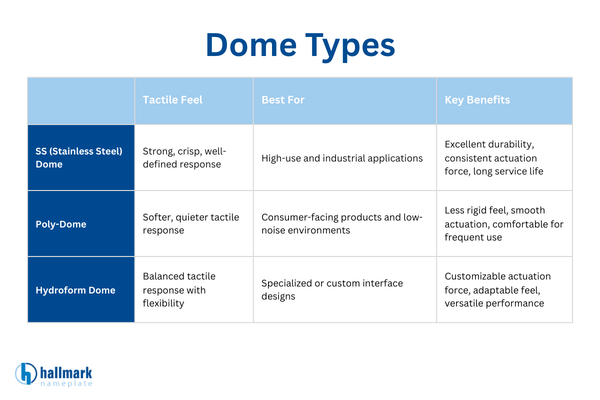
Common Tactile Dome Constructions

dome types for tactile feedback

We offer several tactile switch constructions, each suited for different use cases:

SS (Stainless Steel) Dome

  • Provides strong, crisp tactile feedback
  • Ideal for high-use or industrial applications
  • Excellent durability and consistent actuation force

Poly-Dome

  • Softer tactile response compared to metal domes
  • Often used when a quieter or less rigid feel is desired
  • Suitable for consumer-facing products

Hydroform Dome

  • Offers a balance between tactile response and flexibility
  • Customizable feel and actuation force
  • Works well for specialized or unique interface designs

Because these constructions vary significantly in tactile feel and performance, many customers work directly with engineers to determine the best option. Whether tactile feedback is required or should be avoided plays a major role in selecting the right dome structure.

Additional Membrane Switch Features to Consider

Tactile feedback is often combined with other functional enhancements to improve usability and durability, including:

  • LED indicator lights
  • Backlighting (LED, fiber optic, or electroluminescent)
  • Chemical and weather resistance
  • ESD, EMI, and RFI shielding
  • Various connector configurations

These features can be integrated into tactile membrane switches to meet demanding environmental or operational requirements.

Tactile Switch Element Options

Beyond dome construction, the internal switch elements also influence performance, flexibility, and cost. Below are the primary element options available.

circuit materials

Conductive Silver

Conductive silver elements support both tactile and non-tactile constructions and offer excellent electrical performance.

Key advantages include:

  • High conductivity for faster signal transmission

  • Compatibility with resistors and LED integration
  • Ideal for devices with frequent or continuous input
  • Strong performance in low-light environments

While slightly more expensive, conductive silver is well-suited for demanding applications where reliability and responsiveness are critical.

Copper Flex

Copper flex elements provide the highest density traces and are ideal for compact designs.

Benefits include:

  • Low-profile components
  • Excellent for tight packaging constraints
  • Suitable for both tactile and non-tactile designs
  • Scales well for small or complex devices

Copper flex is a popular choice when space is limited, but performance cannot be compromised.

PCB-Based Elements

PCB-based elements are the most versatile option available.

Key features include:

  • Support for tactile, non-tactile, and capacitive switches
  • Single-sided, double-sided, or multilayer construction
  • Multiple connector configurations
  • Exceptional design flexibility

For complex applications requiring advanced functionality or customization, PCB-based elements offer nearly limitless construction possibilities.

Benefits of Tactile Feedback

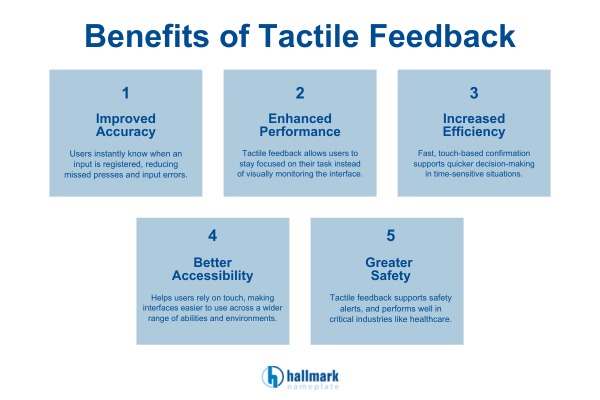
The primary benefit of tactile feedback is confidence. Users know immediately when an input has been registered.

tactile feedback benefits

Key Advantages of Tactile Switches

  • Improved accuracy and reduced missed inputs
  • Enhanced user confidence and peace of mind
  • Increased efficiency in high-pressure environments
  • Better accessibility for users who rely on touch

In industries such as healthcare, tactile feedback is especially valuable. Medical professionals must be certain that data entries or commands have been accepted.
Tactile confirmation has even been shown to reduce patient misdosing by minimizing data entry errors.

How Tactile Feedback Improves Operator Performance

Tactile feedback allows users to focus on the task at hand rather than the interface itself. Vibrations can signal:

  • Input confirmations
  • Safety warnings
  • Positioning or status alerts

By reducing cognitive load, tactile systems improve operator performance across a wide range of industries, from industrial equipment to medical devices and consumer electronics.

How Tactile Feedback Improves Typing and Data Entry

In applications involving typing or repeated data entry, such as virtual keyboards or control panels, tactile feedback plays a critical role. A distinct tactile response helps users differentiate between:

  • Short presses
  • Long presses
  • Successful vs. incomplete inputs

This feedback allows users to type faster, make fewer mistakes, and experience less frustration. The result is an interface that feels more intuitive and closer to a physical keyboard, even when operating on a flat surface.

Potential Drawbacks of Tactile Feedback

While tactile feedback offers many advantages, it is not ideal for every application.
Common concerns include:

  • Strong tactile response may disrupt precision tasks
  • Repetitive use may cause fatigue in high-accuracy environments
  • Users unfamiliar with tactile systems may require adjustment time

For applications that demand extreme accuracy or very high actuation rates, tactile feedback should be carefully evaluated. Consulting with experienced engineers can help determine whether tactile or non-tactile switches are more appropriate.

Get High-Quality Tactile Membrane Switches

Tactile feedback is a valuable option for many membrane switch applications, but selecting the right combination of construction, elements, and features is essential. With capabilities exceeding 1 million actuations, internal venting for complete sealing, and extensive customization options, tactile membrane switches can be tailored to nearly any use case.

At Hallmark Nameplate, our team of experienced designers and engineers will work with you to create a membrane switch that meets your exact performance, durability, and usability requirements.

You don’t need in-depth technical knowledge of tactile feedback; that’s our job. If you have questions about suitability, design, construction, or pricing, we invite you to contact us today and learn how tactile membrane switches can enhance your product.


Creating Overlays for the Toughest Workplaces

Selecting a graphic overlay can be a difficult decision to make. After all, you not only have to make choices in terms of the traditional elements of design (size, shape, color, etc.), but there are other issues that practically no one considers.

Your graphic overlays that are used for membrane switches and control panels must withstand the toughest workplace conditions. From the caustic environments of raw chemicals processing to the high-temperature operations that exist in hot works manufacturing, graphic overlays are the top choice to withstand high temperatures, moisture, chemicals, and dirt infiltration, performing exceptionally well with limited material degradation and long-lasting label readability.

In this article, we will discuss different applications where overlays are used in harsh conditions and how to design an overlay to withstand these difficult environments.

Graphics Overlays Applications

Graphic overlays serve a dual role in the toughest workplaces. While industrial equipment will benefit from the protection that rugged and sealed overlays offer, other industries must endure regular hose-down cleanings, such as food-grade operations, or equipment that requires routine sanitizing, as found in medical facilities. Even delicate instrumentation panels as found in research or testing laboratories now incorporate membrane switches with graphic overlay to add value to the equipment’s operation and its aesthetic appeal.

Overlays are used extensively due to the wide range of material and color options available, the many visually pleasing styles for each end-user application, and the protective properties that add a significant increase to the life-cycle of industrial assemblies or manufactured products.

Overlays for equipment faceplates and control panels are used for the following tough workplace applications.

graphic overlays applications

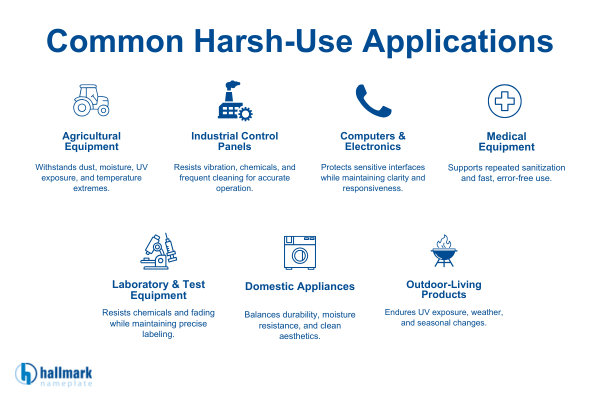
Agricultural Equipment

Graphic overlays used in agricultural machinery must withstand extreme outdoor conditions, including dust, moisture, mud, UV exposure, and temperature fluctuations. Durable materials, abrasion-resistant finishes, and high-contrast graphics ensure controls remain legible and functional during long hours of field use.

Industrial Control Panels

In industrial settings, control panels are exposed to heavy use, vibration, chemicals, and frequent cleaning. Robust overlays with selective texturing, embossing, and chemical-resistant coatings improve operator accuracy, reduce errors, and maintain readability in demanding production environments.

Computers and Electronics

Overlays for computers and electronic devices require precision, clarity, and durability. High-quality inks and materials protect sensitive interfaces while maintaining visual sharpness and tactile responsiveness, even in environments with heat, static, or frequent user interaction.

Medical Equipment

Medical applications demand overlays that support cleanliness, accuracy, and reliability. Chemical-resistant finishes allow for repeated disinfection, while embossed or textured controls improve usability for clinicians who rely on quick, error-free operation in critical care settings.

Laboratory and Test Equipment

Laboratory environments often involve exposure to chemicals, solvents, and temperature extremes. Overlays designed for these applications must resist corrosion and fading while maintaining precise labeling to support accurate testing, calibration, and data collection.

Domestic Appliances

Graphic overlays on household appliances must balance durability with aesthetics. They are designed to resist wear from frequent use, moisture, heat, and cleaning agents, while providing intuitive controls that enhance the user experience.

Outdoor-Living Products

Products designed for outdoor living, such as grills, lighting systems, and recreational equipment, require overlays that can endure UV exposure, rain, heat, and seasonal weather changes.

UV-stable inks and weather-resistant materials help maintain legibility and appearance over time.

Considerations for Tough Environments

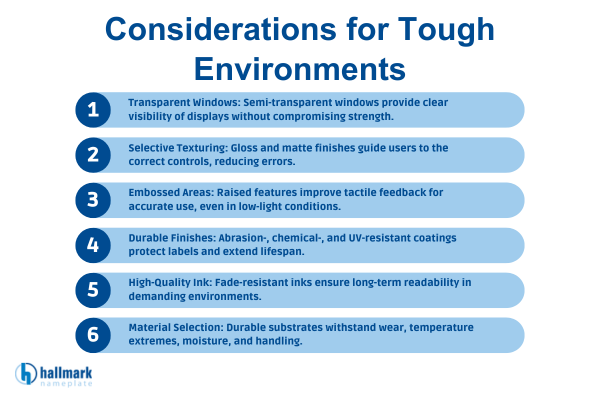
Selecting the right graphic overlay for challenging environments requires careful attention to materials, design, and functionality. By considering these options, you ensure your graphic overlays perform reliably even in the harshest conditions.

overlay consideration touch environment

Transparent Windows

Semi-transparent windows serve as an alternative to traditional cut-outs, offering a peek-through capability that enhances visibility without compromising structural integrity. These windows allow operators to view critical displays such as meters, counters, or digital readouts, enabling efficient monitoring and decision-making in real-time.

Transparent windows are particularly useful in applications where precise observation is required without interrupting workflow.

Selective Texturing

By applying different textures and finishes to specific control areas, selective texturing creates a visual and tactile distinction between operational zones. Gloss and matte finishes can highlight buttons, switches, or sliders, helping operators quickly identify the correct input areas.

This design strategy reduces errors, increases efficiency, and instills confidence during repeated use, especially in high-pressure or fast-paced environments.

Embossed Areas

Embossing adds tactile contrast to control panels, allowing users to locate keys and controls by feel rather than sight. Techniques such as raised, perimeter, or dome embossing enhance touch recognition, ensuring that operators can perform actions accurately even in low-light or visually cluttered conditions.

This feature not only reduces selection errors but also improves overall productivity and operator satisfaction.

Durable Finishes

Overlays can be enhanced with specialized finishes to withstand the toughest workplace conditions. Abrasion-resistant coatings prevent wear from repeated contact, while chemical-resistant treatments protect labeling from exposure to oils, solvents, or corrosive substances.

UV-resistant coatings maintain color integrity and legibility, even under prolonged sunlight exposure. Together, these treatments ensure that critical controls remain readable and functional, extending the life of your overlays.

High-Quality Ink

Ink selection is a critical factor in overlay longevity. Poor-quality inks can fade, smear, or discolor, compromising readability and reducing the overall lifespan of the overlay. By using durable, fade-resistant inks, overlays maintain their visual clarity, ensuring critical information remains accessible throughout the product’s lifecycle, regardless of environmental stressors.

Material Selection

The choice of substrate material impacts both durability and performance. High-quality films, plastics, or laminates can withstand repeated use, extreme temperatures, moisture, and mechanical stress.

Material considerations should include not only operational conditions but also storage, transit, and shelf life, as overlays may be exposed to extended periods of indoor or outdoor environments before installation. Selecting the right material ensures reliability, reduces maintenance costs, and supports consistent performance in demanding applications.

graphic overlays

The Right Overlay for Tough Environments

At Hallmark Nameplate, our design specialists can make sure your membrane panels with graphic overlay are manufactured to withstand hot, cold, wet, dry, chemical, and UV exposure. We have been designing industrial nameplates and customized graphic overlays for a wide range of industries for over 60 years.

At Hallmark Nameplate, we combine current graphics design principles for color, layout, and text style with industry best practices for membrane switch faceplate design to achieve optimum human-to-machine graphical interaction.

Our membrane switches are quality-manufactured to endure over 1 million actuations. When coupled with a heavy-duty graphic overlay that provides high chemical and temperature resistance, you can expect a long-lasting control panel that is custom-designed for your specific equipment and engineered to withstand the harshest working environments.

When you require a completely sealed operator panel, a graphics overlay faceplate is the answer. Contact Hallmark Nameplate for a fast quote based on your uploaded specifications for accuracy. And if you’re not quite sure where to start, our design team is standing by to assist you in selecting the right material and overlay style for your application.

Get to Know Your Nameplate Substrates: Polyester (Mylar)

Polyester nameplates are a popular option for companies that need an abrasion-resistant, UV-resistant, and chemical-resistant product that works well in all types of work environments. With the right manufacturer, they can be custom-designed for clients in a wide range of industries and uses.

Below is a quick guide that will tell you the essentials you need to know about Mylar nameplates and how they can benefit your company.

What is Polyester?

plastic - polycarbonate / polyester nameplate

Say the word “polyester,” and most people have no clue what you’re talking about. Polyester, however, is a stretched polyester film that is used for a number of applications and products that you are familiar with.

Polyester is used for products such as solar filters and specialty balloons. It also makes a great insulating material and can even be used as a protective plastic coating.

Mylar is popular because it exhibits the following properties:

  • Insulates electricity
  • Clear and transparent
  • Malleable and extremely durable
  • Lightweight and chemical-resistant
  • Odor- and gas-resistant

polyester nameplate benefits

How is Polyester Created?

Polyester has been around since the 1950s. It was first developed by DuPont, who named it “Mylar,” and further advanced by NASA in the mid-1960s. NASA engineers used Mylar to create balloons for spacecraft. Mylar was used because it could endure the rigors of long-range flight.

Mylar is made from molten polyethylene terephthalate (PET), which is a thin film-like substance that is cooled and dispersed via a large roller. The film may be drawn or stretched out in one or more directions by designated machinery using the specified rollers.

Once the film is drawn out and held to the appropriate tension, it is heated and set. Once it hardens, it makes a highly durable surface that is ideal for nameplates and other similar applications.

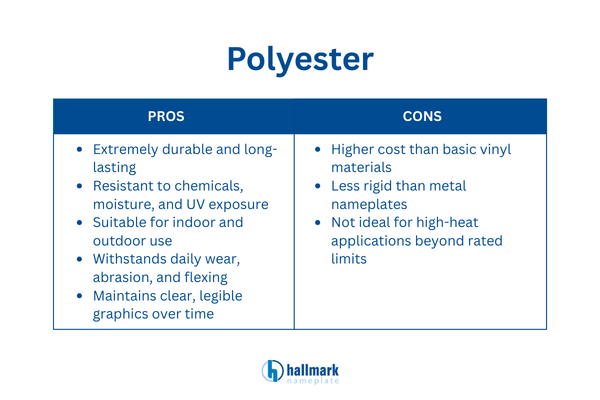
Polyester Offers Exceptional Durability

Polyester is widely used for industrial nameplates because it delivers unmatched durability, stability, and performance in harsh conditions. Manufacturers rely on polyester when long-term reliability, legibility, and resistance to environmental stressors are critical.

Superior Chemical Resistance

In manufacturing, medical, automotive, and laboratory environments, exposure to chemicals is unavoidable. Oils, solvents, cleaning agents, fuels, and industrial chemicals can quickly degrade inferior materials.

Polyester is inherently resistant to chemical attack, meaning it is highly resistant and does not easily stain, swell, crack, or corrode when exposed. This resistance helps preserve printed graphics, safety instructions, and regulatory information, even after repeated cleanings or accidental spills.

Engineered for Indoor and Outdoor Environments

Polyester performs consistently across a wide range of environmental conditions. It maintains dimensional stability in extreme heat or cold and resists moisture absorption in high-humidity or wet environments.

Outdoors, polyester withstands UV exposure, rain, and temperature fluctuations without fading, peeling, or becoming brittle when properly specified or printed. This makes it an ideal solution for equipment labels, control panels, and nameplates that must function reliably both inside facilities and in exposed outdoor settings.

Designed to Withstand Daily Use and Abuse

Polyester nameplates are built for constant interaction. They resist abrasion from frequent handling, vibration from machinery, and flexing in applications that require repeated actuation or movement.

Unlike rigid materials that may crack or break, polyester maintains flexibility without sacrificing strength. This makes it especially well-suited for high-touch interfaces, membrane switches, and equipment that operates in physically demanding environments.

Long-Lasting Graphics and Legibility

Beyond structural durability, polyester excels at protecting printed graphics. When combined with subsurface printing, graphics are sealed beneath the outer surface of the material, preventing wear, scratching, or fading.

This ensures critical information, such as operating instructions, serial numbers, or warning labels, remains clear and readable for the life of the product.

Low Maintenance, High Return on Investment

Polyester’s longevity reduces the need for frequent replacements, lowering maintenance costs and minimizing equipment downtime. Once installed, polyester nameplates require little to no upkeep while continuing to perform as intended.

Over time, this durability translates into cost savings, improved compliance, and a more professional, consistent appearance across your equipment.

A Reliable Choice for Demanding Applications

From factory floors and medical devices to outdoor equipment and transportation systems, polyester delivers dependable performance where durability matters most. Its combination of chemical resistance, environmental stability, flexibility, and long service life makes polyester nameplates a trusted, long-term solution for manufacturers across industries.

plastic substrate nameplate

Polyester Nameplate Options

One of the benefits of polyester is that you can use it on most types of nameplates, regardless of the design. This gives you lots of options when trying to decide what type of nameplate you want.

Polyester will protect the surface of your nameplates without sacrificing creativity and quality design. With polyester, you have the ability to have your nameplate made just the way you want it.

Multiple Thickness Options

Polyester nameplates come in thicknesses ranging from .003″ to .010″, allowing you to choose the perfect balance of durability and flexibility. Thinner options work well for curved or flexible surfaces, while thicker options provide added strength for high-impact or industrial environments.

Customizable Finishes

Polyester supports a variety of surface finishes, including high-gloss, satin, and matte, giving you control over visibility, glare reduction, and overall appearance. These finishes protect graphics while enhancing the look and feel of your nameplate.

Custom Order Your Polyester (Mylar) Nameplates Today!

Hallmark Nameplate offers custom-designed Polyester nameplates for any application. We can review the details of your nameplates and then produce them to your exact specifications. We handle all orders, both large and small, and can ensure on-time delivery and a product of the highest quality in the industry.

Contact us today and let us help you with your next project. Call us at 800-874-9063.

What Is The Best Surface To Mount A Nameplate On?

If you find yourself in need of a nameplate, there are many different surfaces it could be mounted on. Of course, the available options will differ depending on your own situation.

However, if you have a choice of multiple materials that you could mount it on, you should look at the pros and cons of each surface before deciding where to put the nameplate.

To learn more about choosing the right nameplate surface, read on.

surfaces for mounting nameplates

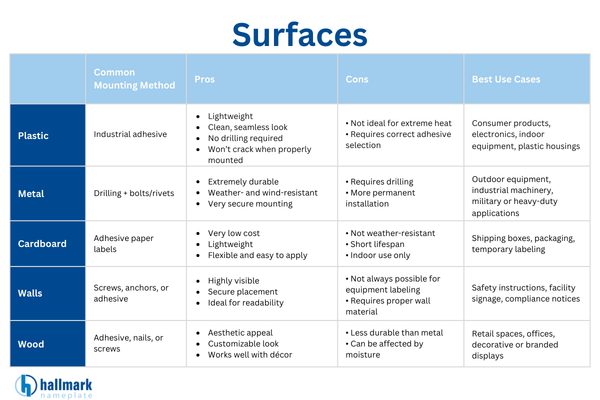
Plastic

Plastic is one of the most popular surfaces for mounting a custom nameplate. Plastic needs to be treated differently from metal for the purposes of mounting a nameplate.

Metal nameplates are usually drilled through and fastened to the metal surface with bolts. However, plastic may crack if it is fastened like this. We usually use adhesive to apply our plastic nameplates to the surface.

We have several different kinds of adhesive. We can recommend the best kind of adhesive for your plastic surface if you give us the required information about the nameplate and the surface.

Metal

Metal nameplates are usually fastened to metal surfaces. They are drilled through and then fastened down with bolts.

This makes them very secure. If you have an application for the nameplate, it will have to stand up to a great deal of inclement weather, especially wind. Metal may be the best surface to mount the nameplate on. It is the toughest and most durable surface available.

Cardboard

We also make paper labels that fall under the category of nameplates. These paper labels are usually used for cardboard boxes. The advantage of using cardboard is that it is a very cheap material.

It is also very flexible, and it is quite versatile. Of course, cardboard will not stand up to the elements. It is a good surface for a paper label nameplate as long as it is going to be kept indoors.

Walls

Walls are another very popular surface that our nameplates are often fastened to. Walls are very secure, and the nameplate can be mounted at eye-height for readability. Mounting the nameplate on a wall is the right choice for a variety of different applications.

However, this is not always possible. Sometimes the nameplate needs to be mounted directly on the device. However, if you have a nameplate that must be mounted so that people in the area can read safety instructions, the wall might be the best bet for you.

Wood

Some of our nameplates are mounted on wooden surfaces, although this is not very common. Wood is a good choice if you are going for a specific look. Many businesses that have nameplates mounted in visible areas like to have them mounted on stained or polished wood.

When you’re mounting the nameplate on wood, you can either glue it or mount it by drilling holes in the wood and attaching it with nails. Wood may not be the most practical choice, but it is a great choice for aesthetic purposes.

Figuring Out the Best Surface for Your Application

As you can see, there are many different surfaces for you to choose from when figuring out what to do with your nameplate. Each surface has its own pros and cons.

Nameplates are very important for the safety and education of your clients and employees, so you should take time to make sure you’re picking the best surface. It can be a difficult decision. If you’re not sure which surface to pick, you can contact us, and we will help you out.

At Hallmark Nameplate, we know a lot about nameplates and the best surfaces to mount them on. If you need an informed recommendation, you can give the details of the situation to one of our professionals, and they will provide you with a suggestion.