


Graphic Overlays Explained: Design, Benefits, and Manufacturing Process
Get a FREE Product Sample Box!
Order a product sample box to feel the quality of our work before deciding to make a batch order.
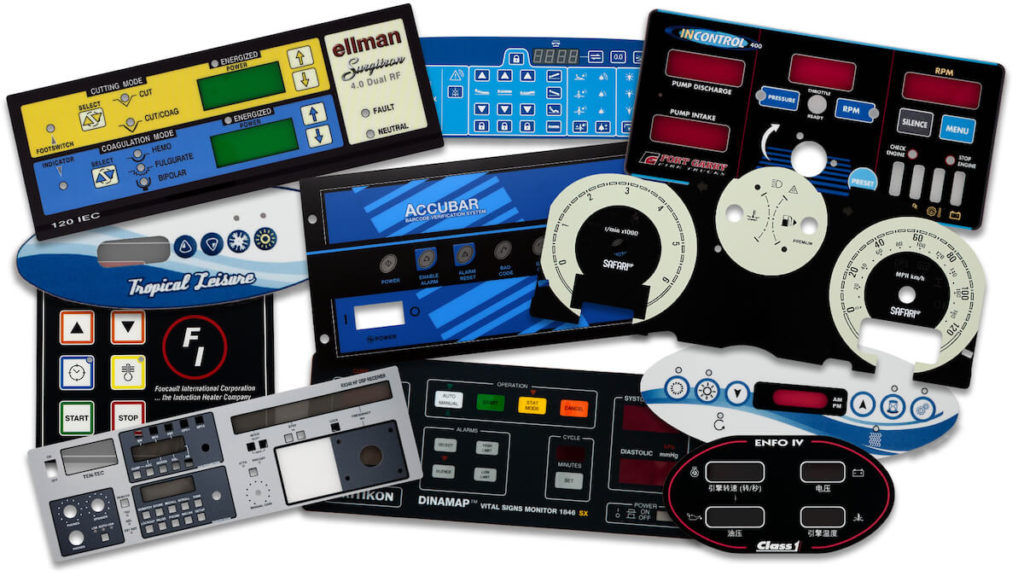
Graphic overlays, sometimes called nameplates, are thin layers of plastic or polymer material with printed symbols or graphics placed on top of an electronic device to identify the branding and functionality of the machine.
They play a vital role in making a powerful first impression for your company, as they are the first component of the equipment a user interacts with. Since they are the interface of the machine’s abilities, it’s critical that they are clear, durable, and can properly communicate with the machine’s driver.
In this article, we will discuss what graphic overlays are, customization options, and applications.
What Are Graphic Overlays?
All electrical products include some form of interface. These include dials, buttons, and joysticks. However, without any text or graphics placed on the machine, the user would find it very difficult to use.
Graphic overlays are film sheets that display custom text and designs that are usually placed on the exterior layer of a product. They add a level of professionalism while also incorporating another layer of protection.
They provide important messages to the machine’s user, such as instructions, warnings, and brand messages, quickly and efficiently.
Types of Overlays
Graphic overlays come in a variety of types, each designed to meet specific functional and operational needs. Understanding the differences can help you choose the right overlay for your equipment and environment.
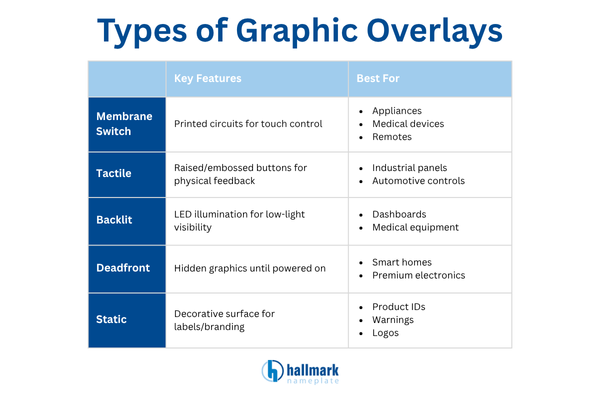
1. Membrane Switch Overlays
Membrane switch overlays are thin, lightweight overlays that integrate printed circuits, allowing operators to control electronic devices through touch. They are widely used in appliances, medical equipment, and remote controls due to their simplicity and reliability.
2. Tactile Overlays
Tactile overlays are a specialized form of membrane switch that features raised or embossed buttons. This physical feedback improves the user experience, making it easier to operate machinery or devices without looking directly at the panel. They are commonly found in industrial equipment and automotive controls.
3. Backlit Overlays
Backlit overlays incorporate built-in lighting, often through LEDs, to enhance visibility in low-light conditions. These overlays are ideal for dashboards, medical devices, and other environments where clear operation is essential at night or in dimly lit areas.
4. Deadfront Overlays
Deadfront overlays provide a sleek, modern look by hiding graphics until the device is powered on or a button is activated. This style is particularly popular in smart home devices and premium electronics, offering both elegance and functionality.
5. Static Overlays
Static overlays are purely decorative, with no electronic functions. They are used for branding, labeling, product identification, or safety warnings, providing clear, professional visuals on any equipment surface.
By selecting the right type of graphic overlay, you can optimize usability, aesthetics, and safety while ensuring your equipment meets operational needs. Now that you understand the different types of overlays, let’s explore the key benefits of a well-designed graphic overlay.
Benefits of Graphic Overlays
Graphic overlays are the key to connecting a machine to its operator. They provide businesses with several benefits that ensure the proper performance of their machinery.

1. Boost User Interface
A well-designed graphic overlay improves usability and makes machine operation intuitive. It guides employees step by step, providing clear instructions, labels, or feedback that reduces errors and training time.
Overlay designers focus on ergonomics and visual clarity, ensuring that each interaction is simple, efficient, and pleasant. When operators can easily understand and navigate the machine controls, overall productivity and safety increase.
2. Clear Branding
Graphic overlays are an opportunity to reinforce your brand identity at every touchpoint. Branding information used on your custom graphic overlay can be as simple as your company name and logo, strictly for branding purposes, or as complex as instructions and warnings.
You can add company contact information, UID or QR code, barcodes, product IDs, or serial numbers. Your company can also require a combination of these or unique details specific to your brand.
3. Equipment Durability
Machines operate in a wide range of environments, indoors, outdoors, or even in sterile or harsh industrial conditions. A durable graphic overlay ensures your equipment can withstand frequent use, chemical exposure, and abrasions without losing functionality or aesthetics.
Features like abrasion resistance, chemical resistance, and UV protection help maintain the overlay’s appearance and performance, ultimately extending the life of the equipment it protects.
4. Enhance Compliance
Graphic overlays can help businesses meet industry regulations and safety standards. By incorporating necessary warnings, labels, or operational instructions, overlays ensure that machinery usage aligns with compliance requirements.
This is especially critical in industries like medical devices, food processing, and manufacturing, where failure to comply can result in legal issues, safety hazards, or operational inefficiencies.
5. Improved Safety
Graphic overlays contribute significantly to operator safety. Colorful overlays improve visibility, which can be critical in emergencies, helping operators quickly locate switches or buttons.
They also clearly display instructions, warnings, and safety labels, making it easier for users to follow proper procedures and avoid accidents. By combining visibility with clear messaging, overlays play a key role in creating a safer working environment.
5 Common Mistakes When Designing a Graphic Overlay
Creating an effective graphic overlay requires more than just aesthetic appeal; it’s about functionality, user experience, and durability. Whether you’re designing for industrial machinery or medical devices, overlooking key design principles can result in overlays that wear quickly, confuse users, or fail in critical conditions.
Here are five common mistakes to avoid.
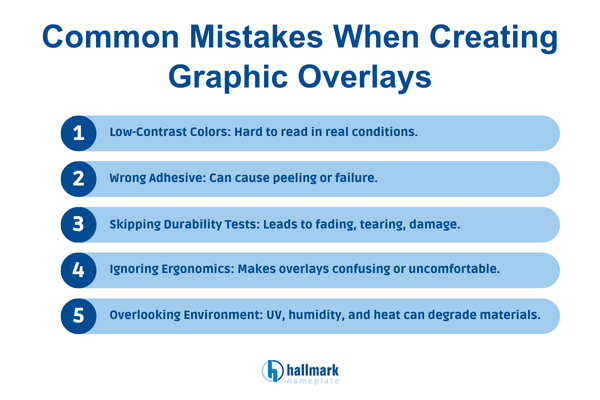
1. Using Low-Contrast Colors
Colors that look great on screen may not perform well in real-world settings. Low contrast between text and background can make labels hard to read, especially in low-light environments or for users with visual impairments.
Always test your design under different lighting conditions to ensure legibility.
2. Choosing The Wrong Adhesive
Adhesive choice is critical to ensuring the overlay bonds properly to the surface. When exposed to heat, chemicals, or moisture, using a generic adhesive could result in:
- Bubbling
- Peeling
- Equipment failure
Make sure the adhesive is tailored to your surface material and operating conditions
3. Not Testing Durability
Graphic overlays are often exposed to wear and tear, harsh cleaning agents, and repeated usage. Skipping durability testing can lead to:
- Premature fading
- Tearing
- Damage
Always test prototypes under realistic conditions to validate material selection and ink adhesion.
4. Ignoring Ergonomic Feedback
The user experience matters. Ignoring ergonomic input during the design phase can result in overlays that are uncomfortable or confusing to interact with.
Buttons should be spaced appropriately, tactile feedback should be considered, and the overall layout should support ease of use.
5. Overlooking Lighting/Environment Factors
Some things that can impact overlay performance are:
- Ambient lighting
- UV exposure
- Humidity
- Temperature extremes
Using materials that degrade in sunlight or fail in humid environments can cause long-term issues. Consider all environmental factors during material selection and design to ensure longevity and performance.
Industries That Need Custom Graphic Overlays
You can find graphic overlays in different environments throughout all industries. Your facility and equipment may require materials that comply with specifications, certifications, or inspection procedures.
The right manufacturer will walk you through the steps and specific processes pertaining to your industry standards. Here’s a closer look at where and how graphic overlays are used in different industries.

Aerospace
Used in cockpit panels, control systems, and test equipment, graphic overlays in aerospace must meet strict durability and compliance standards, often with resistance to temperature extremes, UV exposure, and vibration.
Construction
Heavy-duty machinery like cranes, lifts, and earth-moving equipment relies on overlays to display operational instructions, safety warnings, and branding, often in rugged, outdoor conditions.
Fitness
In fitness equipment such as treadmills, bikes, and strength machines, overlays enhance user interaction through clear control interfaces, branding elements, and waterproof materials.
Manufacturing & Industrial
Production lines, CNC machines, and industrial controls require overlays that can withstand high temperatures, chemicals, and frequent use, while ensuring proper labeling of functions and safety protocols.
Medical & Dental
Equipment in the medical and dental fields requires overlays that are not only easy to clean and disinfect, but also meet FDA and ISO requirements. These overlays are often designed for precise touch control and clear readability.
Research Laboratories
Lab equipment overlays are designed for chemical resistance, cleanroom compliance, and precision interaction and are used on analyzers, incubators, and testing machinery.
Transportation
Vehicles and transit systems, from buses to trains to specialty service vehicles, use graphic overlays in dashboards, control panels, and infotainment systems. These overlays must perform in varying light and temperature conditions.
Agriculture
Overlays on tractors, irrigation controls, and harvesting machines must resist dust, UV rays, and moisture while remaining legible and functional in outdoor environments.
Consumer Products
From home appliances to smart gadgets, overlays provide intuitive controls and product branding that elevate user experience and reinforce brand identity.
Food Service
In restaurants, cafeterias, and vending systems, overlays need to be easy to clean, resist moisture, and withstand frequent use, while clearly displaying controls and instructions.
Marine
Used in boats, ships, and marine instrumentation, overlays must be waterproof, salt-resistant, and readable under sunlight and glare.
Military
Overlays for military applications must meet rigorous specs, often including MIL-STD compliance, and function in extreme environments, from battlefield conditions to naval applications.
Retail
Point-of-sale systems, kiosks, and digital displays rely on overlays for branding, user interface controls, and durability against constant use in busy environments.
Conditions To Consider When Customizing Your Graphic Overlay
Before the development of your overlay, you’ll discuss the environment that it will live in, the chemicals and materials it will be exposed to, the lighting exposure, and the usage frequency. But you may be wondering why knowing the intricate details is so important to the development of your overlay.
Environment
When developing your custom graphic overlay, consider where it will live. Those used outdoors will require different materials than those indoors.
Your graphic overlay might need materials that will protect it from conditions such as extreme heat or wind, and harsh weather conditions. Outdoor use will require a material that can withstand the elements.
Chemicals
Something else to consider is whether or not your overlay will be exposed to cleaning products or industrial chemicals. If so, you’ll want to make sure that your overlay is completely resistant so that the materials do not decompose upon contact.
To make sure your product is protected, a hard coat will be applied to the design.
Lighting
We’re not only talking about the lights in your facility; your graphic overlay might also be exposed to UV rays. UV rays can easily damage the color of the graphic design and even yellow the protective coating if an incorrect finish is used.
It’s important to ensure that your custom graphic overlay stays as clear as it is when it leaves the facility.
Usage Frequency
In short, consider how frequently the graphic overlay will be used. Depending on how often an operator uses the machine, they could have constant contact with the overlay.
If it is a functional overlay (rather than purely decorative/branding), you want to make sure it won’t show signs of wear after a certain amount of usage.
Customizations & Options: Steps to Creating Your Graphic Overlay
Now that you’ve read about “what are graphic overlays” and their different applications, how can you customize your own? Here are some of the key elements of manufacturing your graphic overlay.
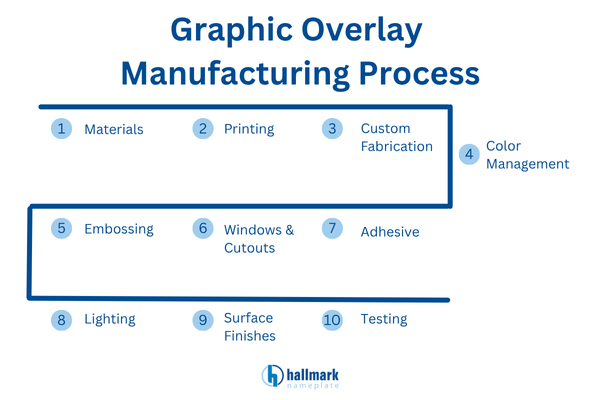
Materials
Most high-resolution graphics are actually printed on the second surface, which is the backside of polyesters, polycarbonates, and acrylic, to protect the ink from the everyday conditions of your facility.
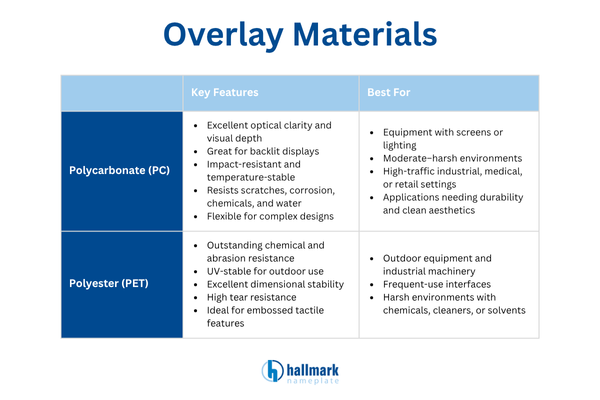
Polycarbonates
Polycarbonate is a versatile material that combines optical clarity with strong impact resistance. It’s ideal for both indoor and outdoor use, offering design flexibility and visual depth.
Key Features:
- Excellent optical clarity and depth effect
- Good for backlit applications and displays
- Impact-resistant and temperature-stable
- Resists scratches, corrosion, chemicals, and water
- Perfect for high-traffic industrial, medical, or retail settings
- Offers flexible design capabilities
Best For:
- Equipment with displays or lighting
- Moderate to harsh environments with physical impact
- Applications requiring clean visuals and functional durability
- Suitable for extreme temperatures
Polyester
Polyester (PET) is highly durable and resistant to wear, chemicals, and UV exposure, making it the top choice for long-term use in harsh industrial or outdoor environments.
Key Features:
- Outstanding chemical and abrasion resistance
- Maintains clarity and structure under UV exposure
- Excellent dimensional stability
- High tear resistance
- Suitable for tactile features like embossed buttons
Best For:
- Commercial and industrial applications, like outdoor machinery or heavy-duty industrial controls
- High-wear surfaces and frequent operator use
- Environments involving chemical cleaners or solvents

Printing Effects
The method used to print your graphic overlay significantly impacts its appearance, durability, and cost.
There are two printing methods to choose from: digital printing and screen printing. Each has its own strengths depending on your application, design complexity, and production volume.
Digital Printing
Digital printing is ideal for high-resolution, full-color designs that include fine gradients, photo-quality images, or variable data. Because it prints directly from a digital file, this method offers:
- Fast turnaround times with minimal setup
- Lower upfront costs, especially for short runs or prototyping
- Unlimited color options without needing separate screens for each color
- Excellent detail and gradients, and precision for intricate, modern designs
Digital printing is the preferred choice for brands that want to test new concepts, produce limited editions, or showcase vibrant, detailed visuals without the complexity of a traditional setup. It’s also ideal for overlays with frequent updates or changing information, such as QR codes or barcodes.
Screen Printing
Screen printing is the gold standard for durability and consistency in high-volume production. It involves applying ink through a fine mesh screen onto the substrate, one color at a time.
This method offers:
- Exceptional color opacity and brightness
- Superior wear resistance for demanding environments
- Ability to print very fine details, with features as small as 0.005 inches
- Options for special effects, such as selective texturing, metallic inks, and tactile finishes
Screen printing is best suited for long production runs, overlays requiring color matching, or designs exposed to heavy use and harsh conditions. It also allows for precise control over ink thickness, which enhances durability and readability over time.
Custom Fabrication
No two overlays are exactly alike, and that’s why we offer custom fabrication services tailored to your specific requirements. Whether your design calls for intricate cutouts, complex shapes, or varying thicknesses, our advanced equipment ensures the highest level of precision and consistency.
Capabilities include:
- Laser and fiber optic cutting for clean, accurate edges
- Tight tolerances for overlays that fit perfectly over displays, buttons, or hardware
- Multi-layer constructions for added durability or multi-function overlays
- Custom thickness options to match your specific use case or ergonomics
- Integration with tactile elements like membrane switches, LEDs, or circuit boards
From prototypes to full production runs, custom fabrication ensures that your overlay performs flawlessly in both function and fit.
Color Management
Color plays a vital role in brand recognition and user experience, so accuracy matters.
Our color management process includes:
- Pantone® (PMS) color matching to ensure visual consistency across all overlays
- Custom color formulations for proprietary or non-standard hues
- Color proofs and samples for your review before production begins
- Advanced digital and screen printing technology to reproduce rich, vibrant colors and gradients with sharp clarity
- Ongoing calibration to ensure consistency across batches and print runs
Whether you’re producing a one-time run or placing recurring orders, our color management process ensures every overlay looks exactly the way you intended, across every product, every time.
Embossing
Designing raised elements, also known as embossing, into your graphic overlays is a great way to make important features more visually prominent.
You will most commonly see dome and embossing for buttons or LEDs, but rim embossing and braille are also common. The type of embossing that is right for your application will depend on how your device will be used and also your personal preferences.
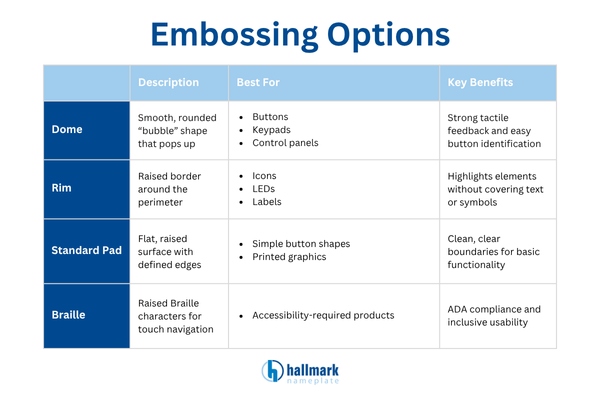
Dome
Creates a smooth, rounded, bubble-like shape, ideal for buttons that require tactile feedback. Dome embossing makes pressing intuitive, especially in control panels or switch-heavy environments.
Rim
Raises only the perimeter of the graphic, leaving the center flat. This style is perfect for drawing attention to icons or maintaining visibility of text or LEDs while adding a tactile edge.
Standard Pad Emboss
A flat-topped raised surface is typically used for simple button shapes. It provides clear boundaries and is often paired with screen or digital printing for added visual definition.
Braille Embossing
Offers ADA-compliant tactile navigation by adding raised Braille characters. This is essential for products that need to meet accessibility requirements or serve visually impaired users.
Windows & Cutouts
Windows and cutouts are a kind of selective texturing that creates a defined viewing area or display window. You can choose from:
- Glossy
- Semi-gloss
- Antiglare
- Dead-front
- Translucent
- Frosted
You can even customize the color and tint.
Adhesive
A critical component, the adhesive ensures the overlay bonds securely to your device or surface. We use 3M-certified adhesives or your preferred brand to ensure performance in any environment.
Options Include:
- Permanent or removable adhesives
- High-tack for rough or low-energy surfaces
- Heat, UV, and chemical-resistant types
- Selective placement or full-coverage options
Lighting
Determine whether your graphic overlay requires backlighting or external illumination to ensure maximum visibility in dim, high-glare, or mission-critical environments.
There are multiple integrated lighting technologies available, each designed to support different functional and aesthetic needs.
LED Backlighting
LEDs provide bright, energy-efficient illumination with a long lifespan and minimal heat output. They are ideal for overlays that require:
- High brightness and color options
- Low power consumption
- Long-term durability in demanding environments
LED lighting works exceptionally well in applications such as industrial control panels, medical devices, and consumer electronics, where reliability and clarity are essential.
EL (Electroluminescent) Panels
Electroluminescent backlighting delivers thin, uniform brightness across large surface areas. EL panels are known for:
- Even, shadow-free illumination
- Ultra-thin profile, keeping your overlay sleek and flexible
- Low power draw for battery-operated devices
EL lighting is commonly used for keypads, handheld instruments, and applications where a slim design and soft glow are preferred.
Fiber Optic Backlighting
Fiber optic systems provide focused, selective illumination for specific zones or symbols within the overlay. Their advantages include:
- Precise light distribution for indicators, icons, and logos
- Low heat, excellent durability, and EMI/RFI immunity
- Compatibility with complex control layouts
This option is ideal for overlays with multiple status indicators, multi-button dashboards, or equipment requiring detailed visual guidance.
Surface Finishes
Polycarbonate and Polyester are the most popular materials. However, you can also supply the material you prefer.
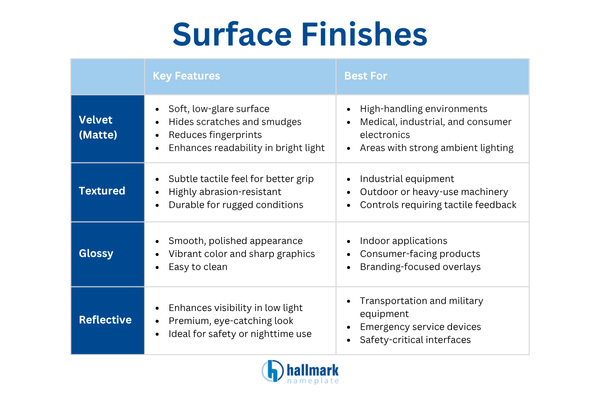
Velvet
A velvet finish offers a soft, matte appearance that reduces glare and fingerprints, making it ideal for environments with high ambient lighting or frequent handling.
- Provides a clean, professional look
- Enhances readability under direct light
- Hides scratches and smudges
- Ideal for medical, industrial, and consumer electronics
Textured
A textured finish adds a subtle tactile feel that not only improves grip but also increases resistance to wear and abrasion.
- Improves tactile feedback for controls
- Durable and rugged for demanding environments
- Commonly used in industrial machinery and outdoor equipment
Glossy
A glossy finish offers a smooth, polished surface that enhances the vibrancy and sharpness of printed graphics. It’s perfect for branding-focused overlays where visual appeal is key.
- High clarity and vibrant color presentation
- Easier to clean and wipe down
- Ideal for indoor applications and consumer-facing products
Reflective
Reflective finishes can make elements of your design, such as logos, icons, or safety indicators, stand out in low-light or dark environments. These are often used for overlays that require visibility in safety-critical or nighttime settings.
- Enhances visibility under poor lighting
- Adds a premium look to your product
- Useful for transportation, military, and emergency service equipment
Testing
Before any graphic overlay leaves the facility, it should undergo rigorous quality control testing to verify:
- Adhesion strength
- Resistance to environmental stress (heat, moisture, UV, chemicals)
- Print integrity
- Emboss performance
- Dimensional accuracy
This ensures your overlay performs reliably and meets all required specifications and industry standards, every single time.
How to Choose A Graphic Overlay Manufacturer
Selecting the right graphic overlay manufacturer is critical to ensuring your equipment is user-friendly, durable, and compliant. With so many options available, focusing on key factors can help you make the best choice.
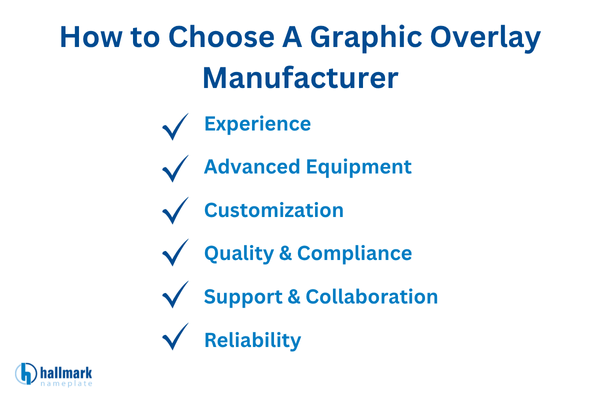
1. Experience and Expertise
Look for a manufacturer with a proven track record in producing high-quality graphic overlays. Experienced manufacturers understand the nuances of materials, adhesives, and printing techniques and can provide guidance on the best solutions for your specific application.
Industry knowledge, whether it’s medical, industrial, or consumer electronics, can make a big difference in the quality and longevity of your overlays.
2. State-of-the-Art Equipment
Your manufacturer should invest in advanced equipment and technology to ensure precision, consistency, and high-quality results.
Modern printing presses, laser etching, embossing tools, and finishing equipment allow for complex designs, sharp graphics, and durable overlays that can withstand harsh environments. A manufacturer with cutting-edge capabilities is better equipped to meet your custom requirements.
3. Customization Capabilities
Every machine and operation is unique. A top manufacturer should offer flexible customization options, including different materials, finishes, textures, backlighting, and protective coatings.
This ensures that the overlay fits your design, operational, and branding needs while maintaining optimal usability.
4. Quality Assurance and Compliance
Choose a manufacturer committed to rigorous quality control. Check for certifications and other industry-standard compliance practices such as:
- UL 969 – Standard for marking and labeling systems used on electrical equipment
- MIL-STD-130 – U.S. Department of Defense standard for identification marking
- ISO 9001 – International standard for quality management systems
- RoHS / REACH – Regulations ensuring materials meet environmental and human health safety requirements
- NSF / FDA – Standards for products used in food-related or sanitary applications
- ITAR – U.S. export-control regulation that governs defense-related articles, services, and technical data
Quality assurance and rigorous testing ensure your overlays meet durability, safety, and regulatory requirements, reducing the risk of failure or non-compliance.
5. Technical Support and Collaboration
The best manufacturers work as partners, not just suppliers. They should provide design consultation, prototype development, and ongoing technical support.
This collaboration ensures that your graphic overlay integrates seamlessly with your equipment and delivers the user experience you expect.
6. Turnaround Time and Reliability
Finally, consider the manufacturer’s production speed and reliability. Timely delivery is crucial for keeping projects on schedule, and consistent quality ensures that every overlay meets your expectations without costly delays or rework.
Why Choose Hallmark Nameplate for Your Graphic Overlays
As a leading graphic overlay manufacturer, Hallmark Nameplate combines decades of experience with cutting-edge technology, meticulous craftsmanship, and a deep understanding of industry-specific requirements.
Whether you need overlays that withstand harsh environments, feature tactile feedback for enhanced usability, or align seamlessly with your brand, our team is here to help you bring your vision to life.
We don’t just manufacture overlays; we create solutions that enhance product performance, user experience, and brand recognition. If you’re ready to design a durable, reliable, and visually impactful overlay that meets the specific demands of your product, you’re in the right place.
Get started today by requesting your FREE, no-obligation quote. Our expert team will guide you through the entire process, from concept to final delivery, to create a custom solution tailored to your business.
Frequently Asked Questions About Graphic Overlays
What materials are graphic overlays made from?
The two dominant face stocks are polyester and polycarbonate, both forms of engineering film often referred to by trade or material shorthand such as PET. Polyester leads on flex life and chemical resistance, which makes it the default where keys are actuated repeatedly or the panel faces aggressive cleaning. Polycarbonate leads on optical clarity, texture range and availability in flame-rated grades, but has shorter flex life. Vinyl is used for conformable applications on curved surfaces in moderate environments.
What is an antiglare or frosted overlay finish?
Antiglare and frosted finishes are surface textures applied to the overlay face to scatter reflected light. They matter on equipment used under bright plant lighting or outdoors, where a gloss finish produces reflections that obscure legends and display windows. The trade-off is a slight reduction in display clarity and a surface that can show fingerprints differently, so the finish is usually selected by viewing condition rather than aesthetics. Velvet, matte and fine-textured finishes sit between full gloss and heavy frost.
What is the difference between screen printing and digital printing for overlays?
Screen printing pushes ink through a mesh stencil, one color at a time. It lays down a thicker ink film, which gives better opacity, more consistent spot-color matching and longer durability, and it becomes more economical as volume rises. Digital printing images the full graphic in one pass with no screens to make, which suits short runs, photographic imagery, variable data such as serial numbers, and fast prototype turnaround. Many production overlays use both: screen printing for the base colors, digital for detail or variable elements.
What are the benefits of graphic overlays?
An overlay consolidates several functions into one part. It seals the panel against dust, moisture and cleaning agents, which a set of discrete labels and bezels cannot do. It presents all legends, branding and safety marking in a single consistent surface. It protects the switch or display beneath it from abrasion and chemical contact. And because the graphics are printed on the reverse of the film, the artwork is protected by the material itself and does not wear off with handling.
How do you specify a graphic overlay for a control panel?
Supply the panel outline with cutouts and display windows dimensioned, the artwork with spot colors called out, the face material and finish, the adhesive type and the surface it mounts to, the environment including temperature range and cleaning agents, and any embossing, backlighting or shielding requirements. Specifying the cleaning protocol up front prevents the most common and expensive late change, which is discovering after tooling that the chosen material will not survive the customer’s disinfectant.
What is the difference between a graphic overlay and a membrane switch?
A graphic overlay is the printed top layer only. A membrane switch is a complete switching assembly, of which the graphic overlay forms the visible face. If your panel needs to display information and protect what is underneath, you need an overlay. If it also needs to register a keypress, you need a membrane switch with an overlay as its top layer.
How much do custom graphic overlays cost?
Cost is driven by material and finish, number of print colors, size, quantity, and whether tooling such as a cutting die is required. Prototype and short runs carry proportionally more setup cost per piece than production volumes. Hallmark Nameplate applies no minimum piece quantity and a $250 minimum order value, so prototype quantities are practical. Accurate pricing requires the artwork and specification, since two overlays of the same size can differ substantially in cost.