

Specifying a graphic overlay starts with one decision that constrains every other one: polycarbonate or polyester. This guide compares the two films on flex life, chemical and UV resistance, abrasion, flame rating, embossing behavior, clarity, thickness, and cost, then gives a verdict for four common applications.
The guidance here is grounded in published film datasheets and standards documents rather than vendor preference, and it reflects how overlays are actually specified for regulated equipment. Hallmark Nameplate has manufactured graphic overlays and membrane switches from its Mount Dora, Florida facility for more than 60 years under ISO 9001:2015 and ISO 13485:2016 certification, with ITAR registration and UL Listing.
You will also see the one variable most comparison articles skip: a hard coat changes the answer, but only on the surface it covers. Start with the short version below.
Quick Answer: Polycarbonate vs. Polyester Overlays
Polyester (PET) delivers the longer flex life, broader chemical resistance, and better abrasion performance once hard-coated, which makes it the default for high-actuation keypads and washdown environments. Polycarbonate (PC) offers better optical clarity, more textures, easier printing and die-cutting, and access to UL 94 flame-rated grades for lower-cycle panels.
What Polycarbonate and Polyester Overlay Films Actually Are
A graphic overlay is the printed face film that a user sees, touches, and cleans, and the two films that dominate it are polycarbonate and polyester. Polyester is the generic name for a family of polymers, and the grade used in overlays is almost always polyethylene terephthalate (PET); polycarbonate is frequently specified by trade name, which is why engineers often frame the question as Lexan vs. polyester.
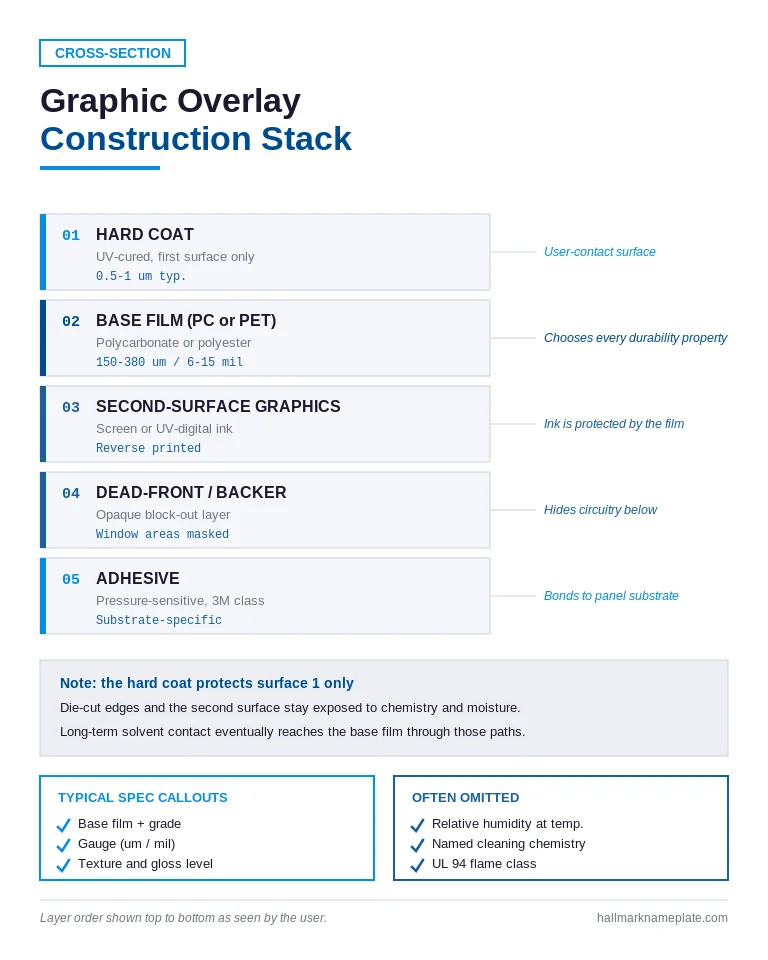
Both films are printed on the second surface, meaning the ink sits on the underside of a transparent or translucent film. The film itself then becomes the wear layer, which is why the base polymer and its coating drive nearly every durability property.
A finished overlay is a stack, not a single sheet. Typical construction runs hard coat, base film, second-surface graphics, an opaque backer or dead-front layer, and a pressure-sensitive adhesive, and the components of a membrane switch sit below that when the overlay is part of a switch assembly.
The distinction matters because a specification that names only the polymer is incomplete. Texture, gauge, hard coat, and print stack are separate line items, and each one moves the performance envelope. The next section puts the two base films side by side.
Polycarbonate vs. Polyester Overlay: A Side-by-Side Property Comparison
Polyester leads on flex life, chemical resistance, abrasion resistance once hard-coated, and tear strength, while polycarbonate leads on optical clarity, texture and finish selection, embossing detail, flame-rated grade availability, and ease of processing. Cost usually follows processing difficulty, which favors polycarbonate on straightforward parts.
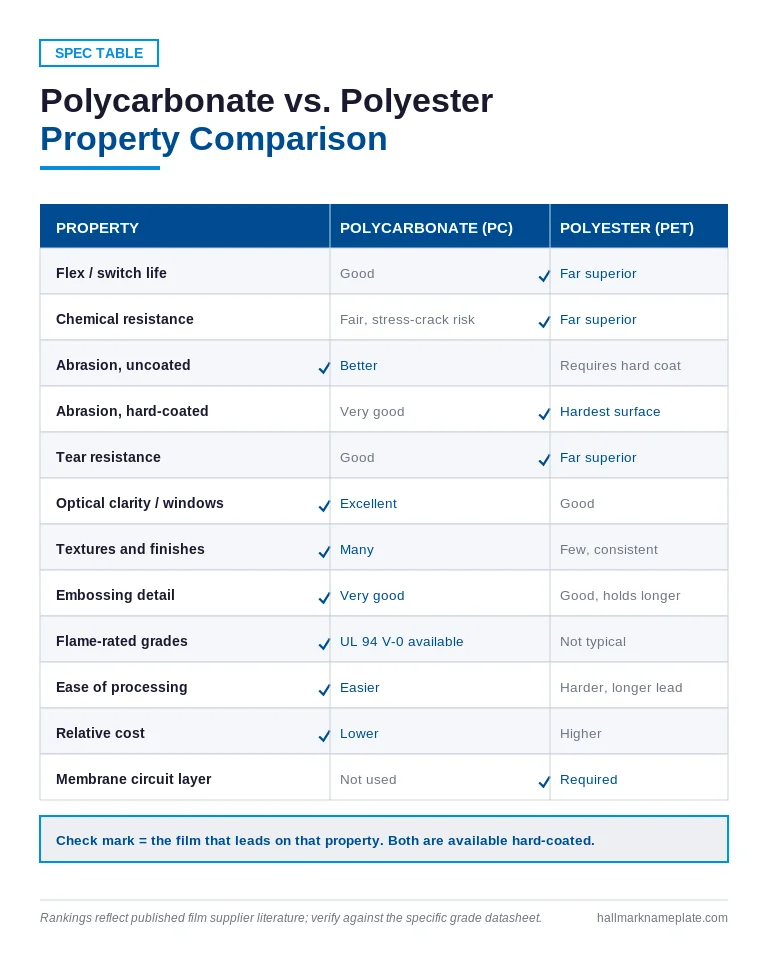
These rankings hold across published supplier literature, with one recurring point of confusion. Several widely cited graphic overlay comparisons claim polycarbonate has superior chemical resistance, which conflicts with film datasheets and with polycarbonate’s documented susceptibility to environmental stress cracking.
The practical reading is that polycarbonate resists brief contact with many substances and holds up well against impact and heat. Polyester resists a broader chemical range over repeated exposure, which is the condition that actually governs an equipment panel wiped down every shift.
Trade names add more noise than signal. Polyester appears as Mylar, Melinex, Autotex, and Autoflex; polycarbonate appears as Lexan, Makrolon, and Makrofol, and the specific grade within each family varies far more than the family name suggests.
Flex Life, Chemical Resistance, and Abrasion: Where the Films Diverge
Flex life is the property with the widest gap between the two materials, and polyester wins it decisively. MacDermid’s Autotex hard-coated polyester product data sheet lists switch life above 5 million actuations under the supplier’s own test method, and polycarbonate is generally specified for panels with materially lower cycle counts.
Flex life describes how many times a key can deform before the film cracks or takes a permanent set. Once it fails, the key either stops actuating or stops returning, so the number belongs in the requirement set for any keypad rather than in a nice-to-have column.
Chemical resistance separates the films for a different reason. Polycarbonate is prone to environmental stress cracking when loaded film contacts alcohols, ketones, or alkaline cleaners, and the failure shows up as crazing, haze, and embrittlement rather than immediate visible damage.
Polyester resists a wider range of household and industrial chemistries, and it is the reason chemical-resistant overlays default to PET in food service, laboratory, and clinical equipment. Where a panel sees isopropyl alcohol or quaternary disinfectants on a schedule, the base film choice is effectively made.
Abrasion resistance is the one property that inverts depending on coating. Uncoated polycarbonate outperforms uncoated polyester because its textured grades carry inherent scuff resistance, but a hard-coated polyester surface is significantly harder to scratch than either uncoated film.
Abrasion is measured with a Taber abraser under ASTM D1044, reported as the change in haze after a set number of cycles. Asking a supplier for delta-haze values rather than adjectives is the fastest way to compare two abrasion-resistant overlay candidates.
How a Hard Coated Polyester Overlay Changes the Comparison
A hard coat is a chemically bonded, UV-cured layer applied to the first surface of the film, and it raises abrasion and solvent resistance without changing the base polymer underneath. Both films are available hard-coated, which means a coated-versus-uncoated comparison is not a polycarbonate-versus-polyester comparison at all.
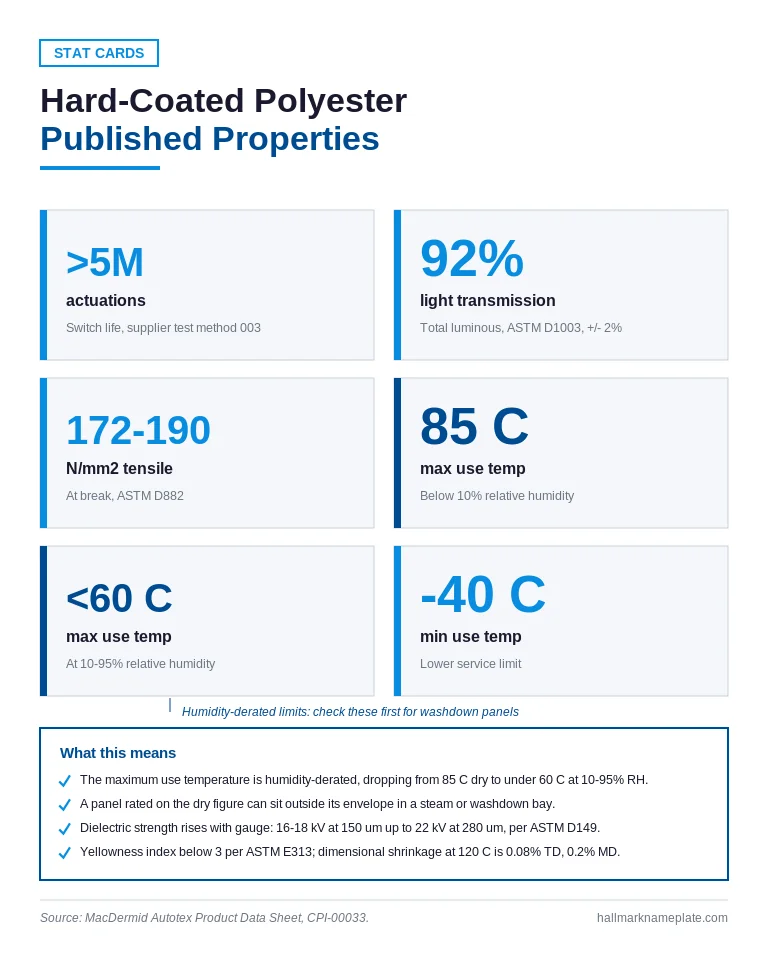
The published properties of a hard-coated polyester overlay film give an engineer something concrete to specify against. The Autotex data sheet reports total luminous transmission of 92 percent plus or minus 2 percent per ASTM D1003, tensile strength at break of 172 to 190 N/mm² per ASTM D882, and a yellowness index below 3 per ASTM E313.
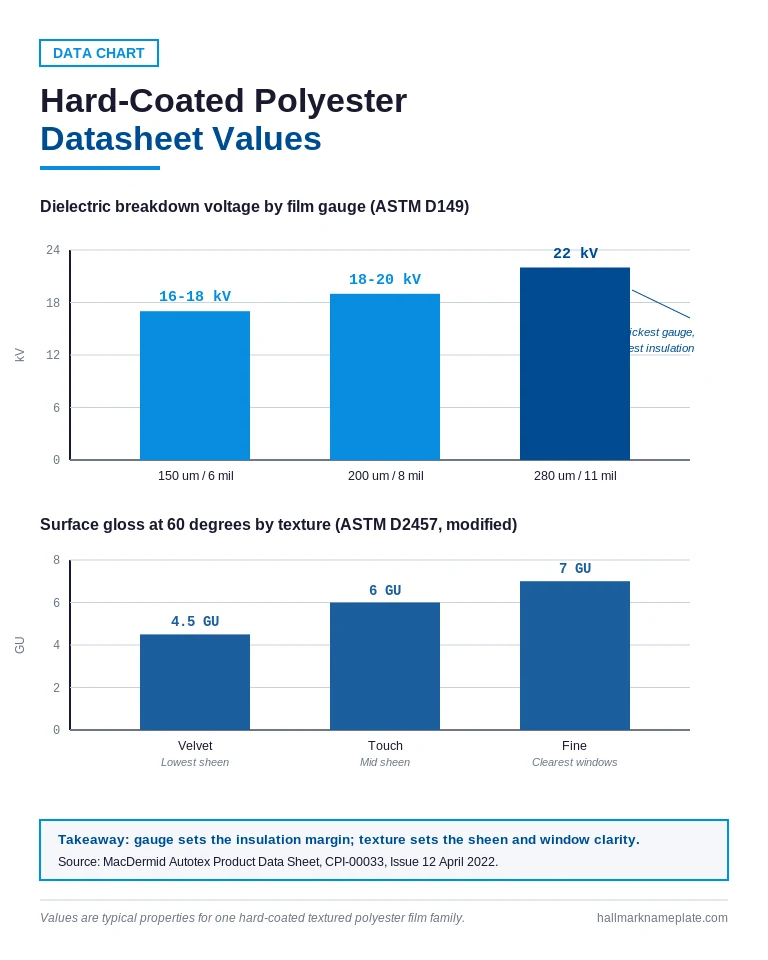
Two datasheet values deserve more attention than they usually get. Dielectric breakdown voltage per ASTM D149 rises with gauge, from 16 to 18 kV at 150 microns to 22 kV at 280 microns, which matters when the overlay doubles as an insulating barrier over live circuitry.
The second is temperature, and it is humidity-dependent. The same film lists a maximum use temperature of 85 °C below 10 percent relative humidity but under 60 °C between 10 and 95 percent RH, with a minimum use temperature of -40 °C.
That derating is the detail most comparison articles omit, and it changes decisions for autoclave-adjacent, steam-cleaned, and outdoor-humid installations. A panel rated on a dry-lab number can sit well outside its envelope in a real washdown bay.
Hard coats have a boundary worth stating plainly. The coating protects the first surface only, so die-cut edges and the uncoated second surface remain exposed, and long-term chemical contact eventually reaches the base film through those paths.
The Best Material for Graphic Overlays, by Application
Material selection resolves quickly once the application is described in terms of actuation count, cleaning chemistry, sunlight exposure, and optical requirements. The four scenarios below cover most industrial and medical panel work.
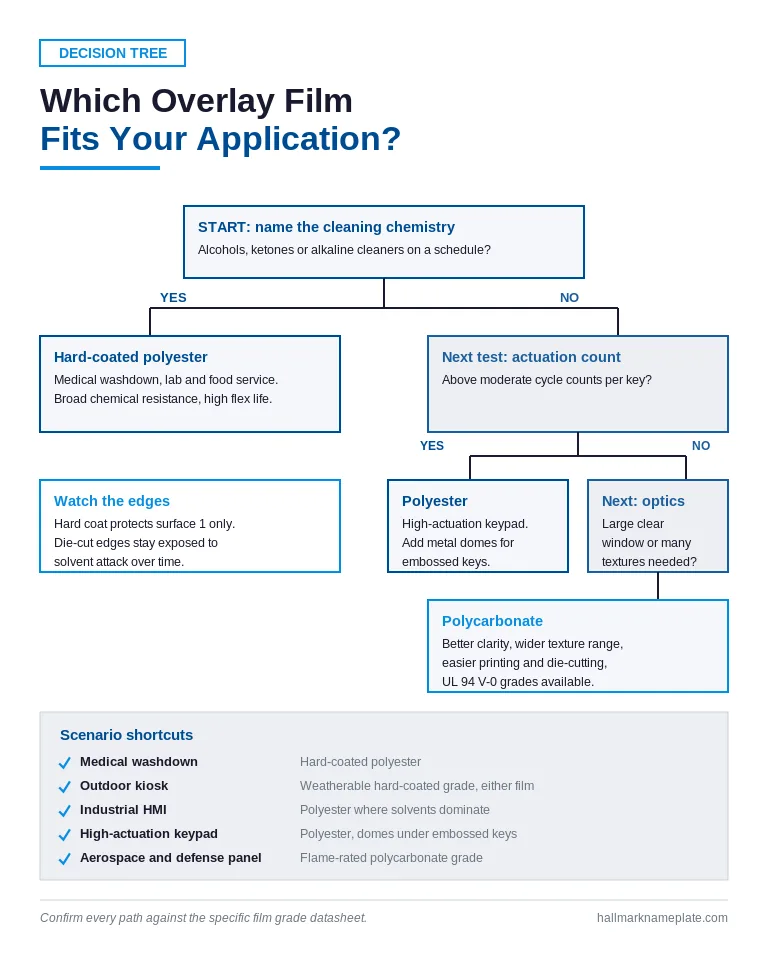
Medical washdown equipment. Hard-coated polyester is the usual specification because infection-control protocols mean repeated alcohol and quaternary disinfectant contact, and medical equipment panels combine that chemistry with high touch frequency.
Polycarbonate enters the medical conversation when a large, optically clear display window dominates the face and the cleaning protocol is mild. In that case the window requirement outweighs the chemical requirement.
Outdoor kiosks and field equipment. UV stability is a grade property rather than a polymer property, so either film can work if the grade is weatherable. Uncoated polycarbonate yellows faster under prolonged sunlight, which pushes most outdoor specifications toward a weatherable hard-coated grade of either material with a UV-blocking print stack behind it.
Industrial HMI panels. These panels see solvents, oils, and abrasive contact more than extreme actuation counts, and hard-coated polyester handles that mix well. Where the panel is largely informational with few keys, polycarbonate delivers better color and texture options at lower cost.
High-actuation keypads. Flex life governs, so polyester is the default and the decision is close to automatic above moderate cycle counts. Adding metal domes under embossed keys extends life further and is standard practice on tactile switch designs.
Aerospace and defense panels. Flame class and temperature range usually decide, and flame-retardant polycarbonate grades exist specifically for that reason. Aerospace programs commonly call out a UL 94 class on the drawing alongside the film family.
How Embossing, Texture, and Thickness Affect the Choice
Embossing shifts the comparison toward polycarbonate on manufacturability and toward polyester on durability. Polycarbonate forms more easily and holds finer detail, while polyester has higher material memory and requires higher forming temperature and longer dwell time to retain a shape.
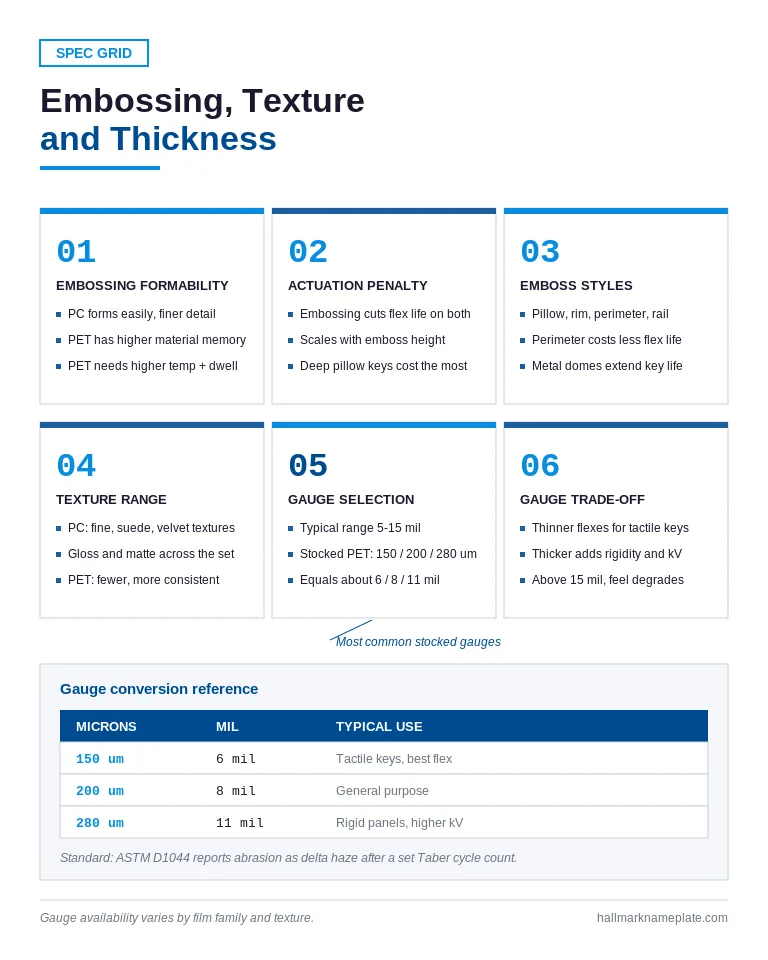
Embossing also reduces actuation life on both films, with the penalty scaling to emboss height and the flex distance required to close the switch. Rail and perimeter embossing carry a smaller penalty than deep pillow keys, which is why they appear on panels that need visual separation without heavy key travel.
Texture is where polycarbonate holds a genuine advantage. It is available in a wider set of gloss and matte fine, suede, and velvet surfaces, while polyester offers fewer textures with more consistent gloss across a run, a difference documented in the graphic overlay design stage rather than discovered at first article.
Thickness is the third lever and it is frequently underspecified. Most overlays fall between roughly 5 and 15 mils, and hard-coated polyester is commonly stocked at 150, 200, and 280 microns, or about 6, 8, and 11 mils.
Thinner gauges flex more readily for tactile keys; thicker gauges add rigidity, improve dead-front appearance, and raise dielectric breakdown voltage. Beyond roughly 15 mils, durability considerations start to outweigh tactile feel.
Print method interacts with all three. Screen printing lays down heavier ink films and denser opaque backers, while digital printing handles variable data and fine gradients, and the film’s ink-receptive primer must match the ink chemistry either way.
A Specification Checklist to Complete Before You Request a Quote
An overlay quote is only as good as the requirement set behind it, and most revision cycles trace back to a missing environmental or regulatory line item. Work through the checklist below before releasing the drawing.
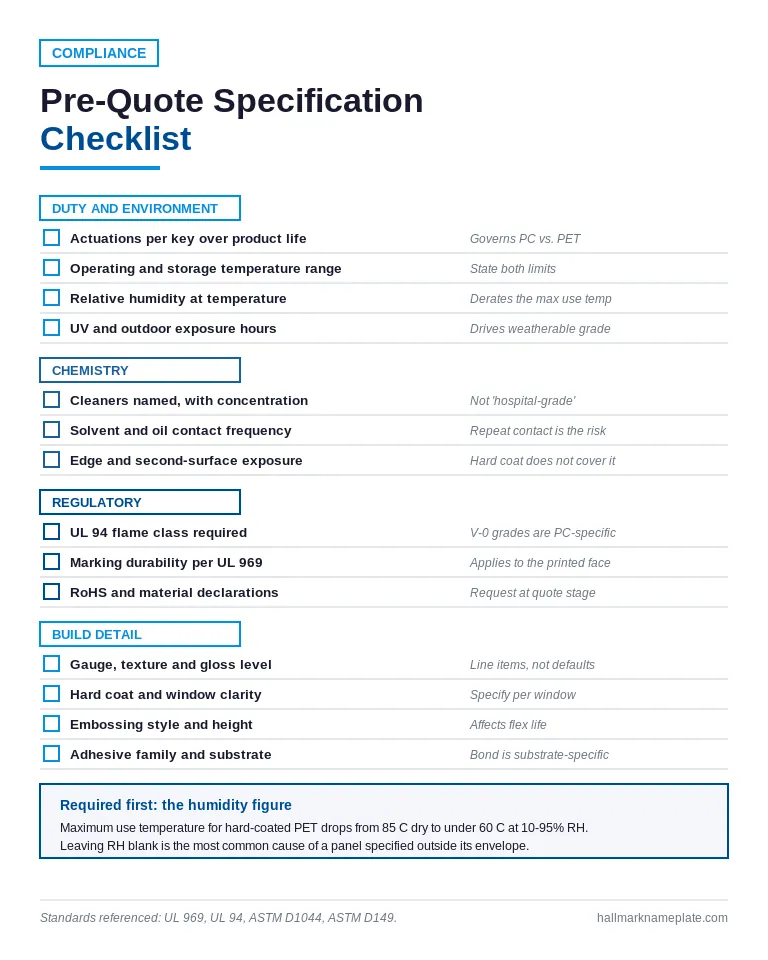
Start with the numbers that constrain the base film: expected actuation count per key over the product life, operating and storage temperature range, and the relative humidity the panel sees at temperature. The humidity figure is the one most often left blank.
Next, list the cleaning and exposure chemistry by name rather than by category. “Hospital-grade disinfectant” is not specifiable; isopropyl alcohol at a stated concentration, a named quaternary compound, or a specific solvent is.
Then capture the regulatory requirements. If the end product carries a certification mark, the marking durability requirements in the UL 969 marking and labeling system standard apply to the printed overlay, and a required UL 94 flame class should be stated explicitly.
Flame-rated construction is available, but it is grade-specific. Flame-retardant polycarbonate film grades such as those in the Makrofol film range are produced for this purpose, and standard polyester films are not typically flame rated.
Finish with the build details: gauge, texture and gloss level, hard coat, window locations and required clarity, embossing style and height, adhesive family and the substrate it bonds to, and color targets with tolerances. Reviewing substrate selection alongside these items keeps the film and the mounting surface compatible.
Frequently Asked Questions About Polycarbonate vs. Polyester Overlays
Which overlay material has the longer flex life, polyester or polycarbonate?
Polyester consistently outlasts polycarbonate in flex-life testing, which is why it is the standard face film for high-actuation keypads. Published data for hard-coated textured polyester films places switch life above 5 million actuations under the supplier’s own test method, while polycarbonate is typically specified for lower-cycle panels.
Is polycarbonate chemical resistant enough for cleaning agents?
Polycarbonate tolerates incidental contact with many mild cleaners, but it is vulnerable to environmental stress cracking from alcohols, ketones, and alkaline solutions. A first-surface hard coat slows that attack but does not protect the die-cut edges, so polyester is the safer specification for repeated wipe-down with disinfectants.
Which material has better UV resistance for outdoor overlays?
Both films are available in UV-stabilized grades, and the grade matters more than the base polymer. Uncoated polycarbonate tends to yellow faster under prolonged sunlight, so outdoor panels generally use either a weatherable hard-coated polycarbonate grade or a hard-coated polyester with a UV-blocking print stack.
What flame rating can a graphic overlay carry?
Flame performance comes from the specific film grade, not from the polymer family in general. Polycarbonate is available in flame-retardant film grades carrying a UL 94 V-0 classification, while standard polyester films are not typically flame rated, so the UL 94 class should be called out on the drawing when the end product requires it.
Does embossing work better on polyester or polycarbonate?
Polycarbonate embosses more easily and holds finer detail because it has lower material memory. Polyester requires higher forming temperatures and longer dwell times to hold an embossed shape, which adds process time but produces a key that survives more actuations.
What overlay thickness should I specify?
Most graphic overlays fall between roughly 5 and 15 mils, and hard-coated polyester films are commonly stocked at 150, 200, and 280 microns, or about 6, 8, and 11 mils. Thinner gauges flex more easily for tactile keys, while thicker gauges improve rigidity and dead-front appearance on flat panels.
What is the best medical device overlay material?
Hard-coated polyester is the usual starting point for medical equipment because it withstands repeated disinfection and high actuation counts. Polycarbonate becomes the better choice when the device needs a large, optically clear display window or a flame-rated face film, and the cleaning protocol is mild.
Can you mix polycarbonate and polyester in one membrane switch?
Yes, and most membrane switches already do. The printed circuit layers inside a membrane switch are polyester because of its dimensional stability and flex life, so a polycarbonate face film simply sits on top of a polyester circuit stack.
Choosing Between Polycarbonate and Polyester Overlays
The comparison resolves into a small number of governing variables. Polyester is the durability film, favored by flex life, chemical resistance, and hard-coated abrasion performance; polycarbonate is the appearance and processability film, favored by clarity, texture range, embossing detail, flame-rated grade availability, and cost.
Neither film is universally correct, and the hard coat, gauge, and texture you specify move the outcome as much as the polymer family does. Use the sequence below to reach a defensible specification.
- Quantify the duty cycle. Estimate actuations per key over product life, and treat anything above moderate cycle counts as a polyester requirement.
- Name the chemistry. List every cleaner and solvent the panel contacts, with concentration and frequency.
- Set the environmental envelope. Record temperature range together with relative humidity, and check the film’s humidity-derated limit rather than its dry maximum.
- Call out the regulatory line items. Specify the UL 94 flame class and any marking-durability requirement on the drawing.
- Specify the build. Lock gauge, texture, hard coat, window clarity, embossing style, and adhesive before requesting pricing.
For a deeper look at how these decisions translate into a finished part, the breakdown of manufacturing overlay graphics walks through the production stages that follow material selection. Engineers specifying for regulated equipment may also find the industries reference useful for environment-specific requirements.