


Choosing a membrane switch manufacturer affects the reliability, appearance, and field life of the finished product. This guide covers ten evaluation criteria, the red flags that signal a poor fit, the questions to ask, and the certifications worth verifying.
Hallmark Nameplate has produced nameplates, graphic overlays, membrane switches, and electronic assemblies in Mount Dora, Florida for more than 60 years, under ISO 9001:2015 and ISO 13485:2016 quality systems and ITAR registration. The framework below stays supplier-neutral so engineers and purchasing teams can apply it to any shortlist.
By the end, you will have a scorecard and a sample-inspection method for comparing quotes on equal terms. Start with the short answer below.
Key Takeaways
- Evaluate on documented capability. Ask for evidence in engineering support, materials, printing, circuits, testing, and prototyping.
- Verify certifications against your program. ISO 9001, ISO 13485, ITAR registration, UL, and RoHS each answer a different question.
- Treat vague answers as a warning. A supplier that cannot explain materials, test methods, or change control is a risk.
- Compare U.S. and offshore options on total program risk, not unit price alone.
- Score every supplier the same way, then inspect a prototype before you commit to production.
10 Criteria to Evaluate in a Membrane Switch Manufacturer
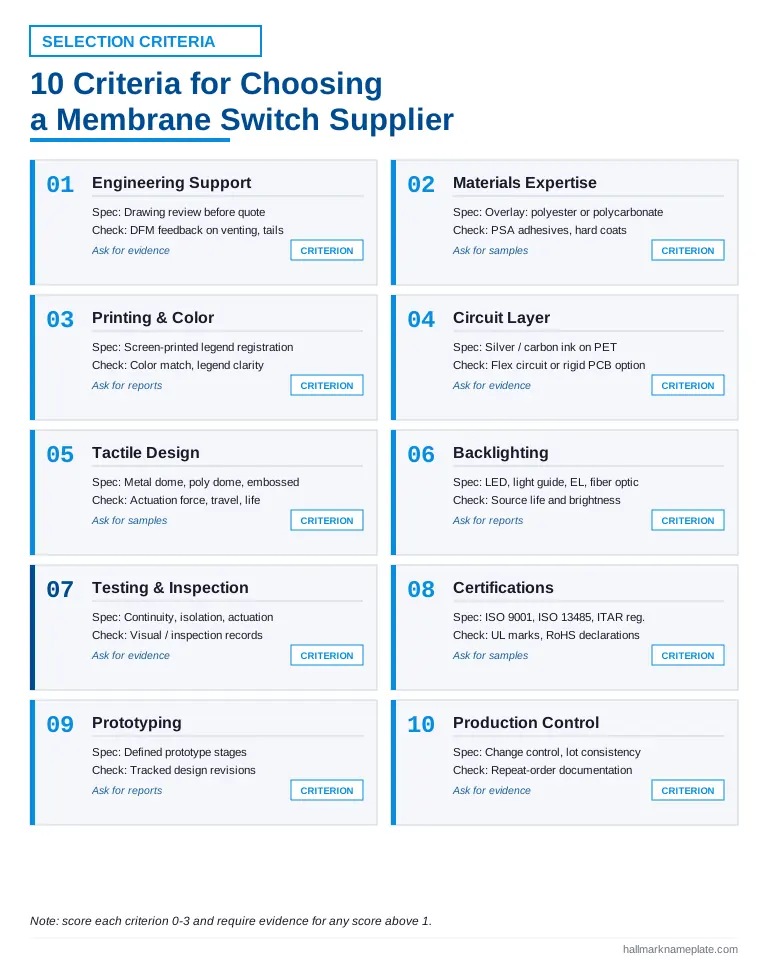
The best membrane switch manufacturers for a given program are the ones that can document capability in ten areas: engineering support, materials, printing, circuitry, tactile design, backlighting, testing, certifications, prototyping, and production control. Weigh each area against your application rather than choosing on price alone.
1. Engineering and Design Support
Ask whether engineers review your drawings before quoting. A supplier that flags tolerance, venting, or tail-routing issues early prevents redesigns after tooling is cut.
2. Materials Expertise
Graphic overlays are typically polycarbonate or polyester, bonded with pressure-sensitive adhesives. The supplier should explain why each material suits your chemicals, UV exposure, and chemical resistance needs.
3. Printing Quality and Color Control
Screen-printed legends must stay legible and register to domes, LEDs, and display windows. Ask how color is matched and how abrasion resistance is verified.
4. Circuit Layer Capability
Silver and carbon conductive inks on flexible PET are common circuit choices, while flexible printed circuits or rigid boards are used for denser layouts (Wikipedia). Ask who prints the circuits, because in-house vs outsourced circuit printing changes lead-time control and traceability.
Rigid-board designs also bring connector and mounting choices into the evaluation.
5. Tactile Feedback Design
Metal domes, poly domes, and embossed keys produce different feel and life. A capable supplier can walk through the trade-offs in tactile versus non-tactile switches and the tactile and non-tactile switch products and explain how actuations are measured.
6. Backlighting and Electronics Integration
LEDs, light guides, EL lamps, and fiber-optic sources each have different life, brightness, and cost profiles. If your design needs a controller or board, confirm the supplier offers electronic assemblies support rather than only flat switches.
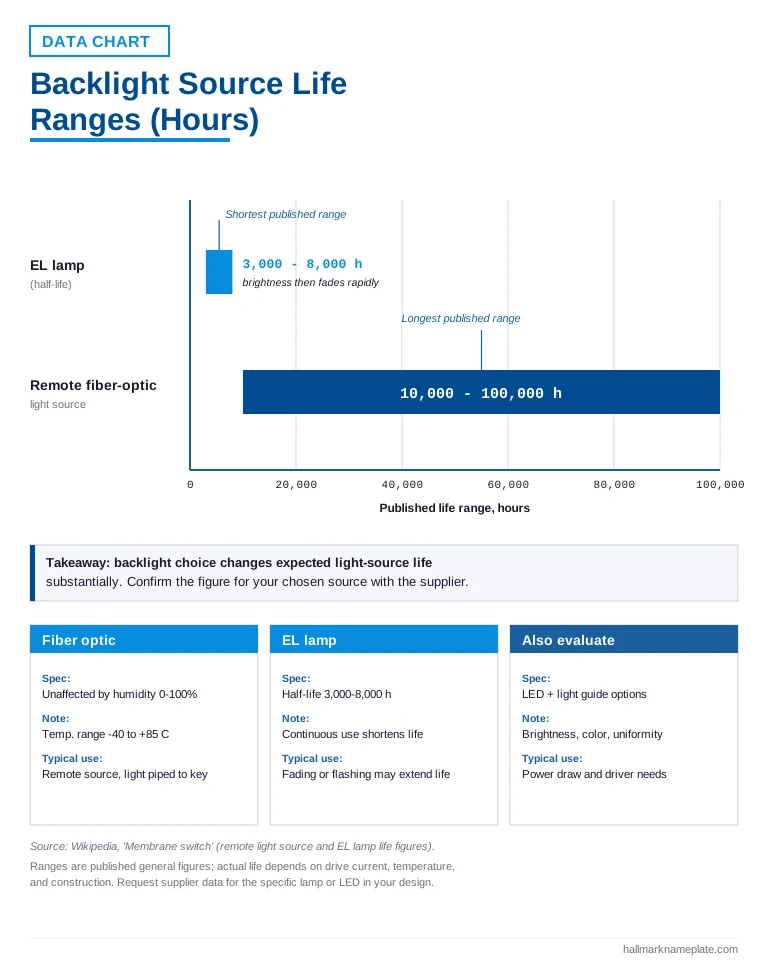
The chart above shows published life ranges for two backlighting options. Backlight choice changes expected light-source life substantially, so confirm the figure for your chosen source with the supplier.
7. Testing and Inspection
Membrane switch quality testing should include electrical checks such as continuity and isolation, plus actuation and visual inspection. ASTM F2592 describes a force-displacement test method for membrane switches, though ASTM lists it as historical (ASTM F2592).
8. Certifications
Certifications show that a quality system exists and is audited, not that every part is perfect. The next sections cover which ones fit which programs, and Hallmark publishes its inspection process for reference.
9. Prototyping Speed and Iteration
Membrane switch prototyping lets you check feel, graphics, and electrical performance before production tooling. Ask what each prototype stage represents and how revisions are documented.
10. Production Support and Change Control
Ask how the supplier controls revisions, communicates schedule changes, and keeps lot-to-lot consistency on repeat orders. Strong documentation matters most when a design runs for years.
Red Flags When Comparing Membrane Switch Suppliers
The clearest red flags are vague answers about materials, no documented testing, no prototype path, and quotes that cannot be compared line by line. Any one of these deserves a direct follow-up before you advance a supplier.
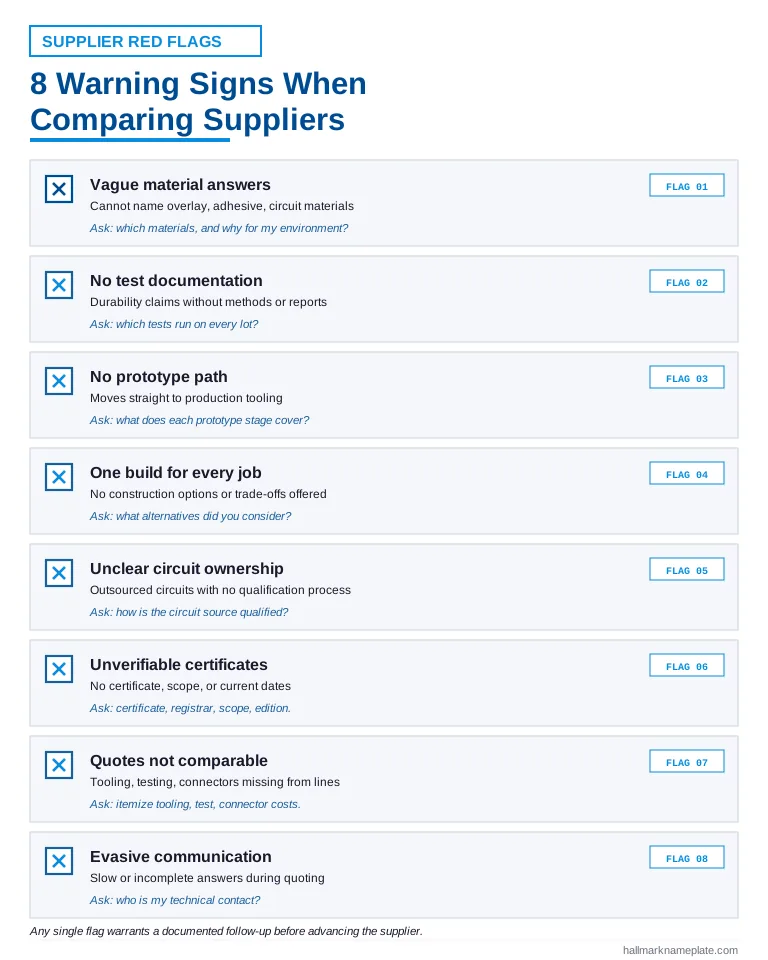
- Vague material answers. A supplier that cannot name overlay, adhesive, and circuit materials may not control them.
- No test documentation. Claims about durability without test methods or reports are not evidence.
- No prototype path. Moving straight to production tooling raises risk on a custom design.
- One construction for every application. Good suppliers offer options and explain the trade-offs.
- Unclear ownership of the circuit process. If circuits are outsourced, ask how the supplier qualifies that source.
- Certifications that cannot be verified. Ask for the certificate, scope, and current dates.
- Quotes that are not comparable. Missing line items for tooling, testing, or connectors hide real cost.
- Slow or evasive communication. Response quality during quoting usually predicts response quality in production.
If a supplier clears these flags, the next step is a structured set of questions.
Questions to Ask a Membrane Switch Manufacturer
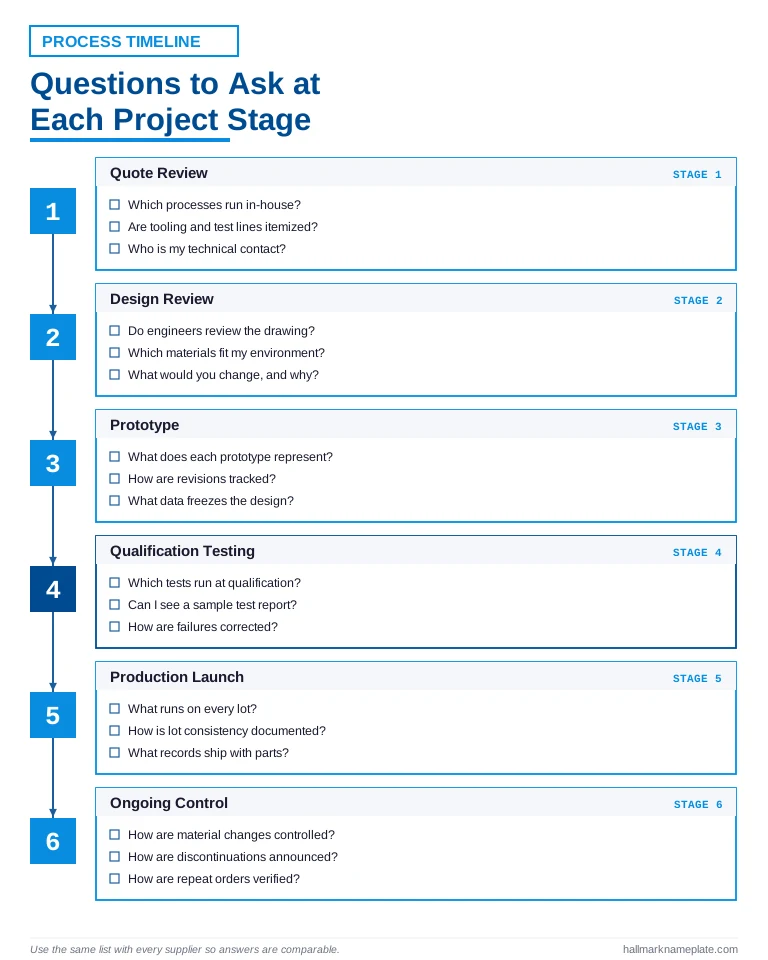
The most useful questions to ask a membrane switch manufacturer follow the project from quote to production: capability, testing, prototyping, and ongoing control. Use the same list with every supplier so the answers are comparable.
Capability and Design
- Do your engineers review drawings and recommend changes before quoting?
- Which overlay, adhesive, and circuit materials do you recommend for my environment, and why?
- Which processes run in-house, and which are outsourced?
Testing and Quality
- What tests run on every lot, and what tests run only at qualification?
- Can you share a sample test report and your nonconformance process?
- How do you verify actuation force and electrical performance?
Prototyping and Launch
- What does each prototype stage represent, and how are revisions tracked?
- What information do you need from me to freeze the design for production?
Production and Support
- How do you control changes to materials or processes after launch?
- How do you notify customers about discontinued materials or schedule changes?
Prototype-stage answers are easier to verify when you also understand membrane switch construction elements.
Certifications That Matter for Membrane Switch Suppliers
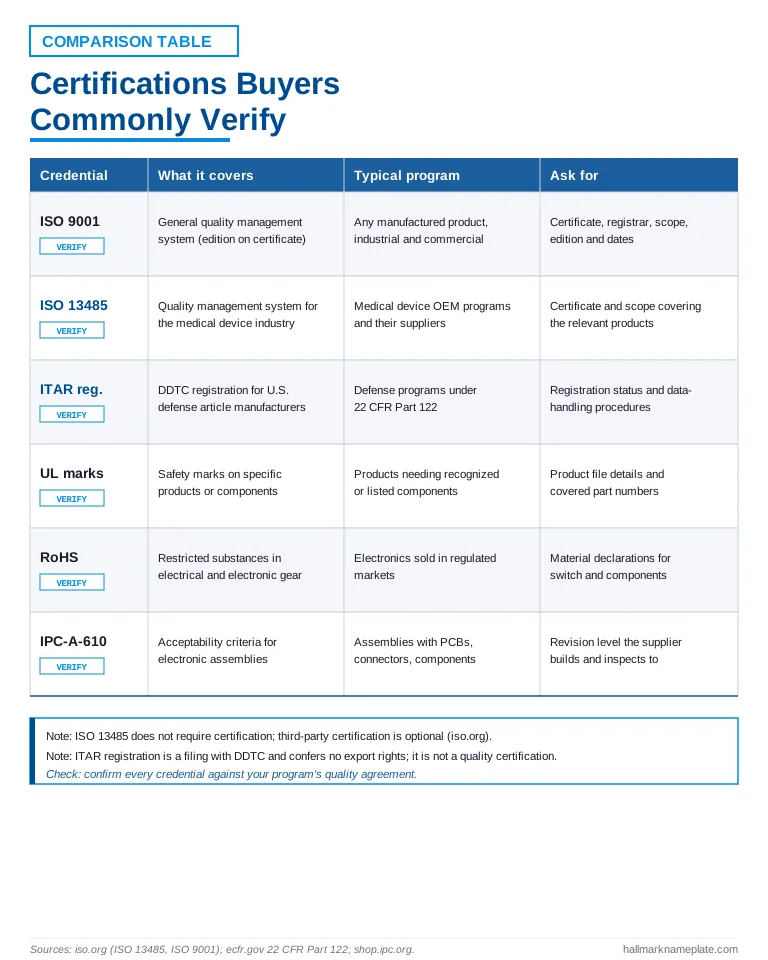
The certifications that matter most are ISO 9001 for general quality management, ISO 13485 for medical devices, ITAR registration for defense work, UL marks for safety-listed products, and RoHS for restricted substances. Each answers a different buyer question, so match the certification to your program.
ISO 9001
ISO 9001 is the general quality management standard, and ISO revises it periodically (ISO 9001:2015 on iso.org). Ask for the certificate, the registrar, the scope, and the edition it covers.
ISO 13485 for Membrane Switch Suppliers
An ISO 13485 membrane switch supplier operates under the quality standard written for the medical device industry (ISO 13485). Read more about what ISO 13485 certification involves.
ITAR Registration
For an ITAR membrane switch program, U.S. manufacturers of defense articles must register with the Directorate of Defense Trade Controls under 22 CFR Part 122. Registration is a filing, not a quality certification, so see what ITAR compliance means and confirm data-handling practices with your compliance team.
UL Marks and RoHS
UL marks apply to specific products or components, so ask which items are covered and request the file details. RoHS addresses restricted substances in electrical and electronic equipment, so confirm material declarations for the switch and its components.
For assembled products, the electronics workmanship standard IPC-A-610 is also commonly referenced when judging acceptability. Ask for the revision level the supplier builds to.
U.S. vs. Offshore Membrane Switch Suppliers
A U.S. supplier is not automatically better than an offshore one, but the trade-offs differ in communication, iteration speed, regulatory fit, and total landed cost. Many of the same trade-offs appear when sourcing boards, as covered in PCB manufacturing and assembly in the USA.
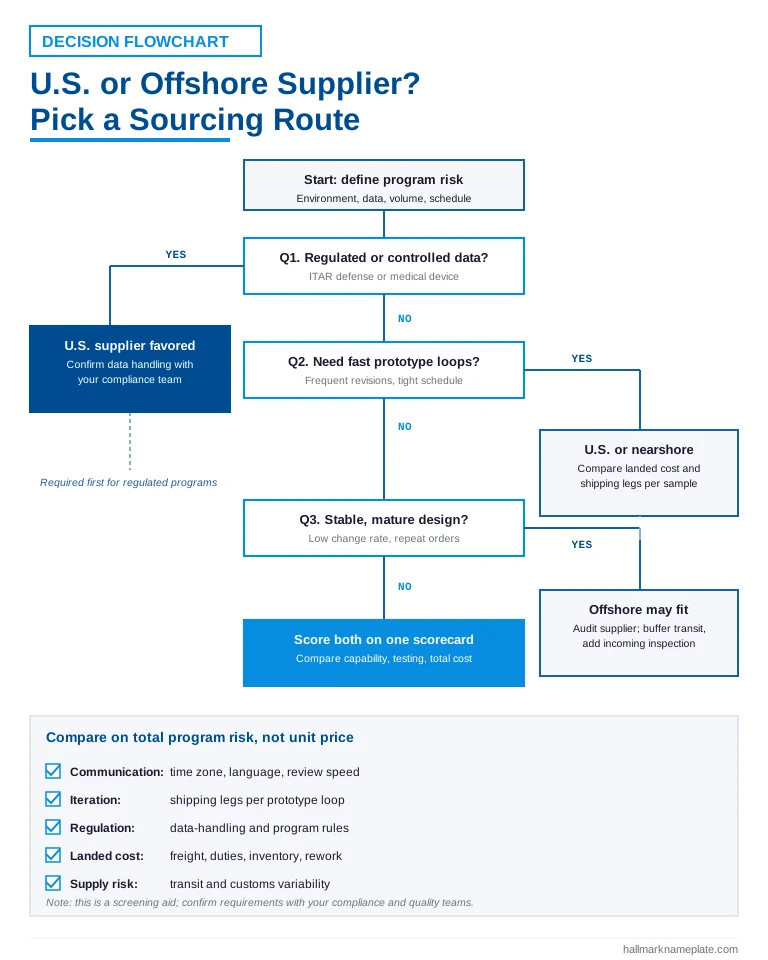
- Communication. Shared time zones and language make design reviews and corrective actions faster to run.
- Prototype iteration. Shorter shipping legs can shorten the loop between a sample, a comment, and a revision.
- Regulated programs. Some defense and medical programs restrict where technical data may go, so confirm requirements with your compliance team.
- Total cost. Compare landed cost, including freight, duties, inventory carrying, and rework, not only unit price.
- Supply risk. Longer supply chains add transit and customs variability that planning must absorb.
Whichever route you choose, apply the same scorecard to every supplier.
How to Score Suppliers and Inspect a Prototype
Score each supplier from 0 to 3 on every criterion, multiply by a weight you set from your application, and require evidence for any score above 1. Then inspect a prototype against the same criteria before committing to production.
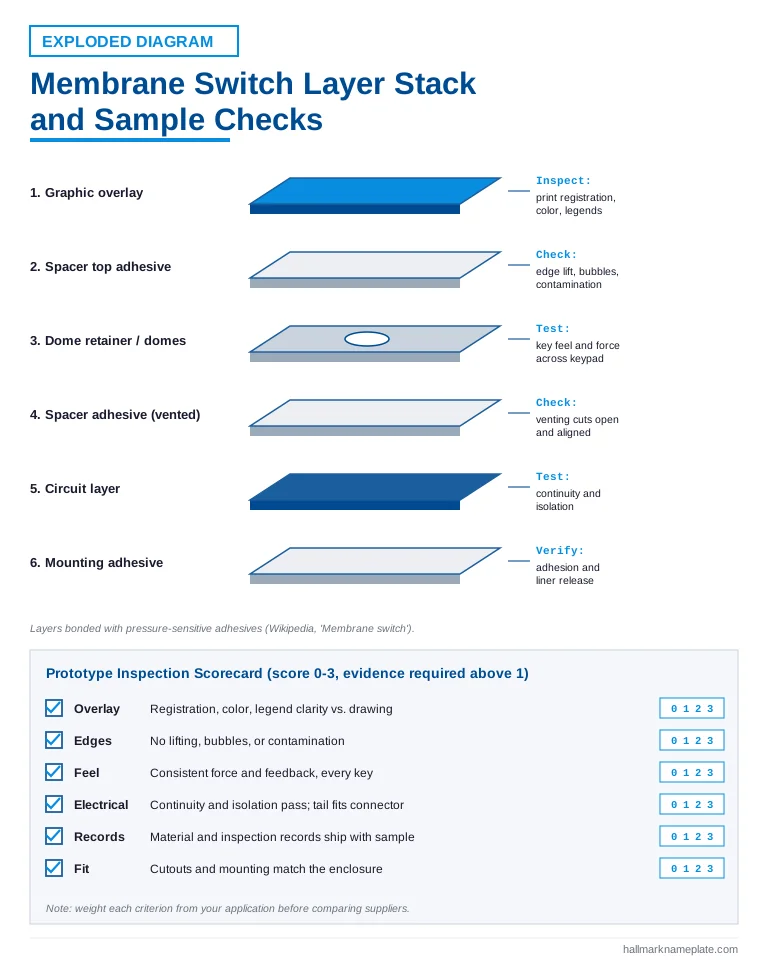
- Overlay. Check print registration, color, and legend clarity against the drawing.
- Edges and adhesion. Look for lifting, bubbles, or contamination along bonded edges.
- Feel. Press every key and compare force and feedback across the keypad.
- Electrical. Test continuity and isolation, and confirm the tail fits the mating connector.
- Documentation. Confirm the sample ships with material and inspection records.
Run Hallmark through the same scorecard as any other shortlisted supplier, using its published pages on membrane switches and its manufacturer selection guide.
Frequently Asked Questions About Choosing a Membrane Switch Manufacturer
What questions should I ask a membrane switch manufacturer?
Ask about engineering review of your drawings, material options for your environment, who prints the circuits, how each lot is tested, and how prototypes are built and revised. Also ask which certifications apply to your program and for documentation that supports each answer.
How should I evaluate membrane switch quality testing?
Ask which tests run on every lot and which run only during qualification, such as actuation life, force-displacement, continuity, and insulation resistance. Request sample test reports and confirm how failures are recorded and corrected.
Do I need an ISO 13485 membrane switch supplier?
ISO 13485 is the quality management standard written for organizations that design, produce, or service medical devices, so medical device programs commonly require it. The standard itself does not mandate certification, but many OEM quality agreements ask for it.
What does ITAR registration mean for a membrane switch supplier?
Under 22 CFR Part 122, U.S. manufacturers of defense articles must register with the Directorate of Defense Trade Controls. Registration is a filing and does not confer export rights, so defense programs still need to confirm how a supplier handles controlled technical data.
Is in-house or outsourced circuit printing better?
In-house circuit printing keeps process control, scheduling, and traceability under one quality system. Outsourcing can work when the supplier qualifies its circuit source and documents incoming inspection, but each handoff adds a coordination point to evaluate.
How should I evaluate membrane switch prototyping?
Ask for the supplier’s prototype steps, what each prototype represents (appearance, function, or production-intent), and how design changes are tracked. A supplier with a defined prototype path usually makes it easier to compare feel, graphics, and electrical performance before production tooling.
Are membrane switches and membrane keypads the same thing?
The terms are used interchangeably in most purchasing contexts, and a membrane keypad is a membrane switch with multiple keys. Membrane keypad suppliers and membrane switch suppliers therefore evaluate on the same criteria: construction, materials, testing, and certifications.
Conclusion: Choose a Membrane Switch Manufacturer on Evidence
The right membrane switch manufacturer is the one that documents its materials, testing, certifications, and prototype process in terms you can verify. Price matters, but a comparable scorecard keeps price in context.
Use these steps to move from shortlist to decision:
- Define environment, life, tactile, and backlighting requirements.
- Send every supplier the same drawings and the same question list.
- Verify certifications and request sample test documentation.
- Score suppliers, then inspect a prototype before production.
For further reading, see the membrane switch guide and the comparison of membrane switches and mechanical switches.