

Sourcing nameplate manufacturers for a small production run is a different problem than sourcing for volume. The factors that make an overseas quote attractive at thousands of pieces, such as tooling amortization and ocean freight, often work against you at a few hundred.
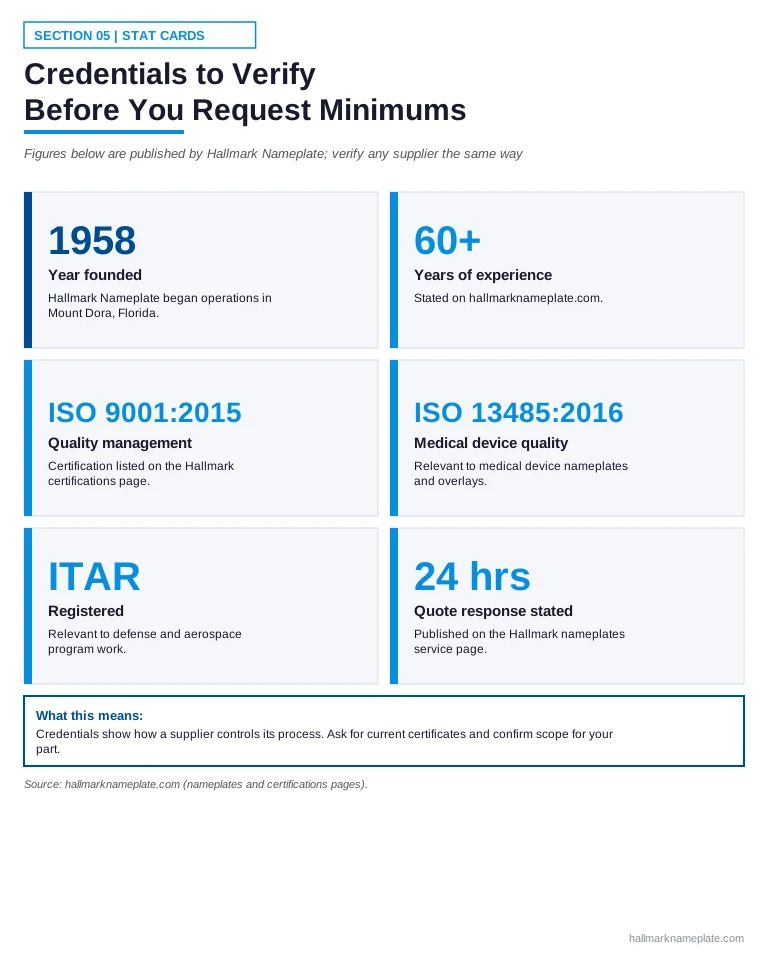
Hallmark Nameplate has produced custom nameplates, graphic overlays, membrane switches, and electronic assemblies in Mount Dora, Florida since 1958, under ISO 9001:2015 and ISO 13485:2016 quality systems and ITAR registration. The comparison below stays supplier-neutral so engineers and buyers can apply it to any shortlist.
By the end, you will know how to compare overseas and U.S. quotes on landed cost, lead time, proofing, and minimums. Start with the short answer.
Key Takeaways
- Small runs carry fixed costs. Setup, proofing, freight, and customs do not shrink with quantity, so unit price alone misleads.
- Compare total landed cost. Add freight, duties, brokerage, inventory carrying cost, and rework to every overseas quote.
- Lead time includes transit. Re-orders and revisions move faster when proofing and production sit in one country.
- Verify quality before production. Require a signed proof, first-article report, and material certifications.
- Confirm minimums in writing. They vary by process, so price three quantity tiers.
Why Small Runs Are Hard to Source Offshore
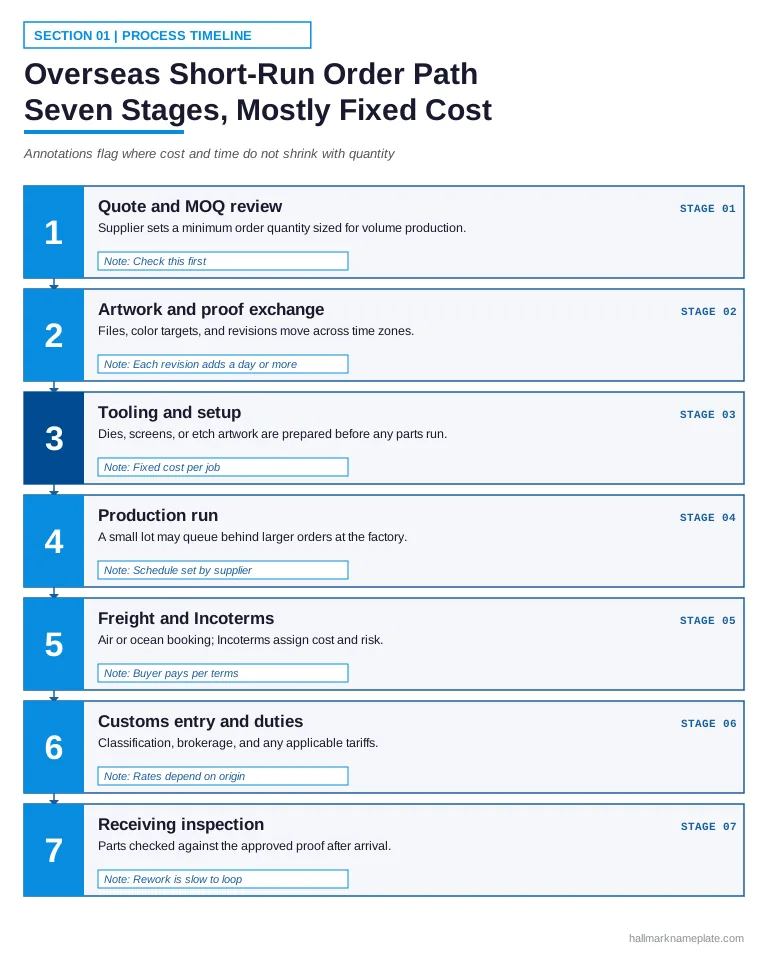
Small runs are hard to source offshore because fixed costs and long supply chains do not shrink with order size. Setup, tooling, proofing, freight booking, and customs entry cost about the same for a few hundred nameplates as for several thousand.
Fixed Costs Spread Across Few Units
When a supplier prices a short run, the setup and tooling charge lands on fewer parts. The effect is largest for etched metal and die-cut parts, where artwork or tooling is prepared for each job.
Minimums Sized for Volume
Overseas suppliers often set minimum order quantities around volume production. A prototype or pilot build can fall well below that threshold, which pushes buyers into ordering more than they need.
Distance Slows Every Revision
Each proof round trip crosses time zones, and each revision restarts the clock. Nameplates carry rev levels, serial formats, and regulatory marks that change more often than buyers expect.
The cost of those delays shows up in the landed-cost math, which is where the comparison starts.
Total Landed Cost Comparison: Overseas vs. U.S.
Total landed cost is the unit price plus every cost required to get usable parts to your dock, and it is the only fair basis for comparing nameplate quotes. A lower overseas unit price can still lose once these items are added.
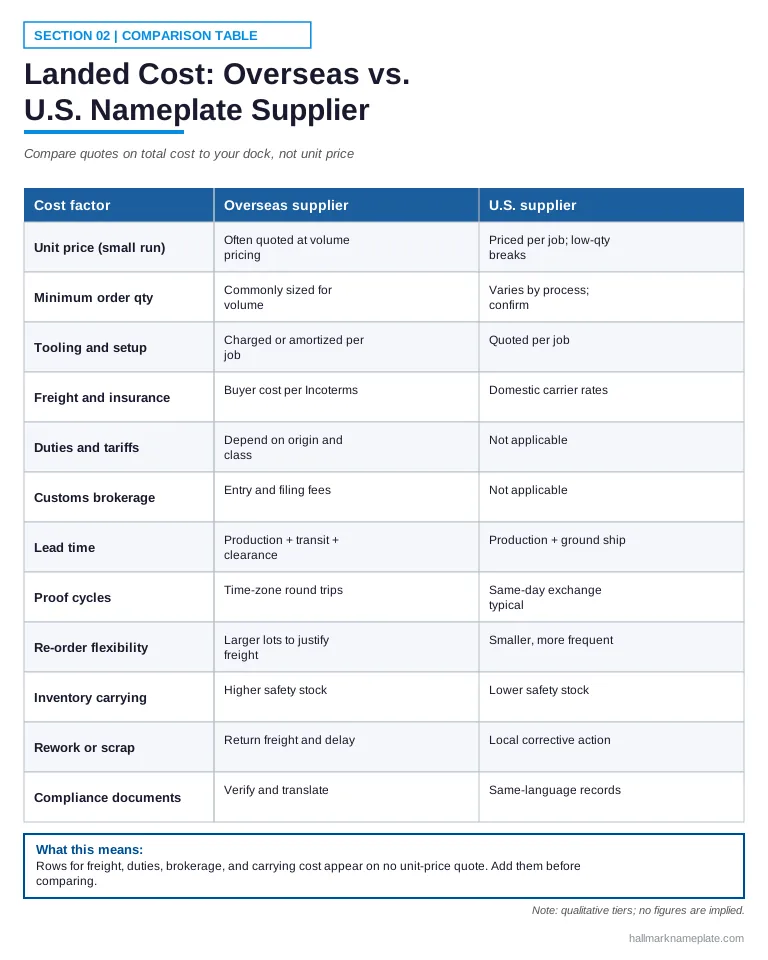
- Freight and insurance: The buyer’s share depends on the agreed Incoterms rule, which allocates cost and risk between buyer and seller.
- Duties and tariffs: Rates depend on origin and tariff classification, and Section 301 actions apply to many products of Chinese origin.
- Customs brokerage: Entry filing and broker fees apply to each import shipment.
- Inventory carrying cost: Larger lots ordered to justify freight tie up cash and shelf space.
- Rework and scrap: A legend error on imported parts means return freight and a second transit.
Where Overseas Pricing Still Wins
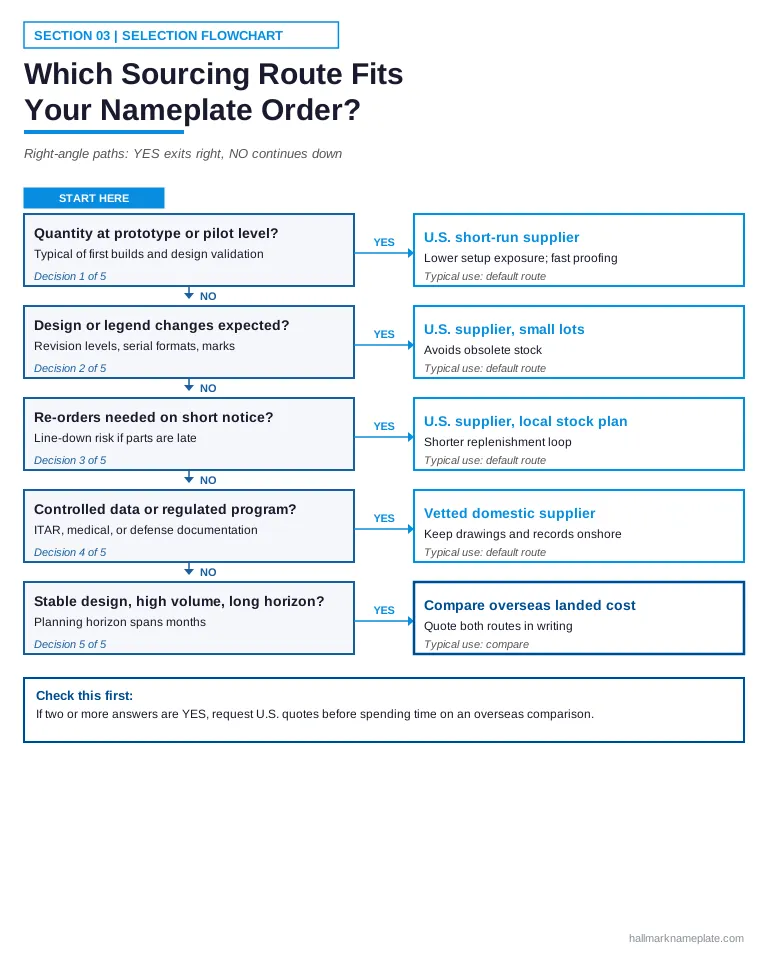
Overseas sourcing can price well for stable designs, high volumes, and long planning horizons. If the artwork will not change and you can forecast demand months ahead, a landed-cost comparison may favor it.
Where U.S. Pricing Closes the Gap
For prototype, pilot, and low-volume runs, the gap narrows because domestic shipping replaces freight, duties, and brokerage. Fewer revision delays and smaller safety stock narrow it further.
The next factor is time, which the unit price never captures.
Lead Time and Re-Order Speed
Overseas lead time is production plus transit plus customs clearance, while U.S. lead time is production plus domestic shipping. The difference matters most when a line is waiting on parts or a revision is pending.
Smaller, More Frequent Re-Orders
Overseas buyers tend to order larger lots to justify freight, which increases inventory. U.S. suppliers can often release smaller lots on a shorter loop, so you hold less stock and risk less obsolete inventory.
Revision Control and Obsolete Stock
If a serial format, regulatory mark, or rev level changes, leftover nameplates become scrap. Shorter replenishment loops reduce the number of parts exposed to that risk.
Ask for the Schedule in Writing
Ask every supplier to state lead time from proof approval to delivery at your dock. Hallmark Nameplate describes its approach on its turnaround time page, including accelerated schedules on request.
Speed only helps if the parts are right, so quality control comes next.
Quality and Proofing for Imported Nameplates
Quality risk on imported nameplates comes less from the part itself than from the distance between you and the process. A defect found at receiving costs more when correction means return freight and a second transit.
Proof and First-Article Approval
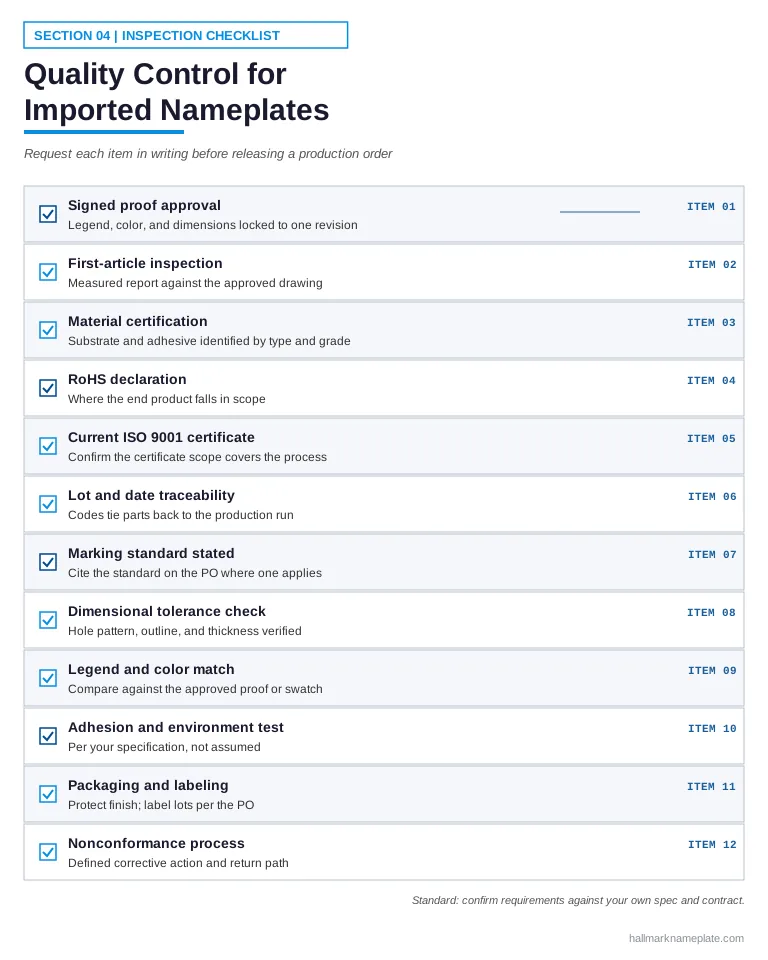
Require a signed proof that locks legend, color, and dimensions to one revision. Then ask for a first-article inspection report measured against the approved drawing before the full run ships.
Documentation and Traceability
Request material certifications for the substrate and adhesive, and confirm that lot or date codes tie parts to the production run. Verify that the supplier’s ISO 9001 certificate is current and covers the process you need. See how an inspection program works in Why the inspection process is crucial.
Regulated-Industry Considerations
Medical, aerospace, and defense programs add documentation requirements, such as RoHS declarations or marking standards cited on the purchase order. Review how nameplates serve the aerospace, medical, and military and defense markets, and involve your compliance team before drawings leave the country.
With quality defined, the remaining question is what minimums to expect.
What Minimums to Expect From a U.S. Nameplate Manufacturer
Minimums at U.S. nameplate manufacturers vary by material, size, and process, and no single figure applies across the industry. Treat any number you see quoted online as a starting point to confirm, not a standard.
What Drives the Minimum
Etched or anodized metal, screen-printed polycarbonate, and digitally printed polyester each carry different setup effort. Nameplates can also ship in sheet form or as individual pieces, which changes handling and pricing.
Price Three Quantity Tiers
Ask for prices at prototype, pilot, and production quantities in the same quote. This shows where the price curve flattens and whether a modest increase in quantity lowers unit cost.
Get Minimums in Writing
Hallmark Nameplate quotes by project, so minimums are confirmed with the quote rather than assumed. Its custom industrial nameplates page lists available materials, and metal nameplates and graphic overlays each have their own process requirements.
A complete request makes those quotes comparable.
How to Request a Quote for Short-Run Nameplates
A complete RFQ lets a supplier price the job accurately on the first pass and lets you compare quotes on equal terms. Send the same package to every supplier on your shortlist.

- Drawing and files: outline, hole pattern, vector artwork, and revision level.
- Material and finish: substrate, thickness, and surface; see which nameplate substrate is right for you.
- Quantity tiers: prototype, pilot, and production, plus any annual forecast.
- Environment and standards: exposure conditions, test methods, and any specifications cited on the PO.
- Delivery: need date, ship-to, packaging, and lot labeling.
Our overview of ordering from a dedicated partner covers how supplier size affects communication and flexibility.
Frequently Asked Questions About Short-Run Nameplates
What is a typical MOQ for custom nameplates?
There is no single industry figure, because minimums depend on material, size, and process. Overseas suppliers often set minimums for volume production, while U.S. suppliers typically quote short runs per job. Ask for pricing at prototype, pilot, and production quantities and confirm minimums in writing.
Can I get prototype nameplates before committing to a production run?
Yes, many U.S. suppliers support prototype quantities so you can verify fit, legend, and finish before releasing volume. See our guide to prototype product identification partners for how to evaluate that stage.
Does reshoring labels and nameplates cost more than importing?
Unit price may be higher, but the comparison is incomplete without freight, duties, brokerage, inventory carrying cost, and rework. For small runs and frequent revisions, total landed cost can narrow or reverse the gap.
How do overseas lead times and tariffs affect small nameplate orders?
Overseas lead time adds transit and customs clearance to production time, and tariffs depend on origin and classification, such as the USTR Section 301 tariff actions that can apply to goods of Chinese origin. Confirm current rates with a customs broker before you order.
How do I control quality on imported nameplates?
Require a signed proof, a first-article inspection report, and material certifications before production. Inspect incoming lots against the approved proof and define the corrective-action path in your purchase order.
How do I find a domestic label supplier for low-volume orders?
Start with suppliers that publish their certifications, materials, and quoting process. Use the criteria in our guide to choosing a nameplate manufacturer, then request quotes with the same RFQ package from each.
Can U.S. nameplate manufacturers handle ITAR or other regulated work?
Some can, and ITAR registration is administered through the U.S. State Department Directorate of Defense Trade Controls. Sending controlled technical data abroad carries obligations you should review with your compliance team. Hallmark Nameplate addresses the basics on its ITAR questions page.
Conclusion
Small-run nameplate sourcing comes down to total cost, time, and risk, not unit price. U.S. suppliers tend to fit prototype, pilot, and frequently revised programs, while overseas suppliers can fit stable, high-volume work.
- Build one RFQ package with three quantity tiers.
- Collect written quotes from U.S. and overseas suppliers on a landed-cost basis.
- Require a signed proof and first-article report before production.
- Confirm lead time from proof approval to delivery, and minimums in writing.
For a fuller supplier checklist, read our buyer’s guide to choosing a nameplate manufacturer, or browse the industries Hallmark Nameplate serves.