

A graphic overlay manufacturer in the U.S. is not automatically better than an overseas printer, but the two fail in different ways. This guide compares both paths for engineers and purchasing teams who need overlays that survive real use.
Hallmark Nameplate has built overlays and nameplates in Mount Dora, FL for more than 60 years, under ISO 9001:2015 and ISO 13485:2016 certification and ITAR registration. Those years show which failures repeat across jobs, and the six below account for most of them.
You will learn how each failure starts in the layer stack, how to price a failed lot, and which records to require before a first order. The answer box below gives the short version.
Short Answer: Are Overseas Graphic Overlays Worth the Risk?
Overseas overlays can work when the spec is complete, a color standard is signed, and incoming inspection is planned. They tend to cost more than the quote suggests when freight, duties, rework and replacement time are added.
A U.S. graphic overlay manufacturer shortens the revision loop. It also simplifies traceability for medical, aerospace and defense-related products.
Require six things from any supplier: a named material stack, adhesive test data, a color standard, drawn tolerances, lot traceability and a quality-system certificate.
Why Teams Source Graphic Overlays Overseas
Teams source overseas mainly because the quoted unit price is lower. That is a real advantage on stable, high-volume artwork that will not change.
The price comparison usually stops at the unit line, however. Lead time for imported overlays, freight, duties and revision cycles sit outside the quote.

Every revision on an overseas order adds a transit leg, so a single artwork fix can add weeks of calendar time. Prototype work suffers most, because engineering needs fast loops while the supplier is many time zones away.
- Stable, high-volume artwork: unit price dominates and the revision rate is low.
- Changing designs: each revision pays freight and waits through transit.
- Regulated products: traceability and change control add review steps for any supplier, and distance can add friction.
The next section covers what actually goes wrong after the lot arrives. For a sourcing view on a related product, see our guide to U.S. alternatives to overseas nameplate manufacturers.
Six Common Failure Modes in Low-Cost Graphic Overlays
Most overlay failures trace to six causes: adhesive lift, color drift, window haze, emboss cracking, registration error and chemical attack. Each begins in a specific layer, and each can occur with any supplier when the stack is under-specified.

The diagram maps each mode to its layer. A quality problem rarely shows up where it starts, so a haze complaint can trace back to a film or ink choice.
1. Adhesive Lift and Overlay Adhesive Failure
Adhesive lift occurs when the pressure-sensitive adhesive does not bond to the mating surface. Low-surface-energy plastics, texture, contamination and transit exposure all contribute.
Ask for the adhesive type and a documented adhesion test such as ASTM D3359, and match the adhesive to your actual housing material.
2. Color Drift and Color Matching Overseas
Color drift is a visible shift between lots or between the approved sample and production. It is most common when no physical color standard governs the job.
Specify Pantone callouts plus a signed physical standard, and request a measurement tolerance such as ASTM D2244 color difference. Our overview of color matching services explains the process in detail.
3. Window Haze
Window haze is clouding in a clear display window that reduces readability. Film choice, hardcoat, and handling scratches contribute, and ASTM D1003 defines a standard haze measurement.
4. Emboss Cracking
Emboss cracking is a split in the film or ink at a raised key edge. It depends on film type, gauge, emboss depth and ink flexibility working together.
Review the options in our guide to graphic overlay visual and functional options before choosing emboss depth.
5. Registration Error
Registration error is misalignment between printed layers, window cutouts or the die-cut outline. It shows as uneven borders and legends that sit off the key.
Draw the tolerances on the part drawing. Our notes on factors in graphic overlay design cover how artwork and tolerances interact.
6. Chemical Attack
Chemical attack is ink or hardcoat degradation from cleaners, solvents or fluids. The cleaner list varies widely between a medical cart and a shop floor.
State the exact chemicals in the spec. See how chemical-resistant overlays are built and our article on abrasion-resistant overlays.
The Total Cost of a Failed Overlay
A failed overlay costs far more than its unit price, because the cost sits in rework, line-down time, replacement lead time and re-qualification. The exact amounts depend on your product and supplier terms.

Overseas lots add a second transit leg and customs step to every replacement. Regulated products add change control and first-article repeats whenever a material or process changes.
- Rework and scrap: rejected lot value and re-inspection labor.
- Line-down time: assemblies waiting on panels and missed ship dates.
- Re-qualification: repeat first-article and test data, especially for medical devices.
- Field returns: the hardest category to reverse once product has shipped.
Quote the delivered, qualified overlay instead of the unit price. The next section lists what to require so the quote can be compared fairly.
What to Require From Any Graphic Overlay Supplier
Require ten items in writing before the first order: certificates, material data, adhesive and color specs, tolerances, window criteria, chemical list, UL and RoHS documents, and lot traceability. The checklist applies to overseas and U.S. suppliers alike.
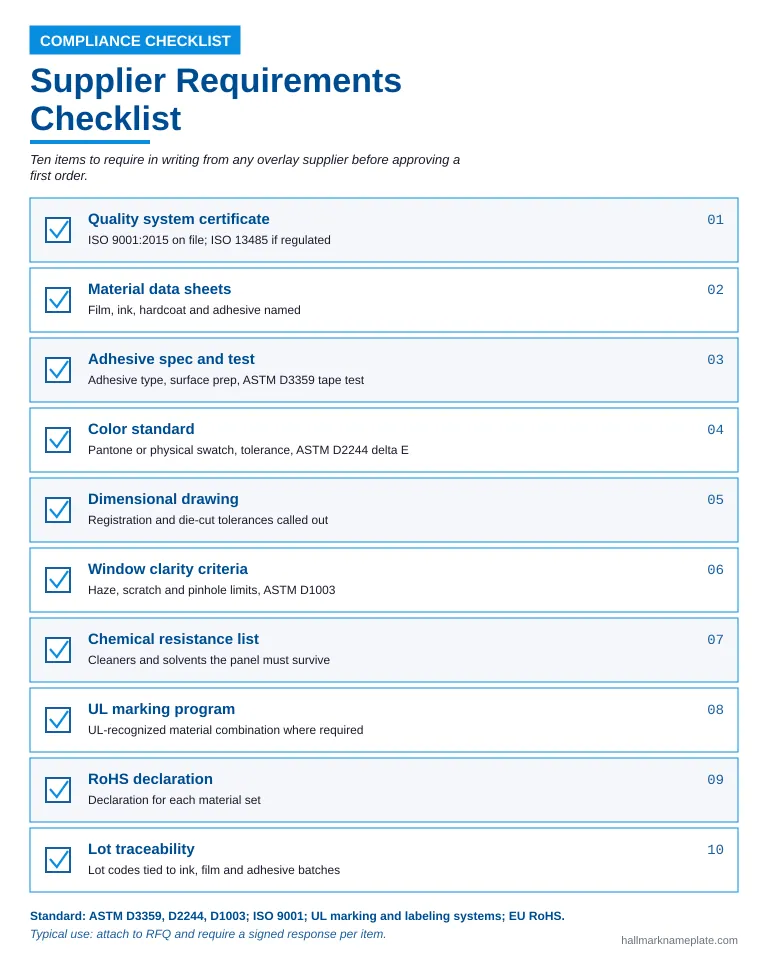
A quality-system certificate such as ISO 9001:2015 shows that a documented process exists. The UL marking and labeling systems program and the EU RoHS directive cover marking permanence and restricted substances for the materials you specify.
Inspection records matter as much as certificates; see why the inspection process is crucial. For material choices, our comparison of polycarbonate vs. polyester overlays is a useful starting point.
U.S. vs. Overseas Graphic Overlay Printers: Side-by-Side
The U.S. path usually costs more per unit and less per qualified overlay on changing designs. The overseas path usually wins on unit price for stable, high-volume work.

The table uses qualitative tiers because supplier performance varies. Replace each cell with data from the suppliers you are evaluating.
Domestic suppliers also simplify regulated programs, since ITAR-registered options and audit trails sit in one country. For program-specific questions, review ITAR questions answered at a general level and confirm requirements with your compliance team.
Credentials to Verify in a Domestic Graphic Overlay Supplier
Verify certificates, registrations and facility details by requesting the documents, not by accepting the claim. The cards below show published facts from one U.S. manufacturer as an example of what to ask for.

Medical products raise the bar further; see what ISO 13485 certification covers, and review the full list of Hallmark Nameplate certifications.
Smaller suppliers can offer direct engineering access, which is covered in customer advantages of ordering from a small business.
Frequently Asked Questions About Overseas vs. U.S. Graphic Overlays
Why do overseas graphic overlays fail?
They fail when the specification leaves the material stack, adhesive, color standard or tolerances open. Transit exposure and limited incoming inspection let defects reach the line before anyone catches them.
What causes overlay adhesive failure?
The usual causes are a mismatch between the adhesive and the housing surface, contamination, low-surface-energy plastics and texture. Specify the adhesive type and request a documented tape adhesion test such as ASTM D3359.
How do I control color matching with an overseas supplier?
Specify Pantone values, approve a signed physical standard, and set a measurable tolerance. Compare each lot against the standard during incoming inspection.
How long does lead time for imported overlays run?
It depends on production queue, freight mode and customs, so quote each leg separately. A revision or replacement lot repeats the freight and customs legs.
Where can I get overlay prototypes in the USA?
Domestic graphic overlay manufacturers typically offer prototype runs with short revision loops. Ask each supplier for prototype lead time and whether prototype and production tooling match.
What should I look for in a graphic overlay manufacturer in the USA?
Look for a documented quality system, named materials, adhesive and color specs, drawn tolerances and lot traceability. For regulated products, add ISO 13485 and ITAR registration where relevant.
Are custom graphic overlays made in the USA always more expensive?
Unit prices are often higher, but delivered and qualified cost can narrow the gap once freight, duties, rework and replacement time are counted. Compare quotes on the same delivered basis.
Conclusion: Choosing a Graphic Overlay Manufacturer
Both sourcing paths can produce a good overlay when the specification is complete and the supplier’s records are verified. The difference lies in how many steps sit between a defect and its correction.
- Name the full material stack: film, ink, hardcoat and adhesive.
- Set a signed color standard and a measurable tolerance.
- Draw registration and die-cut tolerances on the part drawing.
- Request certificates and lot traceability before the first order.
- Compare quotes on a delivered, qualified basis.
For more on overlay options and the industries they serve, explore our graphic overlays overview, read about overlays for the toughest workplaces, or browse the industries we serve.