


Reshoring manufacturing is shifting from a cost discussion to a compliance discussion for medical, aerospace, and defense programs. When a design carries ITAR-controlled data or ISO 13485:2016 quality requirements, the supplier’s location changes what a buyer must document, audit, and defend.
Hallmark Nameplate has operated for more than 60 years from Mount Dora, Florida, and is ISO 9001:2015 and ISO 13485:2016 certified and ITAR registered. This guide relies on public standards and regulations rather than any customer program.
You will learn which questions separate a workable alternative to offshore PCB assembly from a risky one, and a checklist turns them into steps. The short answer comes first.
Key Takeaways
- ITAR: sending controlled technical data to a foreign supplier may require authorization, so supplier location is a compliance variable.
- ISO 13485:2016: supplier controls apply wherever the supplier sits, and FDA’s QMSR has incorporated the standard since February 2, 2026.
- Traceability: lot and serial records must be retrievable on demand, and short communication paths make that simpler.
- Cost: compare total landed cost, including tariffs, freight, inspection, and rework, rather than unit price alone.
- Approach: qualify, transfer, validate, and pilot in stages while the existing supplier keeps shipping.
What Changes for Regulated Programs When Electronics Assembly Is Offshore
Supplier location changes the compliance burden, not only the price. A regulated program must show control over technical data, supplier quality, and product records at every site that touches the build.

Offshore electronics assembly can work for stable, high-volume designs with few regulatory demands. Regulated programs add requirements that tend to grow with distance, as the comparison above shows.
Each row in the table is qualitative, because the outcome depends on the supplier, the contract, and the program. Use it as a prompt for supplier questions, not as a verdict.
Where the Burden Shifts
- Technical data control: drawings, Gerber files, and bills of materials may be export-controlled.
- Audit access: on-site audits and first-article witnessing require travel and scheduling.
- Change control: engineering questions and revision approvals take more calendar time across time zones.
- Records retrieval: complaint and recall investigations need records produced promptly.
ITAR is usually the first requirement that defense and aerospace buyers check, so it is the next topic.
ITAR Considerations for Electronics Manufacturing
ITAR is a U.S. regulation that governs the manufacture and export of defense articles and the transfer of related technical data. Companies that manufacture defense articles generally must register with the State Department’s Directorate of Defense Trade Controls under 22 CFR Part 122.

ITAR registration is a legal registration, not a quality certification. It does not describe a supplier’s process capability on its own.
Sending a controlled drawing or fabrication file to a foreign manufacturer is generally treated as an export that may require authorization. Involve export compliance counsel before releasing controlled data.
Questions to Ask an Electronics Supplier
- Registration: is the supplier registered with DDTC, and can it describe how it handles controlled files?
- Access: who can open technical data, and how is that access recorded?
- Counterfeit avoidance: what documented procedure governs component purchasing and inspection?
- Flow-down: how are compliance terms passed to approved subtier suppliers?
Hallmark publishes general explainers on ITAR compliance and common ITAR questions, and its military and defense page covers the sector at a high level. Medical programs bring a different standard, covered next.
Medical Device (ISO 13485:2016) Considerations
ISO 13485:2016 is the international quality management standard for medical device organizations. FDA’s Quality Management System Regulation has incorporated it by reference since February 2, 2026.

Device manufacturers are expected to control purchased product and the suppliers that provide it. A supplier’s certificate helps, but it does not replace the buyer’s own evaluation.
The certificate’s scope statement shows what the auditor reviewed. Confirm that the scope covers electronics assembly for the device type in question.
Supplier Controls in Practice
- Evaluation records: documented criteria for selecting and monitoring the supplier.
- Quality agreement: defined responsibilities for changes, nonconformances, and notifications.
- Acceptance criteria: workmanship standards such as IPC-A-610 named in the purchase documents.
- Process validation: validation for processes whose results cannot be fully verified by inspection.
- Corrective action: a CAPA process tied to root cause and verification.
Medical device contract manufacturing in the USA can simplify on-site audits, although the regulatory expectation does not change with location. Hallmark’s pages on ISO 13485 certification, the benefits of ISO 13485, and medical PCBs give background, and the medical equipment page lists related applications.
Quality records only help if they can be retrieved, which leads to traceability.
Traceability and Documentation Requirements
Traceability means a team can follow a finished unit back to the component lots, process settings, and inspection results used to build it, and trace in the reverse direction. The depth required depends on the device class, the contract, and the standard in use.

ISO 13485:2016 addresses identification and traceability in clauses 7.5.8 and 7.5.9, and control of records in clause 4.2.5. Defense and aerospace contracts often add their own record and counterfeit-part requirements.
Records to Request Before Awarding Work
- Component data: manufacturer part number, lot or date code, and purchase source.
- Process data: solder paste lot, expiry date, and the reflow profile used.
- Inspection data: results from automated optical inspection and, where applicable, X-ray inspection.
- Test data: final test results linked to each serial number.
- Retention: the period for which records are kept and how they are retrieved.
Ask for a sample record package for a past build, with confidential details removed. The package shows how easily a supplier can answer the questions above.
Offshore PCB Assembly Alternatives: Domestic, Nearshore, and Hybrid Models
The main alternatives to offshore PCB assembly are domestic U.S. assembly, nearshore assembly in a neighboring country, and a hybrid model that splits prototyping from volume production. Hallmark’s guide to PCB manufacturing and assembly in the USA compares these paths in more detail.

The decision tree above starts with the question that matters most for regulated work: where controlled data will be stored and who may access it. Later branches weigh device regulation, volume, design stability, and revision frequency.
Matching the Model to the Program
- Domestic EMS: suits regulated, mixed-volume, and revision-heavy programs that benefit from direct engineering contact.
- Nearshore: can shorten freight and time-zone gaps, with audit and traceability planning still required.
- Hybrid: pairs domestic prototype and first-article builds with volume production elsewhere, using electronic assembly and box-build assembly partners that can share records.
- Process fit: confirm the supplier’s capability for your technology mix, such as SMT and through-hole assembly.
Cost is the next variable, and it needs a broader view than unit price.
Reshoring Electronics: Cost, Tariffs, and Supply Chain Risk
Total landed cost is the fair basis for comparing suppliers, because unit price omits freight, duties, inventory carrying cost, inspection, and rework. Tariffs on electronics have changed repeatedly in recent years, so a quote that ignores duty exposure is incomplete.

The Reshoring Initiative reported 247,000 U.S. manufacturing jobs announced through reshoring and foreign direct investment in 2025, with high- and medium-high-technology products making up 90% of announcements, according to Manufacturing.net. The mix shows that technology-intensive products are a large part of the trend.
Supply chain risk for electronics also sits in the component supply, which often stays global even when assembly moves. A reshoring plan should map component sources and name alternates for single-source parts.
Cost and risk analysis feeds the transition plan, which is the practical next step.
Reshoring Manufacturing Transition Checklist
A reshoring transition works best as seven staged steps, run in parallel with the existing supplier until the first article is approved. Each step produces a record that a regulated program can retain.
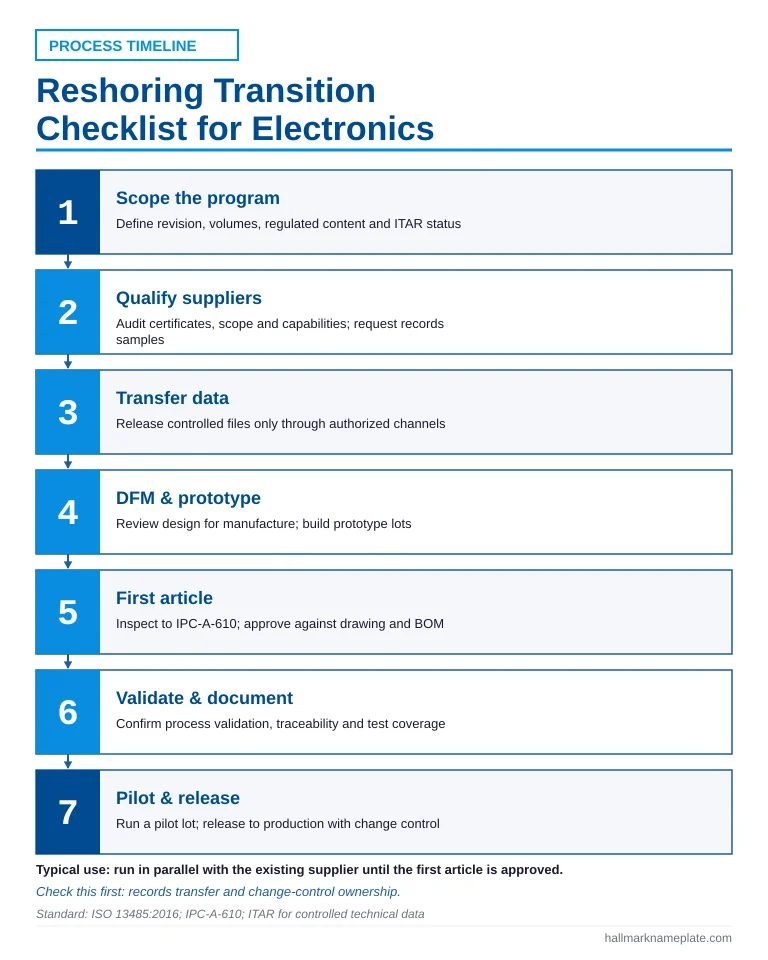
- Scope the program: define the design revision, volumes, regulated content, and ITAR status.
- Qualify suppliers: review certificate scope, audit capability, and request sample records.
- Transfer data: release controlled files only through authorized channels.
- Review and prototype: complete a design-for-manufacture review and build prototype lots.
- Approve a first article: inspect to IPC-A-610 acceptability criteria against the drawing and bill of materials.
- Validate and document: confirm process validation, test coverage, and traceability records.
- Run a pilot lot: release to production under change control.
Keep a single owner for change control and records transfer, because gaps there cause most transition surprises. Document each decision as it is made.
Frequently Asked Questions About Reshoring Electronics Manufacturing
What is reshoring manufacturing?
Reshoring manufacturing means moving production from a foreign location back to the home country, here the United States. For electronics, it usually refers to bringing PCB assembly or box-build work to a domestic supplier.
What are the alternatives to offshore PCB assembly for regulated industries?
The main options are domestic U.S. assembly, nearshore assembly, and a hybrid model that keeps prototyping domestic and moves volume elsewhere. The right choice depends on ITAR exposure, device regulation, volume, and design stability.
Does ITAR require a U.S. electronics manufacturer?
ITAR does not state that every defense program must use a U.S. supplier, but transferring controlled technical data to a foreign party may require authorization. Many contracts and programs also specify how data is handled, so confirm requirements with export compliance counsel.
Is ISO 13485:2016 mandatory for medical electronics suppliers?
FDA’s QMSR incorporates ISO 13485:2016 for device manufacturers, and manufacturers pass expectations to suppliers through purchasing controls. A supplier certificate is common and useful, but it does not replace the buyer’s own supplier evaluation.
How do tariffs affect electronics sourcing decisions?
Tariffs add duty cost and uncertainty to imported assemblies and sometimes to components. Compare total landed cost and ask each supplier how duties are handled in the quote.
What traceability requirements apply to electronics assemblies?
Requirements depend on the device class, contract, and standard, but they typically include component lot or date code, process records, inspection results, and serial-level test data. ISO 13485:2016 addresses identification, traceability, and record control in clauses 7.5.8, 7.5.9, and 4.2.5.
How long does a reshoring transition take?
Duration depends on design complexity, regulatory scope, and how quickly supplier qualification and first-article approval are completed. Plan in stages and keep the existing supplier active until the pilot lot is approved.
Conclusion: Make Supplier Location a Documented Decision
For regulated programs, offshore versus domestic assembly is a question of data control, supplier quality, and record access as much as price. The strongest decisions rest on documented evidence for each factor.
- Confirm ITAR status and where controlled data will be stored.
- Check each supplier’s ISO 13485:2016 scope and purchasing-control fit.
- Request a sample traceability record package.
- Compare total landed cost, including tariffs, freight, and rework.
- Transition in stages, with the existing supplier active until the first article is approved.
For related reading, see Hallmark’s overview of ITAR-compliant manufacturing or browse the industries Hallmark serves and the aerospace industry page.