


When it comes to defense-related products and technology, ensuring security and regulatory compliance isn’t just best practice; it’s the law. That’s where ITAR, or the International Traffic in Arms Regulations, comes in.
These U.S. government regulations control the export and import of defense-related goods or services to protect national security and ensure that sensitive technologies remain in trusted hands. For companies, understanding ITAR and maintaining compliance is essential to safely provide products such as nameplates, graphic overlays, and electronic assemblies for military applications.
In this guide, we’ll break down what ITAR is, who needs to register, how compliance works, and why it matters for manufacturers and exporters in the defense industry.
What is ITAR?
The International Traffic in Arms Regulations (ITAR) are a set of United States government regulations that control the transportation of defense-related goods, services, and technical data on the United States Munitions List (USML). ITAR is administered by the U.S. Department of State through the Directorate of Defense Trade Controls (DDTC) and is designed to protect the country’s military and defense objectives.
By controlling the importation and exportation of these munitions, the government is able to ensure that defense-related technology is handled only by authorized and regulated organizations without putting the American people in danger.

Who Has To Register With ITAR?
Any manufacturers, exporters, or brokers of defense articles or defense services listed on the USML must register with the DDTC, which is a part of the State Department. When going through the registration process, companies must disclose their ownership, activities, or involvement in:
- Manufacturing
- Exporting
- Brokering activities or services
Registering with the DDTC doesn’t give the organization the ability to export, but it is a prerequisite to obtain a license or any other type of approval to be able to export.
How Do Companies Register With ITAR?
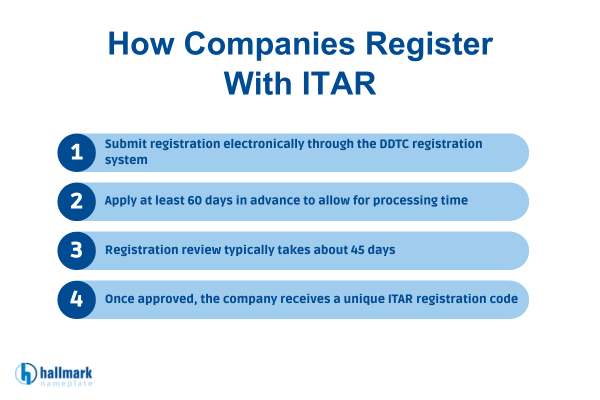
If a company registers with ITAR, it must send its registration electronically to the DDTC, and it is recommended that they submit it 60 days in advance. The review time for registration typically lasts around 45 days.
Once a company is approved with ITAR, it will receive a unique registration code. This code is made up of one letter followed by four or five numbers. If the registrant is a manufacturer or exporter, their code will begin with the letter M. If they are a broker, their code will begin with the letter K.
The code is unique to the company that it has been issued to and is the sole property of that company. From the date the code is issued, it will be good for 12 months, at which time the company must renew its registration.
What Does It Mean to Be ITAR Compliant?
The terms “ITAR certified” and “ITAR compliant” are not used by ITAR. Registration with the DDTC is required, but compliance also involves implementing controls to protect technical data, restrict access, and follow licensing requirements to be able to sell products and services that are on the USML.
- Controlled access to information: Ensuring that technical data related to defense articles is only shared with authorized U.S. persons unless the Department of State grants special authorization.
- Secure handling of materials: Safeguarding physical products and electronic data associated with defense technologies.
- Proper documentation and reporting: Maintaining accurate records of exports, transfers, and other activities involving items on the USML.
If a company is ITAR compliant, they understand what it takes to follow the regulations of ITAR and hold themselves to those standards.
What is a Violation of ITAR and Its Penalties?
If the required license or written approval from the DDTC is not obtained, it is against the law to export, attempt to export, or transfer any products or services listed in the USML to a foreign end-user. It’s also illegal to import, attempt to import, or conspire to export or import any products or services listed in the USML to a foreign end-user.
Additionally, anyone who engages in the business of brokering activities without a license or written approval by the DDTC or engages in regulated activities without proper registration, authorization, or licensing may be subject to penalties.
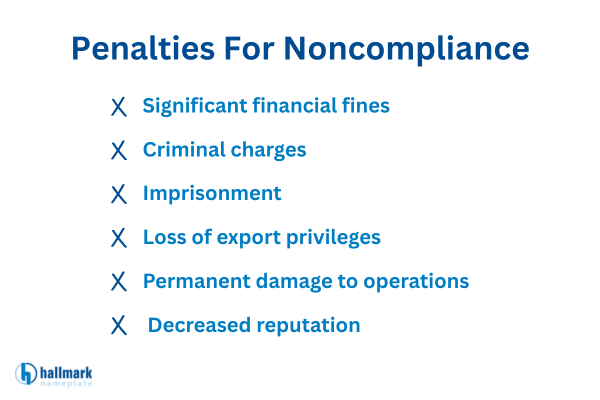
But what kind of penalties can be assessed for committing violations? Illegally exporting, importing, or transferring products and services listed on the USML to a foreign end-user without a license or written approval can result in fines, imprisonment, or both.
Get ITAR Compliant Products
Hallmark Nameplate is proud to partner with U.S. Military suppliers on nameplates, graphic overlays, and electronic assemblies. Our products are thoroughly tested and capable of withstanding military-grade conditions, and our commitment to design and materials integrity is evidenced by our commitment to maintaining ITAR registration and compliance controls.
For Hallmark Nameplate, compliance means that information and material pertaining to defense and military technologies for items listed on the U.S. Munitions List may only be shared with U.S. persons unless authorization from the Department of State is given.
Our ITAR compliance ensures that if your organization is a vendor for the U.S. military, our nameplates, graphic overlays, and electronic assemblies are similarly guarded as part of an ITAR-compliant operation. Contact us today to learn how our products complement your design.
Frequently Asked Questions About ITAR Compliance
What is ITAR compliance?
ITAR compliance means an organization meets the requirements of the International Traffic in Arms Regulations, which the U.S. Department of State administers to control the export of defense articles, services, and related technical data listed on the United States Munitions List. Compliance covers registration, access controls, personnel screening, and handling of controlled technical data.
What does ITAR stand for?
ITAR stands for International Traffic in Arms Regulations. It is codified at 22 CFR Parts 120 through 130 and administered by the Directorate of Defense Trade Controls within the U.S. Department of State.
What does ITAR compliant mean for a supplier?
An ITAR-compliant supplier is registered with the Directorate of Defense Trade Controls where required and has controls in place to prevent unauthorized access to controlled technical data: restricted facility and network access, U.S. person verification for personnel handling the data, documented procedures, training, and recordkeeping.
Who needs to be ITAR compliant?
Any U.S. company that manufactures, exports, or brokers defense articles or furnishes defense services, and any supplier that receives controlled technical data in the course of that work. That reaches well down the supply chain, including nameplate, label, and assembly vendors who receive controlled drawings.
Is there such a thing as ITAR certification?
No. ITAR has no certification or accreditation body, so no third party issues an ITAR certificate. Companies register with DDTC when required and self-certify compliance with the regulations. A supplier claiming to be “ITAR certified” is describing registration and internal compliance, not an audited credential.
How does a company become ITAR registered?
A manufacturer, exporter, or broker of defense articles registers with DDTC through the DECCS system, pays the annual registration fee, and maintains the registration yearly. Registration is a prerequisite for licensing, not a determination of compliance; internal controls over technical data must be built and maintained separately.
What are the penalties for ITAR violations?
Civil penalties reach over one million dollars per violation, and criminal penalties include fines up to one million dollars and up to twenty years imprisonment per violation. Companies can also be debarred from future export activity, which is often the more consequential outcome for a defense supplier.
Why does ITAR matter when sourcing nameplates and labels?
Drawings for military and aerospace identification plates frequently constitute controlled technical data. Sending that data to a supplier without ITAR controls, or to one who offshores production, can itself be an unauthorized export. Verifying that your identification supplier handles controlled data domestically protects the program.