


At the design stage, manufacturers must consider not only how machinery or equipment functions, but how users will ultimately interact with it. Controls, interfaces, and feedback mechanisms all play a critical role in usability, efficiency, and safety.
This is where membrane switches come into play. Membrane switches act as the primary interface between the user and the equipment, providing both visual and tactile cues that guide operation and confirm inputs. Among the many available design options, tactile feedback is one of the most important and misunderstood features.
Tactile feedback is not simply an optional upgrade that adds cost. In many applications, it is a functional necessity. Some environments benefit greatly from tactile response, while others may not require it at all. Understanding how tactile feedback works and how tactile membrane switches are constructed is essential to choosing the right solution for your product.
Below, we’ll break down what tactile feedback is, how tactile switches are constructed, the different element options available, and the key benefits and drawbacks to consider when designing a tactile membrane switch.
What Is Tactile Feedback?
Tactile feedback is the use of physical sensation, typically vibration or resistance, to communicate information to a user. Instead of relying solely on visual cues (like LEDs) or audible alerts (such as beeps or alarms), tactile feedback engages the sense of touch to confirm actions or relay information.
Common examples include:
- Touchscreens in vehicles that provide a subtle “click” sensation
- Barcode scanners that vibrate after a successful scan
- Virtual keyboards that simulate the feel of physical keys
In membrane switches, tactile feedback lets users feel when a button has been pressed and when the device has accepted an input. This confirmation improves accuracy, reduces uncertainty, and enhances the overall user experience, especially in environments where visual or audible signals may be impractical.
Why Tactile Feedback Matters in Membrane Switch Design
Historically, machines communicated with users through lights, sounds, or mechanical indicators. While these methods are still effective, tactile feedback is increasingly used to augment or replace traditional alerts.
Tactile feedback uses a vibrating component, often referred to as an actuator, to deliver physical confirmation. This may involve:
- Vibration motors
- Linear resonant actuators (LRAs)
- Dome-based tactile structures driven by electronic circuits
For applications involving frequent or precise input, such as data entry, control panels, or medical devices, tactile feedback significantly reduces user error and fatigue.
Understanding Tactile Switch Construction
To determine whether tactile feedback is appropriate for your application, it’s important to understand how tactile membrane switches are constructed. The construction directly affects the feel, durability, and performance of the switch.
Common Tactile Dome Constructions
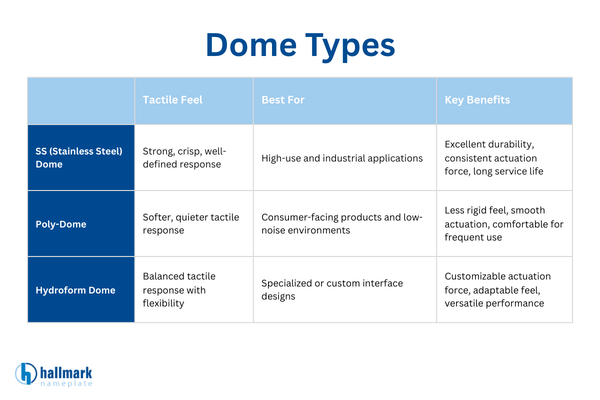
We offer several tactile switch constructions, each suited for different use cases:
SS (Stainless Steel) Dome
- Provides strong, crisp tactile feedback
- Ideal for high-use or industrial applications
- Excellent durability and consistent actuation force
Poly-Dome
- Softer tactile response compared to metal domes
- Often used when a quieter or less rigid feel is desired
- Suitable for consumer-facing products
Hydroform Dome
- Offers a balance between tactile response and flexibility
- Customizable feel and actuation force
- Works well for specialized or unique interface designs
Because these constructions vary significantly in tactile feel and performance, many customers work directly with engineers to determine the best option. Whether tactile feedback is required or should be avoided plays a major role in selecting the right dome structure.
Additional Membrane Switch Features to Consider
Tactile feedback is often combined with other functional enhancements to improve usability and durability, including:
- LED indicator lights
- Backlighting (LED, fiber optic, or electroluminescent)
- Chemical and weather resistance
- ESD, EMI, and RFI shielding
- Various connector configurations
These features can be integrated into tactile membrane switches to meet demanding environmental or operational requirements.
Tactile Switch Element Options
Beyond dome construction, the internal switch elements also influence performance, flexibility, and cost. Below are the primary element options available.
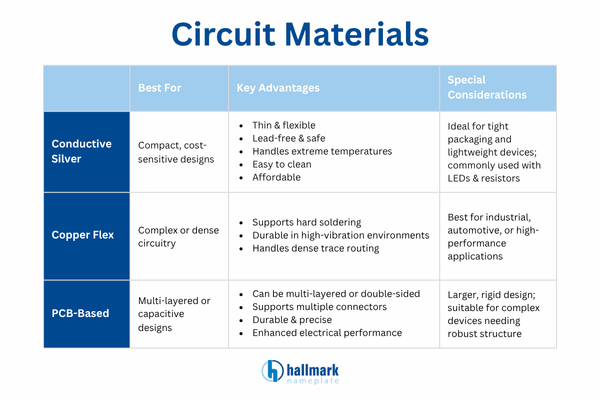
Conductive Silver
Conductive silver elements support both tactile and non-tactile constructions and offer excellent electrical performance.
Key advantages include:
High conductivity for faster signal transmission
- Compatibility with resistors and LED integration
- Ideal for devices with frequent or continuous input
- Strong performance in low-light environments
While slightly more expensive, conductive silver is well-suited for demanding applications where reliability and responsiveness are critical.
Copper Flex
Copper flex elements provide the highest density traces and are ideal for compact designs.
Benefits include:
- Low-profile components
- Excellent for tight packaging constraints
- Suitable for both tactile and non-tactile designs
- Scales well for small or complex devices
Copper flex is a popular choice when space is limited, but performance cannot be compromised.
PCB-Based Elements
PCB-based elements are the most versatile option available.
Key features include:
- Support for tactile, non-tactile, and capacitive switches
- Single-sided, double-sided, or multilayer construction
- Multiple connector configurations
- Exceptional design flexibility
For complex applications requiring advanced functionality or customization, PCB-based elements offer nearly limitless construction possibilities.
Benefits of Tactile Feedback
The primary benefit of tactile feedback is confidence. Users know immediately when an input has been registered.
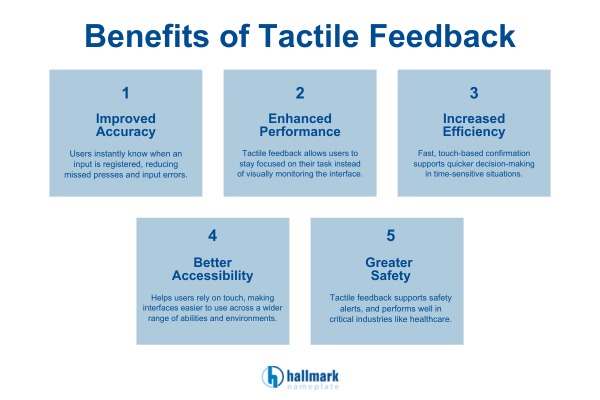
Key Advantages of Tactile Switches
- Improved accuracy and reduced missed inputs
- Enhanced user confidence and peace of mind
- Increased efficiency in high-pressure environments
- Better accessibility for users who rely on touch
In industries such as healthcare, tactile feedback is especially valuable. Medical professionals must be certain that data entries or commands have been accepted.
Tactile confirmation has even been shown to reduce patient misdosing by minimizing data entry errors.
How Tactile Feedback Improves Operator Performance
Tactile feedback allows users to focus on the task at hand rather than the interface itself. Vibrations can signal:
- Input confirmations
- Safety warnings
- Positioning or status alerts
By reducing cognitive load, tactile systems improve operator performance across a wide range of industries, from industrial equipment to medical devices and consumer electronics.
How Tactile Feedback Improves Typing and Data Entry
In applications involving typing or repeated data entry, such as virtual keyboards or control panels, tactile feedback plays a critical role. A distinct tactile response helps users differentiate between:
- Short presses
- Long presses
- Successful vs. incomplete inputs
This feedback allows users to type faster, make fewer mistakes, and experience less frustration. The result is an interface that feels more intuitive and closer to a physical keyboard, even when operating on a flat surface.
Potential Drawbacks of Tactile Feedback
While tactile feedback offers many advantages, it is not ideal for every application.
Common concerns include:
- Strong tactile response may disrupt precision tasks
- Repetitive use may cause fatigue in high-accuracy environments
- Users unfamiliar with tactile systems may require adjustment time
For applications that demand extreme accuracy or very high actuation rates, tactile feedback should be carefully evaluated. Consulting with experienced engineers can help determine whether tactile or non-tactile switches are more appropriate.
Get High-Quality Tactile Membrane Switches
Tactile feedback is a valuable option for many membrane switch applications, but selecting the right combination of construction, elements, and features is essential. With capabilities exceeding 1 million actuations, internal venting for complete sealing, and extensive customization options, tactile membrane switches can be tailored to nearly any use case.
At Hallmark Nameplate, our team of experienced designers and engineers will work with you to create a membrane switch that meets your exact performance, durability, and usability requirements.
You don’t need in-depth technical knowledge of tactile feedback; that’s our job. If you have questions about suitability, design, construction, or pricing, we invite you to contact us today and learn how tactile membrane switches can enhance your product.
Want to learn more? Read our complete guide, Everything You Need to Know About Membrane Switches.