


When designing custom electronics, the right membrane switch can make all the difference in performance and durability. They help countless industries, from medical devices to aerospace, and when done right, can protect your sensitive equipment while providing reliable user interfaces.
In this guide, we’ll break down the three main membrane switch elements, conductive silver, copper flex, and PCB-based, highlighting their pros, cons, and how to choose the best one for your application. Whether you’re working with tight spaces, complex circuits, or high-vibration environments, this overview will help you make an informed decision.
What Are Membrane Switches?
Membrane switches feature a robust construction that is completely sealed from the outside environment.
Membrane switches have both tactile and non-tactile variations, which support a wide variety of designs and applications. Non-tactile switches are more robust, completely sealed from the external environment, and are capable of more than five million actuations. Tactile switch types, on the other hand, are internally vented for a complete seal, available in SS dome, polydome, and hydro form dome constructions. They are also capable of more than one million actuations.
Membrane switches are non-standard, which means that each one is specially designed for your product specifications. This is ideal for medical equipment, computer peripherals, and even the military and aerospace industries. This allows a user interface with equipment while protecting the machinery from contaminants, environmental hazards, and debris.
Membrane Switch Elements
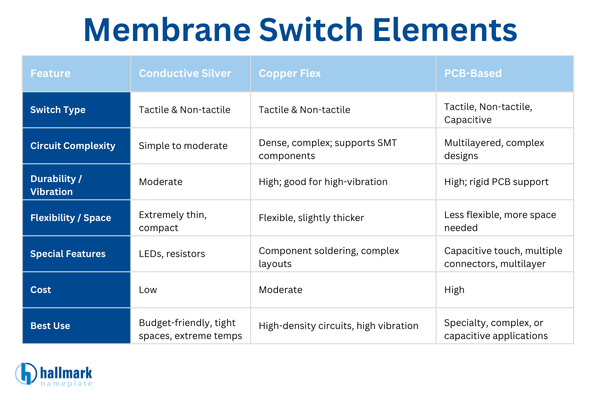
Ultimately, there are three types of membrane switch construction elements: conductive silver, copper flex, and PCB-based.
Conductive Silver
Silver flex membrane switches are the most common construction for flexible, custom membrane switches. It’s also the most popular switch construction due to its affordability, especially when compared to bulky, costly electromechanical switch assemblies.
Silver flex membrane switches feature very thin, flexible layers of material, of which some layers use screen-printed silver and carbon conductive links, and are separated by an adhesive layer. Conductive silver can be used for tactile and non-tactile construction.
It’s also great for LEDs and resistors. A great advantage of using conductive silver is that they’re lead-free. Cure temperatures are much lower than those of some other elements. Conductive silver also works very well for steady-state temperature environments, particularly at extreme temperatures.
Extremely thin construction makes conductive silver great for saving precious design space on your membrane switch. It can also be easily cleaned.
Copper Flex
Membrane switch panels made of copper flex are made by laminating a very thin sheet of copper to a flexible film substrate, and then chemically etching it away. Copper traces are left as a result.
Copper flex has the ability to provide higher-density traces. It also has SMT low-profile components and is available for tactile and non-tactile construction. Copper flex membrane switches are ideal for smaller complex designs, where dense circuit patterns or trace routing limitations exist.
The design also allows the ability to accommodate more complex circuit patterns while still maintaining the flexibility of a membrane switch. The copper flex keypads also have the advantage of being able to hard solder active and passive components into the assembly, making it a great choice in high-vibration, high-reliability environments.
PCB Based
A PCB (aka print circuit board) is typically made of copper-clad fiber infused into a resin material. The PCB membrane switch construction uses a PCB as the main structure or support substrate, with the membrane switch on the front of the PCB assembly, and the display, along with any other discrete components, on the back side of the PCB.
PCB-based membrane switches are available in tactile, non-tactile, and capacitive switches. They are also versatile in that they can be single-sided, double-sided, or multilayered in construction. PCB-based membrane switches also allow for multiple connector options.
How to Determine the Right Membrane Switch Element
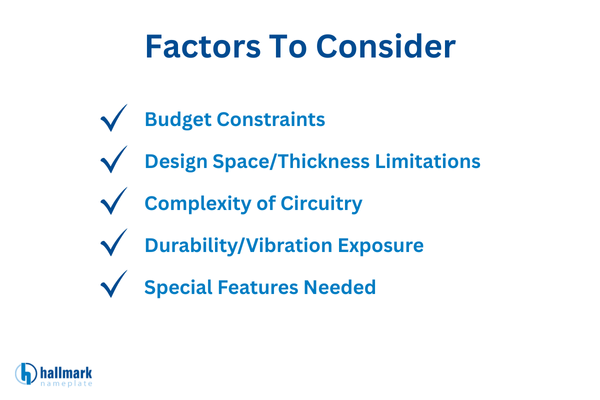
So how do you decide which is right for you? Here are a few things to consider.
Budget Constraints
If cost is a major consideration, conductive silver switches are the most economical option. They provide reliable functionality at a lower price point than copper flex or PCB-based switches, making them ideal for projects with tight budgets or high-volume production runs.
Design Space/Thickness Limitations
When your project requires a compact, thin design, conductive silver or copper flex switches are the best choices. Conductive silver offers extremely thin layers, perfect for tight packaging. Copper flex is slightly thicker but still maintains flexibility while supporting more complex circuitry.
Complexity of Circuitry
For projects with dense circuit patterns or intricate layouts, copper flex switches excel because they allow higher-density trace routing and can handle low-profile surface-mount components.
If your design requires multilayered, double-sided, or specialty connections, a PCB-based switch may be necessary for added versatility and complexity.
Durability/Vibration Exposure
In environments where the switch will be subject to mechanical stress or vibration, durability is key. Copper flex switches allow hard soldering of components and maintain reliability in high-vibration settings. PCB-based switches also offer strong structural support, making them suitable for demanding applications where long-term reliability is critical.
Special Features Needed
Certain applications require unique functionality, such as capacitive touch, multiple connector options, or multilayered construction. Only PCB-based switches can accommodate these requirements, making them the go-to choice for specialized or highly integrated electronic designs.
Get High Quality Membrane Switches
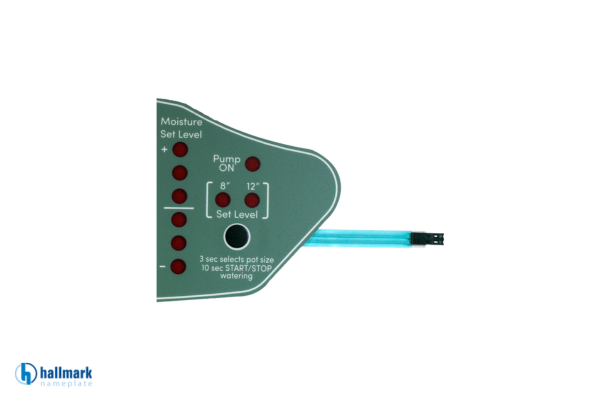
Membrane switches from Hallmark Nameplate can be specifically designed to meet your environmental considerations. Our switches are internally vented and sealed to protect your equipment from contaminants.
Hallmark Nameplate’s membrane switches can also be provided with or without terminating connectors, as well as:
- LED Indicator Lights
- Backlight (LED, fiber optic, EL)
- Chemical and weather-resistant
- ESD/EMI/RFI Shielding
- Various connector configurations
We at Hallmark Nameplate are notorious for producing the highest quality products and using our experience and knowledge in the technology field to the utmost. We keep not just our products, but also our customers, at the top of our priority list when it comes to the task at hand, and membrane switch production is no exception. We’re fully equipped to assist with every step along the way, allowing you to rest easy knowing that your upcoming product is in great hands.
Contact us at Hallmark Nameplate today to learn more about the various constructions and product features we can offer, and learn how we can customize your membrane switch to meet and exceed your unique application requirements. With our experience and our long history of producing high-quality products for various needs, you can rely on Hallmark Nameplate to deliver what you need and beyond, and complete the job efficiently.