



There is nothing worse than spending money on manufacturing an electronic device only to learn that one of the parts is damaged.
The production of printed control boards (PCB) requires that the surrounding environment is safe from electrostatic discharges (ESD) as much as possible.
When you begin working with a new manufacturing company, you need to ensure that they are creating your PCBs in an ESD-safe production environment. In order to do that, you first need to know what ESD is.
Let’s start with the basics.
What is ESD?
An electric current is discharged between objects with varying charges, creating an electromagnetic buildup. Static electricity and electrostatic induction are the main causes of ESD.
When one material rubs against another and then separates, it releases an electrical discharge, such as a spark. You have probably experienced this when you slide your feet on carpet or when you rub a balloon on your hair.

This electrical spark can cause damage to sensitive electrical components like a PCB.
It is true that electrostatic discharge has existed since the beginning of time. However, this natural phenomenon has grown into more and more of an issue with the widespread use of solid-state electronics.
Where does Electrostatic Discharge Come From?
All materials, insulators and conductors alike, are sources of electrostatic discharge. They are lumped together in what is known as the “triboelectric series,” which defines the materials associated with positive or negative charges. Positive charges accumulate predominantly on human skin and animal fur, while negative charges are more common to synthetic materials, such as Styrofoam or plastic. The amount of electrostatic charge that can accumulate on any item is dependent on its capacity to store a charge.
How does Electrostatic Discharge Damage Electronic Circuitry?
ESD is like a tiny version of lightning. As the current dissipates through an object, it’s seeking a low impedance path to the ground to equalize potentials. In most cases, ESD currents will travel to the ground via the metal chassis of a device. However, it’s well known that current will travel on every available path within reach. In some cases, one path may be between the PN junctions on integrated circuits to reach the ground. This current flow will burn holes visible to the naked eye in an integrated circuit, with evidence of heat damage to the surrounding area. One ESD event will not disrupt equipment operation; however, repeated events will degrade the equipment’s internal components over time.
How Does Electrostatic Discharge Occur?
ESD can occur in a variety of forms. One of the most common is through human contact with sensitive devices. Human touch is only sensitive to ESD levels that exceed 4,000V.
A recent investigation found that the human body and its clothing are capable of storing between 500V and 2500V electrostatic charge during the normal workday. This is far above the level that damages circuits yet below the human perception threshold. Other sources of ESD damage to equipment include:
- Troubleshooting electronic equipment or handling of printed circuit boards without using electrostatic wrist straps;
- Placement of synthetic materials (plastic, Styrofoam, etc.) on or near electronic equipment; and
- Rapid movement of air near electronic equipment (including using compressed air to blow dirt off printed circuit boards, circulating fans blowing on electronic equipment, or using an electronic device close to an air handling system).
In all of these scenarios, the accumulation of static charges may occur, but you may never know. Furthermore, a charged object does not necessarily have to contact the item for an ESD event to occur.
How is Electrostatic Voltage Measured?
One of the most effective ways to identify potential ESD problem areas is to make measurements using an electrostatic voltmeter. This meter will effectively measure electrostatic voltage up to 30,000V on all conductors and insulators. It will also display whether the charge is negative or positive. This may help you determine the source of the electrostatic accumulation.
How is Electrostatic Discharge Prevented?
Experience has shown that the following guidelines are helpful:
- Keep all synthetic materials at least four inches away from electronic equipment.
- When cleaning printed circuit boards, use a spray labeled as non-static forming.
- When troubleshooting electronic equipment, always wear a static wrist wrap that is grounded to the frame of the device. Also, wear the wrist electrostatic discharge straps when handling printed circuit boards.
- Treat carpets and floors with compounds that reduce the buildup of static charges.
- Use static floor mats where necessary.
- Make sure the grounding system for equipment has a low impedance for ESD currents to dissipate to an earthing reference.
4 Steps to Accomplish an ESD-Safe Production Environment
An ESD of as little as 30 volts can cause damage to electronic components in a PCB during its production, storage, and/or shipping stages. When you consider that the average ESD you feel when walking across a carpet contains about 3000 volts, it doesn’t take much to hurt a circuit board.
This is why it’s imperative to take the following steps to ensure that the cleanroom where the PCBs are made is an ESD-safe working environment.
1. Put Down ESD-Resistant Flooring
The working space needs to be free of things that can cause ESD releases to occur. This means the flooring has to be ESD-safe. Remove carpeting and replace it with anti-static materials like static dissipative tiles (SDT) for the floor.
The tiles typically have a 4-layered structure:
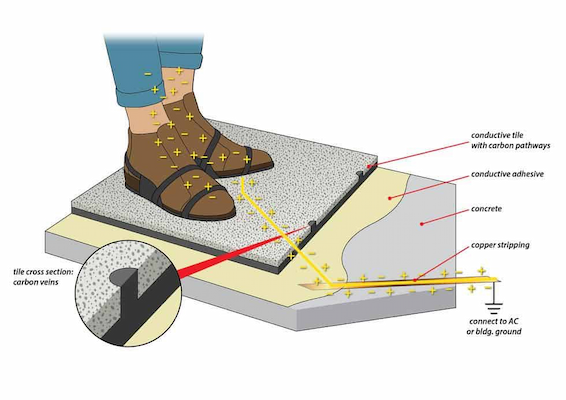
The base layer is made with a static dissipative adhesive to affix the tile to the sub-flooring.
On top of the base layer is another one made of conductive metals like copper strips.
The third layer of the SDT is typically made out of plastic because of its conductive ability. Some tiles have added bits of carbon graphite, aluminum flakes, carbon fiber, and other conductive materials to increase the conductivity of the tiles.
The fourth layer is often an anti-static acrylic floor polish to cover the tiles. This flooring system takes an electrical charge that gets created by something or someone moving over the floor. Since an electrical charge will follow the path of least resistance, it will flow from the top of the floor down through the adhesive. There it gets grounded and dissipates.
When using flooring mats at workstations, ensure the matting has a material like conductive carbon fibers. This will disperse the electrical charge from the mat to the SDT tiles under it.
2. Provide Protective Clothing
To keep the room ESD safe when making printed circuit boards, regulate the clothing people wear in the clean room. Workers should be wearing shoes with static-dissipating soles that meet the ESD-compliance guidelines. On the side of the shoes, the letters “SD” identify compliance.
Regular clothing often builds up electricity that can lead to an ESD. When entering a cleanroom, dress in clothing made with electrically conductive textiles. The clothing incorporates metal strands mixed with other materials like cotton to make cloth for the clothing. Protecting hands with ESD-safe gloves is also important to minimize the risk of discharge.
A worker should also be “grounded” when working in a cleanroom. This is achieved by having the workers wear grounding wristbands. The wristband moves an electrical charge from the person to the ground, where it dissipates.
3. Use ESD-Safe Tools
Tools used in the cleanroom should have a double-layered grip made out of a material like polyethylene. This minimizes the movement of an electrical charge from a worker to the electronic device she is working on. Plug your electronics tools into a properly grounded outlet before using them.
4. Control the Atmosphere
Controlling the atmospheric conditions in the cleanroom is also important to reduce the chances of an ESD event. You can use Ionization machines to control the electrical charges in the atmosphere. The machine uses a fan to pull the air in the cleanroom into it.
As the air passes through the ionizer, it electrically charges the positive and negative ions connected to the air molecules. The ions spread out into the room and bond to their positive and negative ion counterparts on workbenches, clothing, and other things. This provides an electronically-charged balanced workspace that minimizes the probability of an ESD event occurring.
Work With Hallmark Nameplate, An ESD-Safe Manufacturer
The electrostatic discharge safe environment at Hallmark Nameplate is designed to prevent electrical discharges from the body or from devices, both of which could impact the delicate electronic components we value so highly. Our ESD-Safe production environment ensures that components of your product remain safe through the assembly process and through packing for shipment to you.
Hallmark Nameplate does what it must do to maintain a safe environment for not just our employees, but also for the products we create and send to our clients. When you choose a company for your electronic assemblies, your first concerns should be quality, safety, and reliability. Hallmark Nameplate is passionate about all of these things and designs products with longevity and safety in mind.
If you have any questions about ESD and how Hallmark maintains an ESD-Safe environment to protect the printed circuit boards we make, just give us a call. We have seasoned personnel who can answer any questions you may have about printed circuit boards and our ESD-Safe environment.
If you’re ready to start your next product with a leading industry group of experts, contact us at Hallmark Nameplate today.